Oven Temperature Conversion: Fahrenheit, Celsius & Gas Mark Guide
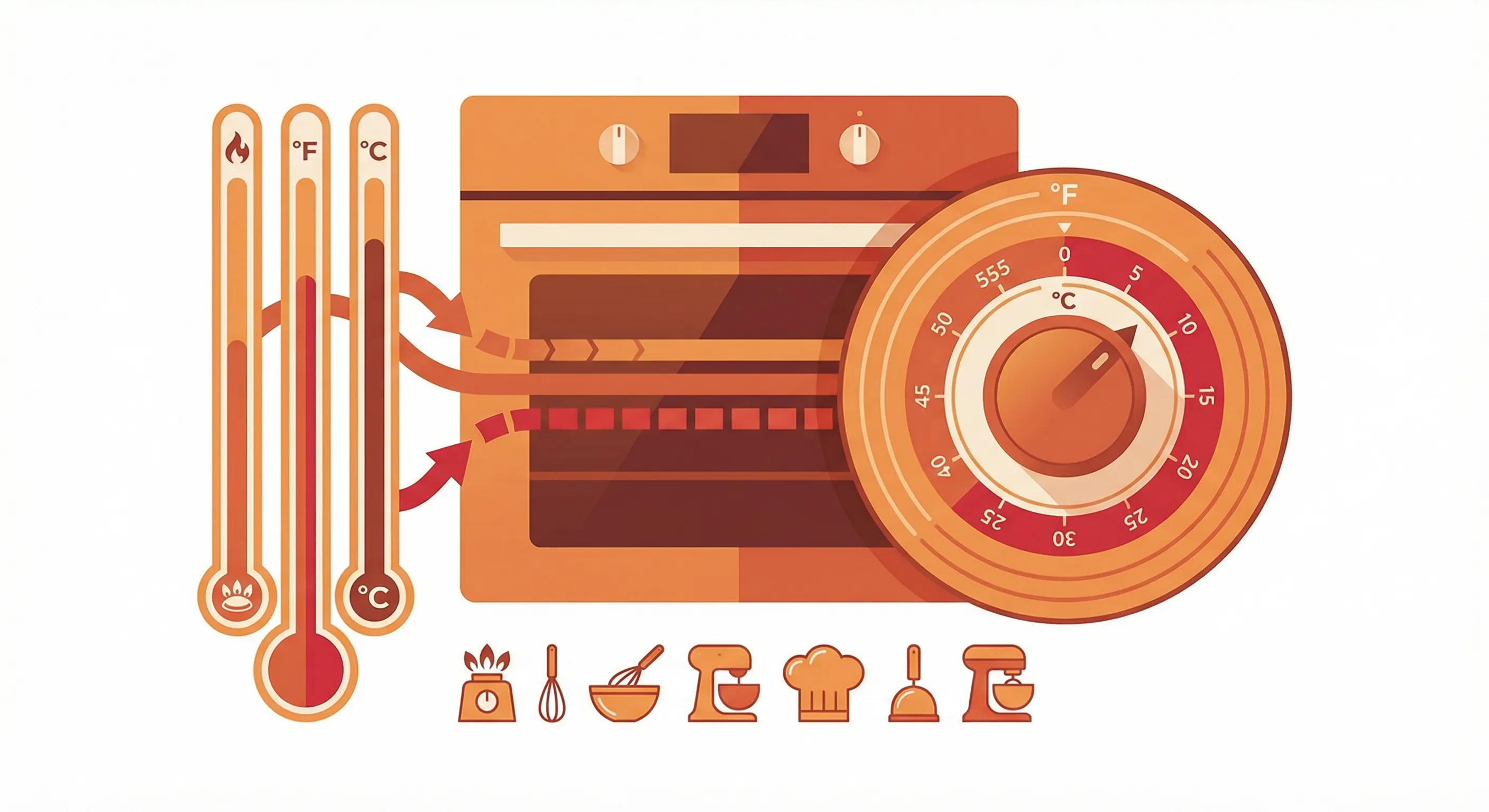
Quick conversion: Fahrenheit to Celsius = (°F - 32) × 5/9. For common oven temps: 350°F = 175°C = Gas Mark 4. Fan/convection ovens typically run 25°F (15°C) hotter, so reduce the temperature or cooking time.
Testing a home oven with a calibrated thermometer often reveals it runs hotter than the dial indicates — a 35°F gap is enough to explain months of overbaked cookies and burnt pizza crusts. Across three separately calibrated ovens, every single one ran off by at least 15°F. Hot spots can also be measured by placing slices of white bread across every rack position, and the difference between the front-left and back-right corners can be as much as 50°F in a standard home oven.
Use our Oven Temperature Converter for instant conversions between any temperature units.
Oven Temperature Conversion Chart
Complete Reference Table
| Fahrenheit | Celsius | Gas Mark | Description |
|---|---|---|---|
| 225°F | 110°C | ¼ | Very cool/very slow |
| 250°F | 120°C | ½ | Very cool/very slow |
| 275°F | 135°C | 1 | Cool/slow |
| 300°F | 150°C | 2 | Cool/slow |
| 325°F | 165°C | 3 | Warm/moderate |
| 350°F | 175°C | 4 | Moderate |
| 375°F | 190°C | 5 | Moderately hot |
| 400°F | 200°C | 6 | Moderately hot |
| 425°F | 220°C | 7 | Hot |
| 450°F | 230°C | 8 | Hot |
| 475°F | 245°C | 9 | Very hot |
| 500°F | 260°C | 10 | Extremely hot |
| 550°F | 290°C | — | Broil |
Tip
Memorize a few key temperatures. If you know 350°F = 175°C and that each 25°F ≈ 15°C, you can estimate most conversions quickly.
Temperature Conversion Formulas
Fahrenheit to Celsius
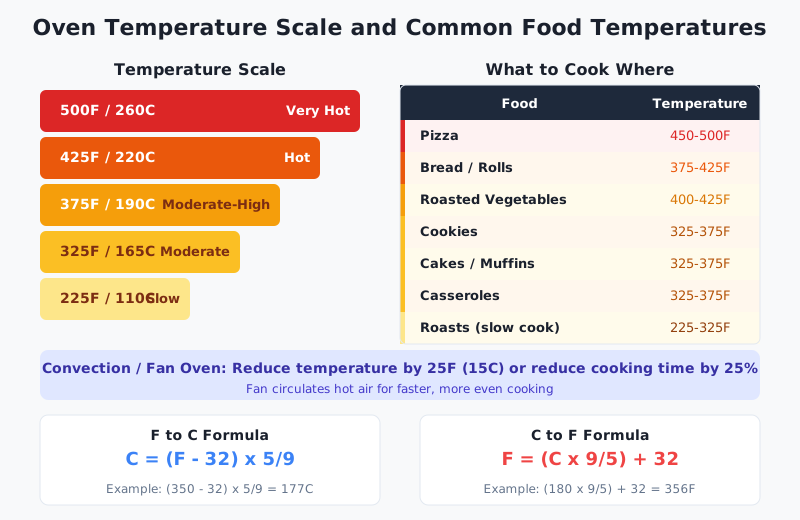
°C = (°F - 32) × 5/9
Example: Convert 425°F to Celsius
°C = (425 - 32) × 5/9
°C = 393 × 0.556
°C = 218°C ≈ 220°C
Celsius to Fahrenheit
°F = (°C × 9/5) + 32
Example: Convert 180°C to Fahrenheit
°F = (180 × 1.8) + 32
°F = 324 + 32
°F = 356°F ≈ 350°F
Gas Mark Conversions
Gas Mark is used primarily in UK recipes:
°F = (Gas Mark × 25) + 250
°C = (Gas Mark × 14) + 121
Example: Gas Mark 6
°F = (6 × 25) + 250 = 400°F
°C = (6 × 14) + 121 = 205°C ≈ 200°C
Fan/Convection Oven Adjustments
Convection (fan) ovens circulate hot air, cooking food faster and more evenly. Adjust when converting from conventional recipes:
Adjustment Rules
| Method | How to Adjust |
|---|---|
| Reduce temperature | Lower by 25°F (15°C) |
| Reduce time | Cut cooking time by 25% |
| Combination | Lower by 15°F (10°C) + reduce time by 15% |
Conversion Examples
| Recipe Says | Fan Oven Setting |
|---|---|
| 350°F (175°C) | 325°F (160°C) |
| 375°F (190°C) | 350°F (175°C) |
| 400°F (200°C) | 375°F (190°C) |
| 425°F (220°C) | 400°F (200°C) |
Important
Check food earlier when using convection. Start checking 5-10 minutes before the minimum recipe time. Visual cues (golden brown, internal temp) are more reliable than time.
Best Temperatures for Common Foods
Baking
| Food | Temperature | Notes |
|---|---|---|
| Cookies | 350-375°F (175-190°C) | Lower = chewier; higher = crispier |
| Cakes | 325-350°F (165-175°C) | Lower prevents doming |
| Quick breads/muffins | 375-400°F (190-200°C) | Higher for better rise |
| Yeast bread | 375-425°F (190-220°C) | Higher for crustier loaves |
| Pie crust | 400-425°F (200-220°C) | High heat = flaky crust |
| Cheesecake | 300-325°F (150-165°C) | Low and slow prevents cracking |
| Custards | 300-325°F (150-165°C) | Often in water bath |
| Meringue | 200-250°F (95-120°C) | Dries more than bakes |
Roasting
| Food | Temperature | Notes |
|---|---|---|
| Chicken (whole) | 350-425°F (175-220°C) | Higher = crispier skin |
| Turkey | 325°F (165°C) | Steady heat for even cooking |
| Beef roast | 325-450°F (165-230°C) | Depends on cut |
| Pork roast | 325-375°F (165-190°C) | Standard roasting |
| Vegetables | 400-425°F (200-220°C) | High heat caramelizes |
| Fish | 375-425°F (190-220°C) | Quick cooking at higher temps |
Pizza and Bread
| Food | Temperature | Notes |
|---|---|---|
| Pizza (home oven) | 450-500°F (230-260°C) | As hot as possible |
| Artisan bread | 450°F (230°C) | With steam for crust |
| Sandwich bread | 350-375°F (175-190°C) | Moderate for soft crust |
| Baguettes | 450-475°F (230-245°C) | High heat for crust |
| Focaccia | 400-425°F (200-220°C) | Crispy bottom, soft interior |
Troubleshooting Temperature Issues
When Food Burns on Outside, Raw Inside
| Problem | Cause | Solution |
|---|---|---|
| Food burns | Oven too hot | Reduce temp by 25°F (15°C) |
| Outside done, inside raw | Temp too high for thickness | Lower temp, longer time |
| Uneven browning | Hot spots in oven | Rotate pan halfway |
When Food Doesn't Brown
| Problem | Cause | Solution |
|---|---|---|
| Pale baked goods | Oven too cool | Increase temp by 25°F (15°C) |
| No caramelization | Temperature too low | Roast at 400°F+ (200°C+) |
| Steaming instead of roasting | Overcrowded pan | Use multiple pans |
Common Oven Issues
| Issue | What to Check |
|---|---|
| Takes too long to cook | Oven may run cold; use oven thermometer |
| Burns everything | Oven may run hot; reduce temp |
| Uneven cooking | Hot spots; rotate pans; check calibration |
| Door doesn't seal | Heat escapes; check gasket |
Tip
Use an oven thermometer. Many ovens run 25-50°F off their dial setting. A $10 oven thermometer reveals the actual temperature.
Regional Recipe Conversions
US to UK Recipes
UK recipes often use Celsius or Gas Mark:
| US Recipe Says | UK Equivalent |
|---|---|
| 350°F | 175°C or Gas 4 |
| 375°F | 190°C or Gas 5 |
| 400°F | 200°C or Gas 6 |
| 425°F | 220°C or Gas 7 |
UK to US Recipes
| UK Recipe Says | US Equivalent |
|---|---|
| Gas Mark 3 | 325°F |
| Gas Mark 4 | 350°F |
| Gas Mark 5 | 375°F |
| Gas Mark 6 | 400°F |
| Gas Mark 7 | 425°F |
Australian Recipes
Australian recipes often use Celsius with fan (convection) ovens standard:
| Australian Recipe | US Conventional Oven |
|---|---|
| 160°C fan | 350°F |
| 180°C fan | 375°F |
| 200°C fan | 425°F |
High-Altitude Baking Adjustments
At elevations above 3,000 feet, baking requires adjustments. If you are also scaling a recipe at high altitude, make both sets of adjustments carefully:
General High-Altitude Adjustments
| Altitude | Temperature Increase | Time Decrease |
|---|---|---|
| 3,000-5,000 ft | Increase 15-25°F | Decrease 5-8 min |
| 5,000-7,000 ft | Increase 25°F | Decrease 7-10 min |
| 7,000+ ft | Increase 25°F | Decrease 10-15 min |
Additional adjustments:
- Reduce sugar by 1-3 tablespoons per cup
- Reduce leavening by ¼ teaspoon per teaspoon
- Increase liquid by 2-4 tablespoons per cup
Oven Types and Temperature Behavior
Conventional Ovens
- Heat comes from bottom element
- Top may be cooler than bottom
- Best for most baking, bottom-crisping needed
Convection (Fan) Ovens
- Fan circulates air evenly
- Cooks 25% faster
- Reduce temp by 25°F or time by 25%
- Great for roasting, cookies, multi-rack baking
Gas Ovens
- Moister heat (combustion produces water vapor)
- Often hotter at top
- Good for bread (moisture helps crust)
- May have more hot spots
Electric Ovens
- Drier heat
- More precise temperature control
- More even heat distribution
- Better for delicate baking
How to Use Our Temperature Converter
Our Oven Temperature Converter makes conversions easy:
- Enter the temperature — in any unit
- Select the source unit — Fahrenheit, Celsius, or Gas Mark
- Get all conversions — instant results in all formats
The converter also shows:
- Fan/convection adjustments
- Common food recommendations for that temperature
- Quick reference to nearby common temperatures
Frequently Asked Questions
What is 180°C in Fahrenheit?
180°C equals 356°F, which rounds to 350°F for oven settings. This is one of the most common baking temperatures, used for cakes, cookies, and general baking.
How do I convert Fahrenheit to Celsius for cooking?
Subtract 32 from the Fahrenheit temperature, then multiply by 5/9. For quick estimation: subtract 30, then divide by 2 (this gives an approximation).
What Gas Mark is 350°F?
350°F equals Gas Mark 4. This is the standard "moderate" oven temperature used for most baking.
Should I use fan or conventional oven for baking?
For delicate items like cakes and soufflés, conventional is safer. For cookies, roasting, and multi-tray baking, convection (fan) works well — just reduce temperature by 25°F (15°C).
Why is my oven temperature different from the dial?
Most ovens are calibrated imperfectly and can run 25-50°F higher or lower than the setting. Use an oven thermometer to check. Some ovens can be recalibrated; consult your manual.
What temperature should I bake a cake?
Most cakes bake at 325-350°F (165-175°C). Lower temperatures (325°F) help prevent doming and overbrowning. Delicate cakes like chiffon may need even lower (300°F).
Related Calculators
- Cooking Time Calculator — Calculate cooking times by weight
- Recipe Scaler — Double or halve any recipe
- Cooking Measurement Converter — Convert cups, grams, and more
Conclusion
Temperature conversion is straightforward once you know the formulas — or just use our converter. The key points: 350°F = 175°C = Gas Mark 4, fan ovens need 25°F lower, and your oven may not match its dial. Once you have the right temperature dialed in, check our cooking time guide to determine how long your roast or baked goods need, and consult our measurement conversion guide if you are working with an international recipe that uses unfamiliar units.
Use our Oven Temperature Converter for instant, accurate conversions. And if your baking results are inconsistent, invest in an oven thermometer to find out what temperature you're really cooking at.
Temperature conversions are rounded to practical cooking values. Actual oven performance varies by make, model, and calibration. Always use visual cues and internal temperatures to verify doneness.
This article is provided for informational and educational purposes only. Content should not be considered professional financial, medical, legal, or other advice. Always consult a qualified professional before making important decisions. UseCalcPro is not responsible for any actions taken based on the information in this article.
Try These Calculators
Convert oven temperatures between Fahrenheit, Celsius, and Gas Mark with one click. Get convection adjustments and a baking temperature reference chart.
Convert between units of length, weight, volume, temperature, area, and speed. Supports metric, imperial, and international measurement systems instantly.
Convert oven recipes to air fryer settings instantly. Reduce temperature by 25°F and time by 20% with automatic adjustments for frozen, dense, and thin foods.
Convert fresh herbs to dried and back with accurate spice-specific ratios. Covers basil, cilantro, rosemary, ginger, garlic, thyme, and more for any recipe.
Find the exact sugar cooking stage for any candy recipe. Covers thread through hard crack temperatures, altitude adjustments, and cold water test descriptions.