Electrical Panel Upgrade Cost 2026: $1,300-$4,000 (100A to 200A)
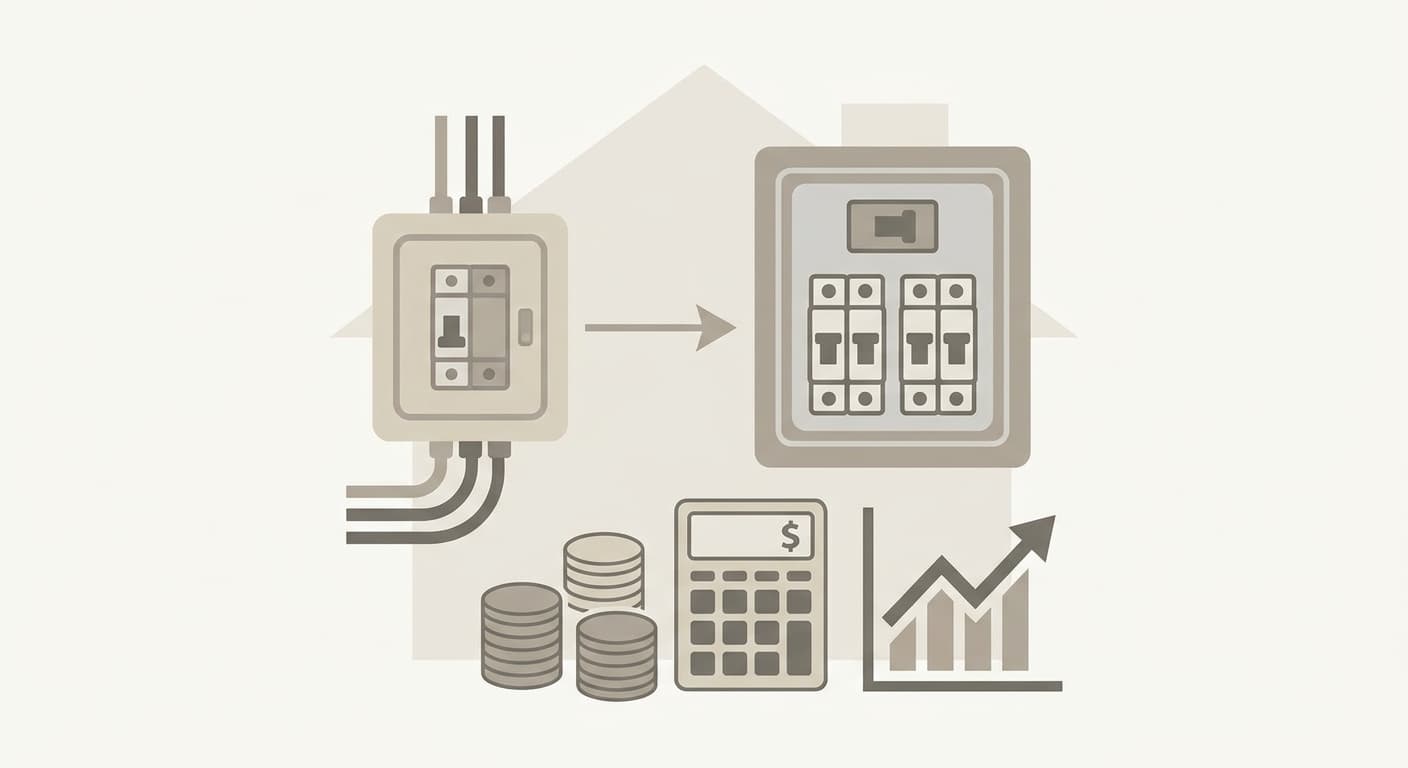
A residential electrical panel upgrade costs $1,300 to $4,000 in 2026 for the most common job — swapping a 100-amp service for a 200-amp panel — with most homeowners landing between $2,000 and $3,000 installed. Bigger jobs cost more: replacing a 60-amp fuse box runs $1,100 to $4,000, and a 400-amp upgrade for EV-plus-heat-pump homes runs $4,000 to $7,500. Get a ZIP-specific number with our electrical panel upgrade cost calculator before you call an electrician.
The number that surprises homeowners in 2026 is rarely the panel itself — it is the timing. The 25C federal tax credit that refunded up to $600 of a panel upgrade expired on December 31, 2025, so a $2,400 swap that would have netted out to $1,800 in 2025 now costs the full $2,400 if you have no EV charger to bundle with it. This page is the 2026 data sheet: what the upgrade actually costs by amperage, region, and panel condition, and which incentives are still alive.
This is the averages-and-data companion to the calculator. The tool prices your specific job; this article shows you the national benchmarks every quote should fall inside so you can spot an overcharge. If you only need to swap an obsolete interior on the same amperage (a Federal Pacific or Zinsco box), that is a cheaper job — use the electrical panel box upgrade cost calculator instead, because you keep your meter and service drop.
Residential Panel Upgrade Cost at a Glance (2026)
The single biggest cost driver is scope: are you keeping your amperage, raising it, or rebuilding from a fuse box? Here is the 2026 national picture, with figures cross-checked against HomeGuide's electrical panel cost data.
| Upgrade Scope | Typical 2026 Cost | Average | What's Included |
|---|---|---|---|
| 100A → 200A swap | $1,300 - $4,000 | $2,500 | Panel, breakers, service cable, permit |
| 150A → 200A swap | $1,500 - $3,500 | $2,400 | Panel, breakers, minor cable work |
| 60A fuse box → 200A | $1,100 - $4,000 | $2,800 | Panel, full circuit rework, grounding |
| 200A → 400A upgrade | $4,000 - $7,500 | $5,500 | Dual 200A panels, new meter base |
| Meter mast replacement (add-on) | +$500 - $1,500 | +$1,000 | Weatherhead, conduit, meter socket |
| Service relocation (add-on) | +$1,500 - $4,000 | +$2,500 | New wall, re-routed service drop |
Tip
The 100A-to-200A swap is the workhorse of residential electrical upgrades in 2026. Most homes that were built before 2000 and have not added an EV charger or heat pump sit on this exact path. If a quote comes in above $4,000 for a clean swap with no meter work, ask the electrician to itemize — something is hidden in that number.
A clean swap means the existing meter base, service-entrance cable, and utility drop are all in good shape and stay in place. The moment any of those three needs replacing, you move from the $2,000-$3,000 band into the $3,500-$5,500 band. That is why two homes on the same street can get quotes $2,000 apart for "the same job."
What a 200-Amp Panel Upgrade Actually Costs by Region
Regional labor is the largest swing factor after scope. A licensed electrician charges $50 to $130 per hour plus a $100 to $200 call-out fee according to HomeGuide's 2026 labor data, and a panel swap is 6 to 10 labor hours. That 2.6x hourly spread, multiplied across a full day, is why the Northeast and California coast run 40-60% above Southern markets.
| Region | 100A → 200A Swap | Electrician Rate/Hr | Why |
|---|---|---|---|
| South | $1,300 - $2,800 | $50 - $90 | Lowest labor, mild permit fees |
| Midwest | $1,500 - $3,000 | $70 - $110 | Median labor, moderate codes |
| Northeast | $2,200 - $4,500 | $95 - $150 | High labor, strict inspection |
| West Coast | $2,500 - $5,000 | $100 - $175 | Highest labor, Title 24 permits |
| Mountain/Southwest | $1,800 - $3,800 | $80 - $130 | Variable by metro |
Important
A 200A swap quoted at $2,400 in Indianapolis can legitimately cost $3,800 in Boston for identical work. When you compare bids, compare them against electricians in your own metro, not a national average — a "high" bid in the South may be a "low" bid in the Northeast.
Permit and inspection fees ride on top of labor and vary even more by jurisdiction: $150 in a rural Texas county versus $400 in a California Title 24 city. The permit is never optional. Skipping it voids your homeowner's insurance and surfaces as a disclosure problem at resale, which can knock $5,000-$15,000 off your asking price when a buyer's inspector finds unpermitted service work.
The 60-Amp Fuse Box: Why It Costs More Than a Swap
A 60-amp fuse box replacement is not a simple swap — it is a rebuild, and that is why it runs $1,100 to $4,000 even though 60A is a smaller service than the 200A you end up with. The new panel and main breaker are cheap. The expensive part is that every branch circuit has to be re-terminated, re-labeled, and brought up to modern grounding code, and old cloth-insulated or undersized wiring often gets flagged for replacement during the work.
Here is how a typical 60A-to-200A rebuild decomposes on a real job:
| Line Item | Typical Cost | Notes |
|---|---|---|
| 200A panel + main breaker | $450 - $700 | Square D QO, Eaton CH, or Siemens |
| New branch breakers (12-20) | $300 - $600 | $15-$30 each, more for AFCI/GFCI |
| Service-entrance cable + grounding | $300 - $700 | Upgraded to modern code |
| Circuit rework labor | $1,000 - $2,500 | Re-terminate and relabel every circuit |
| Permit + inspection | $150 - $400 | Always required |
Add those five lines and a clean rebuild lands around $2,200-$4,900 before contingency, which is why the average sits near $2,800. The reason the calculator and this page both quote a wide $1,100-$4,000 range is that the circuit-rework labor depends entirely on how many circuits exist and how bad the old wiring is — and you cannot know that until the cover comes off.
Warning
If your home still runs on a 60-amp fuse box, you almost certainly cannot add a Level 2 EV charger, a heat pump, or an electric range without upgrading first. Many jurisdictions will not even issue an EV charger permit on a service that small. Budget the panel upgrade as the prerequisite, not an afterthought. Run the numbers in our electrical load calculator to confirm before you buy the appliance.
200A vs 400A: When You Actually Need the Bigger Service
200 amps is the modern residential baseline, and it is enough for the vast majority of 2026 homes. It comfortably handles one Level 2 EV charger drawing 40-48 amps, plus a central heat pump, plus standard household loads. Roughly 95% of residential EV charger permits go through on a 200A service without any trouble.
You only need 400 amps when you stack multiple high-draw loads at once. The classic 400A profile is two EV chargers, or one EV plus a whole-house cold-climate heat pump (whose resistive backup strip can pull 10-15 kW), plus solar interconnection, plus an electric range and dryer.
| Household Profile | Calculated Load | 100A | 200A | 400A |
|---|---|---|---|---|
| Standard pre-2000 home | 60 - 80A | yes | yes | overkill |
| Home + Level 2 EV charger | 100 - 120A | no | yes | overkill |
| Home + EV + electric range | 120 - 140A | no | yes | overkill |
| Home + EV + heat pump + solar | 160 - 200A | no | tight | safer |
| Full-electric home + 2 EVs | 220 - 280A | no | no | required |
Tip
Before paying for 400A, have the electrician run a National Electrical Code Article 220 load calculation from your actual appliance nameplates. Some contractors oversell 400A because the margin is better. If your real load lands under 160 amps, 200A is the right and far cheaper call. Planning solar? Check the solar panel install cost calculator — interconnection usually requires a 200A minimum.
A 400A service is typically delivered as two 200A panels in parallel rather than one oversized panel, so the material cost roughly doubles versus a single 200A upgrade. That, plus the larger service-entrance conductors and a 400A meter base, is what pushes the total to $4,000-$7,500.
Tax Credits and Incentives: What Changed for 2026
This is where 2026 differs sharply from 2024 and 2025, and it is the part most cost guides have not updated. The 25C Energy Efficient Home Improvement Credit — which refunded up to 30% of an electrical panel upgrade, capped at $600 — expired on December 31, 2025, per Rewiring America's 25C guidance. If you upgraded your panel in 2025, you can still claim it on IRS Form 5695 with your return. If you are upgrading in 2026, that federal credit is gone.
One federal door is still open, but it is narrow and closing. The 30C EV charger credit refunds 30% of the cost — up to $1,000 — of a home EV charging install, and that credit explicitly includes a new electric panel, conduit, and wiring needed to support the charger. Per Plug In America's 30C summary, it is limited to homes in eligible low-income or non-urban census tracts, and it expires June 30, 2026.
| Incentive | Covers | Cap | Status in 2026 |
|---|---|---|---|
| 25C panel credit | Panel upgrade | $600 | Expired Dec 31, 2025 |
| 30C EV charger credit | Panel + charger wiring | $1,000 | Expires June 30, 2026 (eligible areas) |
| State / utility rebates | Panel for electrification | Varies | Still active in many states |
Important
If you live in an eligible 30C census tract and are bundling a panel upgrade with an EV charger, finish the install before June 30, 2026 to capture up to $1,000. After that date, the federal EV charger credit is gone too. Check your address against the eligibility map before assuming you qualify — most urban tracts do not.
Beyond federal credits, many state and utility electrification rebates remain active in 2026, especially in California, the Pacific Northwest, and the Northeast. These are tied to adding heat pumps or going all-electric and often cover a slice of the panel work that makes the load possible. Always check your specific utility's program before booking.
How to Use the Panel Upgrade Calculator
The calculator turns these national averages into a number for your specific job. Here is the fastest way to use it:
- Pick your current service size. 60A fuse box, 100A, 150A, or 200A — this sets the baseline scope.
- Pick your target amperage. 200A for almost everyone; 400A only if you stack multiple high-draw loads.
- Set the meter work. Keep existing (cheapest), mast replacement (+$500-$1,500), or full relocation (+$1,500-$4,000).
- Enter your ZIP. This applies the regional labor multiplier so your estimate reflects local rates, not a national average.
- Compare the estimate to your bids. Any quote more than 20% above the estimate deserves a line-item breakdown.
Try the electrical panel upgrade cost calculator now, then pull three written quotes. If you are also wiring a car charger, the EV charger install cost calculator covers the companion job that most often triggers the upgrade in the first place.
How to Avoid Overpaying
Panel upgrade is one of the most standardized residential electrical jobs, which makes a lowball bid a strong red flag rather than a deal. A bid 20% or more below the pack on a clean 100A-to-200A swap almost always hides one of three things: a recalled-brand or unbranded panel, a skipped permit, or under-quoted meter work that returns as a mid-job change order.
- Get three written, itemized bids. Each should separate panel, breakers, service cable, meter work, labor hours, and permit.
- Reject single-line bundled quotes. A "$3,200 — done" bid with no breakdown is where surprise change orders live.
- Verify the license at the state board — not just a business license — plus general liability and workers' comp insurance.
- Confirm the contractor pulls the permit in their name. "You pull it to save $200" shifts liability to you and usually means they are working outside their jurisdiction.
- Insist on Square D, Eaton, or Siemens. Federal Pacific Stab-Lok and Zinsco panels are safety-recalled equivalents that should be reject-on-sight.
Warning
Deposit norms for panel upgrades are 20-30% on jobs under $5,000 and 10-20% on larger jobs. Any request for 50% or more upfront is the documented disappear-with-deposit pattern. Reputable electricians invoice in milestones: deposit at signing, materials draw on delivery, final payment on inspection sign-off.
For broader home-electrical budgeting, two companion jobs are worth pricing in the same planning session: see how much electrical outlet installation costs for the dedicated 120V and 240V circuits you will likely add after the panel is in, and how much AC installation costs since HVAC swaps frequently require panel capacity and a dedicated breaker.
Frequently Asked Questions
Residential electrical panel upgrade cost: what is the 2026 average?
A residential electrical panel upgrade costs $1,300 to $4,000 in 2026 for a 100A-to-200A swap, with most homeowners paying $2,000 to $3,000 installed. A 60-amp fuse box rebuild runs $1,100 to $4,000, and a 400-amp upgrade runs $4,000 to $7,500. Use the electrical panel upgrade cost calculator for a ZIP-specific number.
How do I get an accurate electrical panel upgrade cost estimate?
Enter your current service size, target amperage, meter-work scope, and ZIP code into the calculator, then collect three written itemized bids from licensed local electricians. Compare each bid against the estimate — anything more than 20% above warrants a line-item breakdown, because clean swaps rarely exceed $4,000 without hidden meter or cable work.
Why does a 60-amp fuse box cost more to replace than a simple swap?
A 60A fuse box replacement is a rebuild, not a swap, costing $1,100 to $4,000 because every branch circuit must be re-terminated, re-labeled, and brought up to modern grounding code. The circuit-rework labor alone adds $1,000 to $2,500 that a clean 100A-to-200A swap never incurs.
Do I need 200 or 400 amps for an EV charger?
200 amps is enough for one Level 2 EV charger plus a heat pump in about 95% of homes; 400 amps is only required when you stack two EV chargers or an EV plus a cold-climate heat pump, solar, and electric range. Run an NEC 220 load calculation before paying for 400A — run yours in the electrical load calculator.
Is there a tax credit for an electrical panel upgrade in 2026?
The 25C federal credit that refunded up to $600 on a panel upgrade expired December 31, 2025, so panel-only upgrades in 2026 do not qualify federally. The 30C EV charger credit still refunds up to $1,000 — including panel and wiring — for homes in eligible census tracts, but it expires June 30, 2026.
Can I keep my existing meter when upgrading the panel?
Yes, if your meter base, service-entrance cable, and utility drop are in good condition, keeping the existing meter is the cheapest scope. Replacing the meter mast adds $500 to $1,500, and relocating the meter to a different wall adds $1,500 to $4,000 — often the single largest line item on the project.
How long does a panel upgrade take and how long is the power off?
A standard 100A-to-200A swap takes one 6-to-10 hour day with power off for 4 to 8 hours during the cut-over. A 400A upgrade runs 1-2 days, and a 60A fuse-box rebuild runs 2-3 days. Add 2-6 weeks upfront for permit issuance and utility scheduling, and book the work in spring or fall to avoid losing HVAC in a heat wave or cold snap.
Related Articles
- How Much Does Electrical Outlet Installation Cost in 2026? — Pricing for the dedicated 120V and 240V circuits you add after a panel upgrade.
- How Much Does Central AC Installation Cost in 2026? — HVAC swaps that often require panel capacity and a dedicated breaker.
- Gas vs Electric Water Heater Cost in 2026 — Going electric is a major load that may push you toward a 200A upgrade.
Related Calculators
- Electrical Panel Upgrade Cost Calculator — Price a full amperage upgrade by current service, target amps, and meter work.
- Electrical Panel Box Upgrade Cost Calculator — For a same-amperage interior swap of an obsolete Federal Pacific or Zinsco box.
- EV Charger Install Cost Calculator — The companion job that most often triggers a panel upgrade.
- Electrical Load Calculator — Run an NEC load calc to confirm whether you need 200A or 400A.
- Solar Panel Install Cost Calculator — Interconnection usually requires a 200A minimum service.
This article provides general pricing information for educational purposes. Actual costs vary by location, contractor, and project specifics. Main service-panel work is not a DIY job — always hire a licensed electrician and get three written bids before committing.
Sources: HomeGuide, HomeGuide Electrician Labor, Rewiring America 25C, Plug In America 30C.
This article is provided for informational and educational purposes only. Content should not be considered professional financial, medical, legal, or other advice. Always consult a qualified professional before making important decisions. UseCalcPro is not responsible for any actions taken based on the information in this article.
Try These Calculators
Estimate 2026 electrical panel upgrade cost by current amperage, target service, and meter work. 100A to 200A $2,000-$3,500; 200A to 400A runs $4,000-$7,500.
Estimate 2026 electrical service upgrade cost: 100A to 200A overhead $1,500-$4,000; underground conversion $5,000-$15,000. Mast, meter base, SEU, permit.
Price a 2026 electrical panel BOX-only upgrade (same amperage). Federal Pacific, Zinsco, and Pushmatic swaps run $1,800-$3,500 plus a $250 permit fee.
Estimate 2026 heat pump installation cost by type, home size, and climate. Air-source ducted $7,000-$14,000; ductless $8,000-$16,000; geothermal $20K-$40K.
Estimate 2026 water line repair cost. Spot leak repair $350–$1,700, full service line replacement $2,000–$5,000, or trenchless $75–$150 per linear foot.