Salt to Cabbage Ratio for Sauerkraut by Weight (2026 Guide)
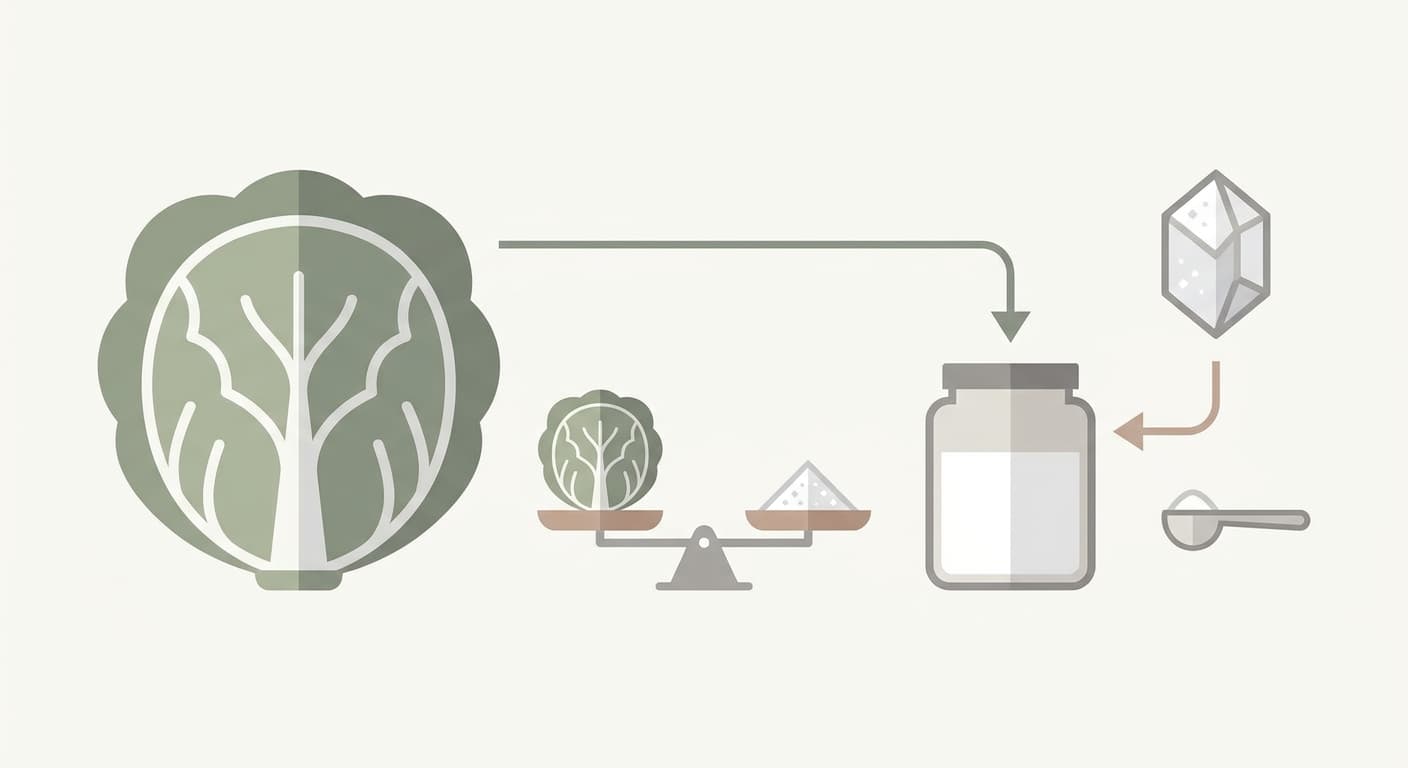
The correct salt to cabbage ratio for sauerkraut is 2% by weight — that is 20 grams of salt per kilogram of shredded cabbage, or about 9 grams (9.1g) per pound. Most fermenters work in the 2.0% to 2.5% band, where the brine is salty enough to suppress spoilage bacteria but mild enough to let Lactobacillus do its job. You weigh, you don't scoop. Run your own batch through our Sauerkraut Calculator and it returns the exact grams in one click.
Across 573 real UseCalcPro sauerkraut batches, the median salt level fermenters enter is exactly 2% by weight — the textbook ratio. That tells me something clear from the data we host: home fermenters have settled on the same number food scientists recommend. The single most common mistake I see in the support inbox is not the ratio at all — it is measuring salt by the tablespoon, where one brand weighs nearly double another and a "1 tablespoon" batch silently lands anywhere from 1.5% to 2.6%.
This guide is the ratio reference, not a general how-to. It gives you the salt-in-grams for every batch size, explains why weight beats volume, and shows exactly what happens when the percentage drifts too high or too low. For the full step-by-step method, jar sizing, and fermentation timing, see our fermentation usage-data report.
The 2% Rule: What the Salt to Cabbage Ratio Actually Means
The ratio is a percentage of the cabbage's weight, not its volume and not the jar size. You weigh the shredded cabbage, multiply by your chosen percentage, and that is your salt in grams. The formula is one line:
Salt (g) = Shredded cabbage weight (g) × Salt % ÷ 100
So 1,000 grams of cabbage at 2% needs 1000 × 2 ÷ 100 = 20 grams of salt. A 2-pound batch — 907 grams — needs 907 × 0.02 = 18.1 grams. The Sauerkraut Calculator runs this same equation and also converts the gram figure back into tablespoons for whichever salt you own.
According to the National Center for Home Food Preservation, the standard recipe is 3 tablespoons of canning salt per 5 pounds of cabbage. Three tablespoons of fine salt is roughly 54 grams, and 5 pounds is 2,268 grams — that works out to about 2.4% by weight, right inside the recommended band. The percentage method simply makes that ratio portable to any batch size instead of locking you into 5-pound increments.
Important
The safe, recommended range is 2.0% to 2.5% salt by weight. The UC ANR cooperative extension sauerkraut guide targets 2.25–2.5%. Below ~1.5% you risk soft, off-smelling kraut; above ~3.5% fermentation stalls and the kraut turns harshly salty.
Why You Weigh the Salt, Not Scoop It
A tablespoon is a volume, and salt crystals pack differently by brand. The same "1 tablespoon" can be 10 grams or 18 grams depending on the salt. That is an 80% swing in the actual ratio — enough to push a 2% batch down to 1.1% (spoilage territory) or up past 3% (stalled, oversalted). MakeSauerkraut's salt-by-weight breakdown makes the same case: the only consistent way to hit 2% is a kitchen scale set to grams.
| Salt Type | Weight per Tablespoon | "1 tbsp" on 907g cabbage = | Actual Ratio |
|---|---|---|---|
| Table salt (fine) | 18g | 18g | 1.98% |
| Morton kosher | 16g | 16g | 1.76% |
| Sea salt (fine) | 15g | 15g | 1.65% |
| Diamond Crystal kosher | 10g | 10g | 1.10% |
Read that last row twice. A cook following a recipe that says "1 tablespoon of salt for 2 pounds of cabbage" using Diamond Crystal kosher salt is fermenting at 1.10% — well under the safe floor. That is the exact failure the gram-based method eliminates. Weigh 18 grams and you are at 1.98% regardless of which box is in the cupboard.
Salt in Grams by Cabbage Weight (the Reference Table)
This is the table to bookmark. Every row is the salt-to-cabbage ratio applied at both ends of the safe band. Cabbage weights use 1 lb = 453.6 g; salt figures are the cabbage grams times the percentage, rounded to one decimal.
| Cabbage | Salt at 2.0% | Salt at 2.25% | Salt at 2.5% | Finished Yield (~50%) |
|---|---|---|---|---|
| 1 lb (453.6g) | 9.1g | 10.2g | 11.3g | ~0.5 lb |
| 2 lbs (907.2g) | 18.1g | 20.4g | 22.7g | ~1 lb |
| 3 lbs (1,360.8g) | 27.2g | 30.6g | 34.0g | ~1.5 lb |
| 5 lbs (2,268g) | 45.4g | 51.0g | 56.7g | ~2.5 lb |
| 10 lbs (4,536g) | 90.7g | 102.1g | 113.4g | ~5 lb |
Working in metric? The math is even cleaner because 2% of 1,000 grams is exactly 20 grams.
| Cabbage | Salt at 2.0% | Salt at 2.25% | Salt at 2.5% |
|---|---|---|---|
| 0.5 kg (500g) | 10g | 11.3g | 12.5g |
| 1 kg (1,000g) | 20g | 22.5g | 25g |
| 1.5 kg (1,500g) | 30g | 33.8g | 37.5g |
| 2 kg (2,000g) | 40g | 45g | 50g |
| 5 kg (5,000g) | 100g | 112.5g | 125g |
Tip
The two anchor numbers worth memorizing: 9 grams of salt per pound and 20 grams per kilogram, both at the baseline 2%. Multiply by your batch size and you are done. For odd weights, the Sauerkraut Calculator does the decimals for you.
Grams of Salt Per Pound of Cabbage
At the baseline 2% ratio, you need 9.07 grams of salt per pound of cabbage (453.6 g × 0.02). Bump to the upper-safe 2.5% and it becomes 11.34 grams per pound. Per kilogram, the figures are 20 g and 25 g respectively. Those four numbers cover essentially every home batch — scale them linearly and the ratio holds.
What Happens When the Ratio Is Wrong
Salt is not seasoning here; it is the safety mechanism. It pulls water out of the cabbage to form the brine, then keeps the environment hostile to spoilage organisms while Lactobacillus converts cabbage sugars into lactic acid. Drift too far in either direction and you change which microbes win.
| Salt % by Weight | What Happens | Result |
|---|---|---|
| Below 1.5% | Spoilage bacteria outcompete Lactobacillus | Soft, slimy, off-smelling — discard |
| 1.5–2.0% | Fast, vigorous ferment | Tangy, slightly softer texture |
| 2.0–2.5% | Balanced, recommended range | Crisp, clean, reliable sauerkraut |
| 2.5–3.5% | Fermentation slows noticeably | Very firm, salty, slow to sour |
| Above 3.5% | Lactobacillus growth stalls | Harshly salty, may not sour at all |
Warning
If your kraut turns mushy and smells putrid rather than pleasantly sour, under-salting is the most likely cause. The fix is not rinsing — it is starting over with weighed salt at 2%. Soft texture plus a clean sour smell is just fast fermentation and is safe to eat.
Too Much Salt: How to Recover
Oversalted kraut at 3% or higher is safe but unpleasant and ferments sluggishly. You cannot remove salt mid-ferment, but you can blend the finished kraut with a fresh, unsalted shredded-cabbage batch to dilute the ratio, or simply rinse servings before eating. Better to weigh correctly up front. If you routinely ferment in a warm kitchen above 75°F, intentionally nudging up to 2.5% is the right call — the extra salt offsets faster bacterial activity, the same logic the fermentation calculator applies for kombucha and pickles.
Too Little Salt: The Bigger Risk
Under-salting is the more dangerous error because it can produce genuinely spoiled food. Below 1.5%, the cabbage softens and unwanted bacteria and yeasts can take hold before the brine acidifies. There is no salvage step: if a batch smells wrong, throw it out. This is precisely why measuring by the tablespoon is so risky — the lightest kosher salts can drop a "correct-looking" batch below the floor without you noticing.
How This Ratio Compares to Other Ferments
The 2% salt-by-weight method is the backbone of lacto-fermentation, but the exact percentage shifts by food. Sauerkraut and most dry-salted vegetable ferments sit at 2.0–2.5%; brined pickles and kimchi often run differently because the salt is dissolved into water rather than massaged into the vegetable.
| Ferment | Typical Salt % | Method | Calculator |
|---|---|---|---|
| Sauerkraut | 2.0–2.5% by veg weight | Dry-salt + massage | Sauerkraut Calculator |
| Kimchi | 2–3% (salting), rinsed | Salt-soak then drain | Kimchi Calculator |
| Brined pickles | 3.5–5% brine | Salt dissolved in water | Pickle Brine Calculator |
| General lacto-veg | 2–3% by weight | Dry-salt or brine | Fermentation Calculator |
The takeaway: sauerkraut's "salt by weight of the vegetable" is the simplest of the four because there is no added water diluting the ratio. What you weigh is what ferments. For pickles where salt is dissolved into brine water, the percentage refers to the brine, not the cucumbers — a different calculation the Pickle Brine Calculator handles separately.
A Worked Example, Start to Finish
Say you buy two cabbage heads totaling 2.5 pounds. After stripping the outer leaves and core (roughly 20% loss), you shred and weigh 2 pounds — 907 grams of usable cabbage. At the baseline 2% ratio:
907 g × 0.02 = 18.1 grams of salt.
You set the scale to grams, tare a small dish, and weigh out 18.1 grams of non-iodized salt — no tablespoons involved. Massage it in for 5–10 minutes until the cabbage releases its brine, pack tight into a quart jar, keep everything submerged, and ferment 3–4 weeks at room temperature. The 18.1 grams is the only number that has to be exact; everything else has slack.
Want it firmer for a long, cool basement ferment? Run the same 907 grams at 2.5%: 907 × 0.025 = 22.7 grams. That is the entire decision the ratio governs — crisp-and-salty at 2.5% versus tangy-and-tender at 2.0%, with the safe baseline in between.
Frequently Asked Questions
Salt to cabbage ratio sauerkraut by weight?
The salt to cabbage ratio for sauerkraut is 2% of the shredded cabbage's weight, with a safe working range of 2.0% to 2.5%. That means 20 grams of salt per kilogram or 9.1 grams per pound at the 2% baseline. Always weigh both the cabbage and the salt in grams — across 573 real UseCalcPro batches, 2% is the median ratio fermenters actually use.
How much salt for sauerkraut?
For a standard 2-pound (907g) batch you need 18.1 grams of salt at 2%, or 22.7 grams at 2.5%. For 1 pound it is 9.1 grams; for 5 pounds, 45.4 grams. The National Center for Home Food Preservation recipe of 3 tablespoons salt per 5 pounds works out to about 2.4%, inside the same band.
Sauerkraut salt to cabbage ratio?
It is 2.0–2.5% salt by weight of cabbage, with 2% as the everyday default. Expressed as a fraction, that is roughly 1 part salt to 50 parts cabbage (2%) or 1 part salt to 40 parts cabbage (2.5%). Use the Sauerkraut Calculator to convert any cabbage weight into exact salt grams.
Cabbage to salt ratio sauerkraut?
Flipped around, the cabbage-to-salt ratio is about 50:1 by weight at 2% (50 grams of cabbage per 1 gram of salt) and 40:1 at 2.5%. So 1,000 grams of cabbage takes 20 grams of salt. Keeping the ratio in grams — not cups or tablespoons — is what keeps it consistent batch to batch.
How many grams of salt per pound of cabbage?
9.07 grams of salt per pound at the 2% baseline, and 11.34 grams per pound at 2.5%. Per kilogram those figures are 20 grams and 25 grams. Multiply by your batch weight: a 3-pound batch at 2% needs about 27.2 grams.
What happens if I use too much or too little salt in sauerkraut?
Too little salt (below 1.5%) lets spoilage bacteria win — the kraut turns soft, slimy, and foul-smelling and must be discarded. Too much salt (above 3.5%) stalls Lactobacillus, leaving the kraut harshly salty and slow to sour. Staying at 2.0–2.5% gives crisp, reliably tangy sauerkraut, which is why MakeSauerkraut and university extensions both recommend weighing salt to the gram.
Related Articles
- What 250+ Fermentation Calculations Reveal About Home Preservation in 2026 — The first-party data behind the 2% default, plus jar sizing, yeast conversion, and timing patterns.
- Sourdough Hydration & Starter Guide — Another weight-ratio ferment where measuring by the gram, not the cup, makes or breaks the result.
Related Calculators
- Sauerkraut Calculator — Enter cabbage weight and salt %, get exact grams, jar size, and fermentation time.
- Fermentation Calculator — Salt ratios and schedules for kombucha, pickles, and other lacto-ferments.
- Kimchi Calculator — Gochugaru, fish sauce, garlic, and salt amounts for traditional or vegan kimchi.
- Pickle Brine Calculator — Vinegar, water, and salt ratios for brined pickles at any batch size.
This article provides general information for educational purposes. Follow tested recipes from a trusted food-safety authority when fermenting at home, and discard any batch that smells or looks spoiled.
This article is provided for informational and educational purposes only. Content should not be considered professional financial, medical, legal, or other advice. Always consult a qualified professional before making important decisions. UseCalcPro is not responsible for any actions taken based on the information in this article.
Try These Calculators
Calculate exact salt amounts for homemade sauerkraut by cabbage weight. Get salt-to-cabbage ratios, jar sizes, and fermentation time based on temperature.
Calculate dye material, mordant weight, and dye bath water for natural dyeing projects. Supports 8 plant dye sources, 4 fiber types, and 3 color depths.
Calculate soap fragrance oil or essential oil amount from oil weight, fragrance load, and batch size. Get ounces, grams, per-bar cost, and scent load guidance.
Calculate the ideal pickle brine ratio for vinegar-based or fermented pickles. Get precise measurements for water, vinegar, salt, and sugar for any jar size.