How Baker's Percentage Works: The Math and Science Behind Sourdough Fermentation
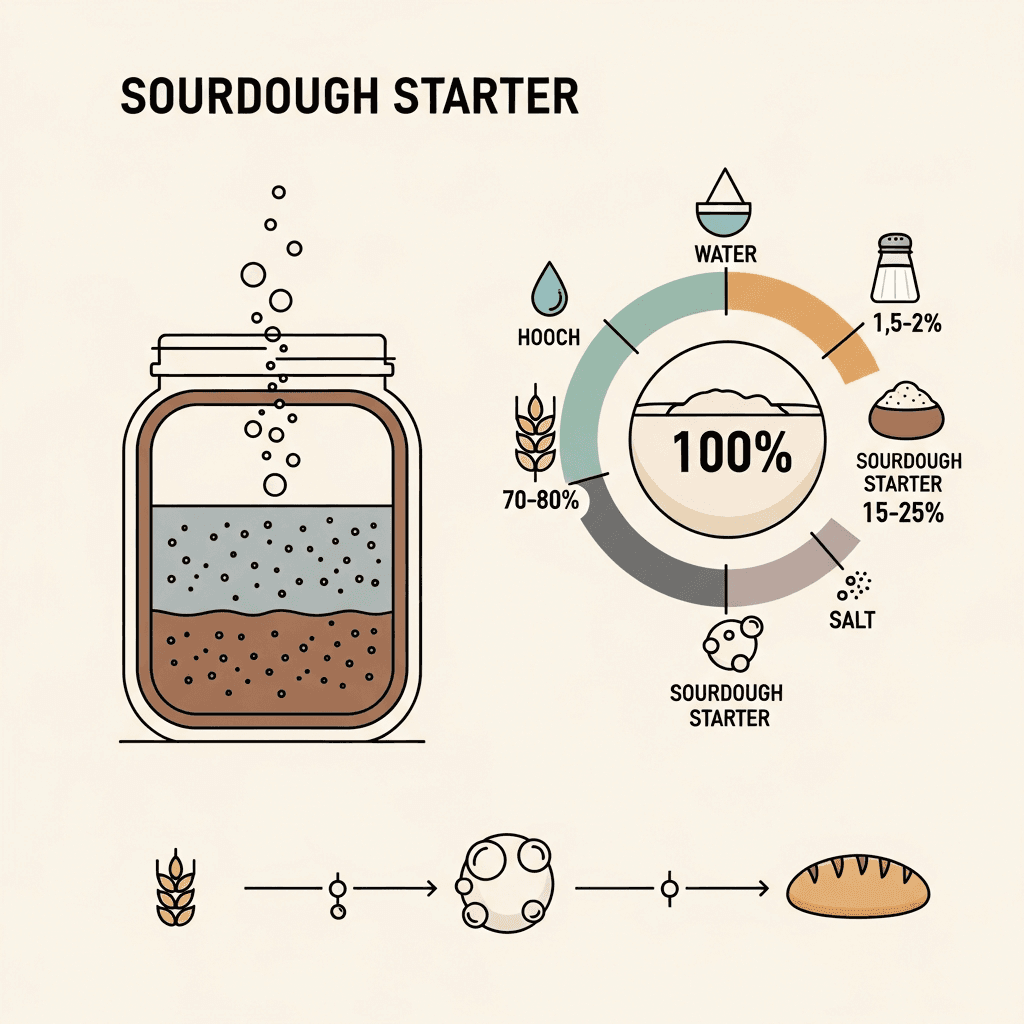
Baker's percentage is a ratio system where every ingredient is expressed relative to total flour weight, which is always 100%. A "70% hydration" dough contains 700 grams of water per 1,000 grams of flour. This single number — hydration — determines whether your crumb is tight and uniform (60-65%) or wild and open (80-85%). But the percentage only sets the stage. What actually builds your bread is fermentation: a biochemical process where wild yeast produces CO2 for rise while lactic acid bacteria produce the acids that define sourdough's flavor, extend its shelf life, and reduce its glycemic index by up to 25 points compared to commercial bread.
At UseCalcPro, we've watched thousands of bakers plug numbers into our sourdough tool and then ask the same question: "I got the right amounts, but my bread still came out wrong — why?" The answer is almost never the math. It's fermentation. Getting the percentages right is step one. Understanding what those percentages do during the 4-12 hours your dough sits on the counter is what separates flat, dense loaves from the ones with crackling crust and open crumb.
This guide covers the science behind the numbers — what happens at the molecular level when you change hydration by 5%, why your kitchen temperature matters more than your recipe, and how to read your finished loaf like a diagnostic report.
Build Your Recipe
How Baker's Percentage Actually Works
Every professional bakery in the world uses baker's percentage. The system is deceptively simple: flour is always 100%, and every other ingredient is expressed as a percentage of that flour weight. A recipe with 1,000g flour, 700g water, 200g starter, and 20g salt is written as 100% flour, 70% hydration, 20% starter, 2% salt.
The critical insight most home bakers miss: total percentages always exceed 100%. In the recipe above, the percentages sum to 192%. That's correct. Baker's percentage is not about proportions of the whole — it's about ratios to flour.
This design exists for a practical reason. When you want to scale a recipe from 1 loaf to 6, you don't recalculate every ingredient. You set your target flour weight and multiply:
| Ingredient | Percentage | 1 Loaf (500g flour) | 6 Loaves (3,000g flour) |
|---|---|---|---|
| Flour | 100% | 500g | 3,000g |
| Water | 70% | 350g | 2,100g |
| Starter | 20% | 100g | 600g |
| Salt | 2% | 10g | 60g |
| Total dough | 192% | 960g | 5,760g |
The Starter Flour Problem
Here's where most home recipes get the math wrong. Your starter is not pure leavening — it's a mixture of flour and water. A 100% hydration starter (the most common type, fed with equal weights flour and water) is 50% flour and 50% water by weight.
When you add 200g of starter to a recipe, you're actually adding 100g of flour and 100g of water. If you don't account for this, your actual hydration and flour amounts will differ from your target.
The correct adjustment:
- Starter flour contribution = Starter weight / (1 + starter hydration). For 200g of 100% hydration starter: 200 / 2 = 100g flour.
- Starter water contribution = Starter weight - starter flour. For 200g: 200 - 100 = 100g water.
- Main flour = Total flour - starter flour = 500 - 100 = 400g.
- Main water = Total water - starter water = 350 - 100 = 250g.
Skip this step and your dough will be wetter than you planned. Professional bakeries never skip it.
Hydration: The Single Number That Controls Your Crumb
Hydration percentage is the ratio of water to flour, and it is the most consequential variable in your recipe. A 5-percentage-point change transforms the bread.
What Each Range Produces
60-65% hydration creates a stiff dough that holds its shape aggressively. The crumb is tight and uniform — no dramatic holes, consistent texture from crust to center. This is the territory of bagels, pretzels, and sandwich bread. The dough is easy to shape and forgiving of handling mistakes.
65-70% hydration is where most successful home bakers start. The crumb opens slightly, with moderate irregular holes and a pleasant chew. Shaping requires some technique but tolerates imperfection. If you've never baked sourdough, start at 68%.
70-75% hydration produces the classic artisan loaf: open crumb with irregular holes, thin crackling crust, and enough structure to hold a slice of butter without collapsing. This range demands stretch-and-fold technique during bulk fermentation. You cannot knead high-hydration dough on a counter — it will stick to everything.
75-85% hydration creates the dramatic open crumb of ciabatta and focaccia, with holes large enough to lose a cherry tomato in. This range is genuinely difficult. The dough behaves more like a batter than a bread, and shaping requires coil folds, lamination, or other advanced techniques. Many experienced bakers still struggle above 80%.
Why Water Changes Everything
The mechanism is gluten geometry. Gluten proteins (glutenin and gliadin) form a mesh network when hydrated. At low hydration, this mesh is dense and tightly packed — gas bubbles from fermentation can't expand much before hitting resistance. At high hydration, the mesh is more extensible: strands are farther apart, gas bubbles can inflate larger before the protein structure constrains them.
A 2024 review in PMC confirms that hydration also affects enzymatic activity during fermentation. Higher water content increases amylase activity, breaking more starch into sugars that feed the wild yeast. This accelerates fermentation — high-hydration doughs ferment faster than low-hydration doughs at the same temperature.
The Science of Fermentation: Temperature Controls Flavor
Every sourdough starter contains two classes of organisms: wild yeast (primarily Saccharomyces and Kazachstania species) and lactic acid bacteria (LAB, primarily Lactobacillus species). These organisms produce different compounds at different rates depending on temperature.
The Temperature-Flavor Map
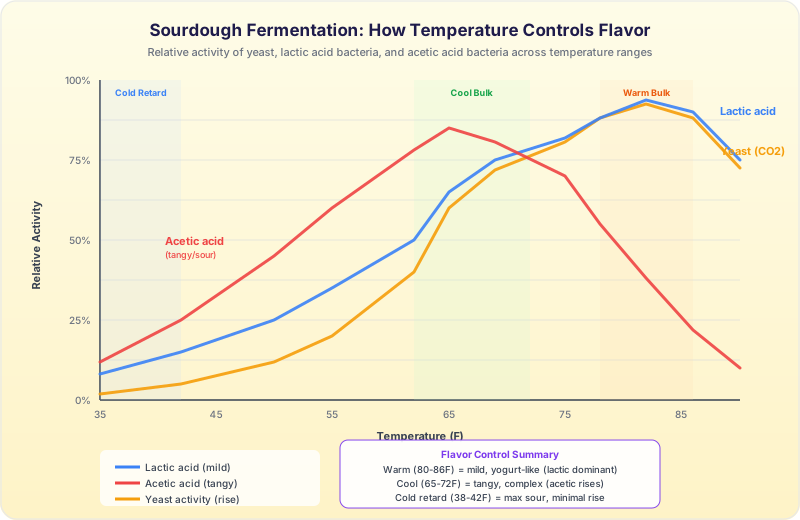
Warm fermentation (80-86F / 27-30C) favors homofermentative LAB, which produce primarily lactic acid. Lactic acid tastes mild, creamy, and yogurt-like. Yeast activity is also high at this temperature, so fermentation is fast: bulk fermentation may finish in 3-4 hours.
Cool fermentation (65-72F / 18-22C) shifts the balance toward heterofermentative LAB, which produce acetic acid alongside lactic acid. Acetic acid tastes sharp, vinegary, and tangy. Yeast activity slows significantly, extending bulk fermentation to 8-12 hours but developing more complex flavor.
Cold retard (38-42F / 3-6C) nearly stops yeast activity but allows LAB to continue working slowly. This is why an overnight cold retard in the refrigerator intensifies sourness without overproofing — the dough doesn't rise much, but the acids keep accumulating.
The fermentation quotient (FQ) — the molar ratio of lactic to acetic acid — quantifies this balance. An FQ of 2.0-2.7 produces the classic balanced sourdough flavor most people expect. Below 2.0, the bread tastes aggressively sour. Above 4.0, it tastes mild enough that many tasters wouldn't identify it as sourdough.
Practical Temperature Control
Most home kitchens sit between 68-74F, which produces moderately tangy bread with 5-8 hour bulk fermentation. If you want:
- Milder bread: Ferment in a warm spot (top of refrigerator, inside oven with light on) at 78-82F. Reduce bulk time to 3-4 hours.
- Tangier bread: Use a longer, cooler bulk (12-16 hours at 62-65F) or extend the cold retard to 36-48 hours.
- Maximum complexity: Warm bulk (4 hours at 78F) followed by long cold retard (24-48 hours). This builds both lactic and acetic acid in stages.
Why Sourdough Is Nutritionally Different From Commercial Bread
The fermentation process doesn't just create flavor — it fundamentally changes the bread's nutritional profile. Three mechanisms are well-documented.
| Property | Sourdough (long ferment) | Commercial White Bread |
|---|---|---|
| Glycemic index | ~54 | 70-80 |
| Phytic acid | Reduced 50-70% | Minimal reduction |
| Fermentation time | 4-48 hours | 1-2 hours |
| Mineral bioavailability | High (phytase-activated) | Low (phytate-bound) |
| Shelf life (no preservatives) | 4-5 days | 1-2 days |
| Leavening | Wild yeast + LAB | Commercial yeast only |
Lower Glycemic Index
Commercial white bread has a glycemic index (GI) of approximately 70-80. Sourdough bread made from the same flour has a GI of roughly 54, according to a systematic review in PubMed.
The mechanism: lactic acid and acetic acid produced during fermentation modify the starch structure. Acetic acid specifically inhibits amylase, the enzyme that breaks starch into glucose during digestion. The result is slower glucose absorption. For context, the difference between GI 75 and GI 54 is roughly equivalent to the difference between white bread and whole wheat pasta.
Phytic Acid Reduction
Phytic acid (phytate) binds to minerals like iron, zinc, calcium, and magnesium in grain, preventing your body from absorbing them. It's the reason that eating whole wheat bread doesn't deliver the mineral content that the nutrition label promises.
Sourdough fermentation degrades phytic acid because the process drops dough pH below 5.0, which activates cereal phytases — enzymes that break down phytate. Research from a Frontiers in Nutrition review found that long sourdough fermentation can reduce phytate content by more than 70%, substantially increasing mineral bioavailability.
Commercial bread, by contrast, uses fast-acting commercial yeast that completes fermentation in 1-2 hours — far too fast for significant phytase activity.
Gut Microbiome Effects
A 2024 study published in Frontiers in Microbiology investigated sourdough bread's impact on gut microbiota using an in vitro colonic fermentation model. The findings showed increased production of short-chain fatty acids (SCFAs), which are associated with reduced inflammation and improved gut barrier function.
A separate mouse feeding study in PMC found that sourdough bread consumption reduced total cholesterol and triglycerides, improved the ratio of LDL to HDL cholesterol, and increased magnesium absorption owing to phytate degradation.
These benefits come with a caveat: the extent of nutritional improvement depends heavily on fermentation duration, starter microbial composition, and flour type. A 4-hour bulk fermentation delivers less phytate reduction than a 12-hour one. The science supports sourdough's benefits, but only when the fermentation is long enough to matter.
The Five Most Common Fermentation Mistakes
After thousands of calculations processed through our tool, we've identified patterns in the questions bakers ask. These five mistakes account for the vast majority of failed loaves.
1. Overproofing: The Collapsed Loaf
Overproofing happens when fermentation runs too long. The wild yeast exhausts available sugars, the gluten network weakens from sustained acid exposure, and the dough can no longer hold the gas it produced. Signs:
- Dough feels slack, wet, and lifeless — it spreads rather than holds shape
- The poke test shows no spring-back at all — the indentation stays permanently
- After baking, the loaf is flat with a pale, thin crust
- Crumb is dense and gummy with collapsed structure
The fix: Watch the dough, not the clock. A recipe that says "6 hours bulk" was written in someone else's kitchen at a specific temperature. At 78F, you might need 4 hours. At 68F, you might need 8. Target a 30-50% volume increase during bulk, not a specific time.
2. Underproofing: The Dense Brick
Underproofing is more common than overproofing among home bakers. The yeast hasn't produced enough CO2, and the crumb reflects it. Signs:
- Uneven crumb with dense patches and a few random large holes
- Gummy, dough-like texture in the center
- Tight, tearing "ear" on a scored loaf (the score rips rather than blooming)
- Very thick bottom crust
The fix: Extend your bulk fermentation. If using 20% starter at 72F, expect 5-7 hours. The dough should be puffy, jiggly, and show visible bubbles on the surface and sides before shaping.
3. Using Inactive Starter
The most frustrating mistake because the math is perfect but the biology isn't. A starter that hasn't been fed in a week or hasn't reached peak activity won't leaven bread regardless of your percentages.
The fix: Feed your starter 4-8 hours before mixing. A healthy starter at 75F peaks in 4-6 hours after a 1:1:1 feed. It should have doubled in volume, show a domed top with bubbles throughout, and pass the float test (a teaspoon dropped in water floats).
4. Ignoring Kitchen Temperature
A recipe that works perfectly in July will fail in January if your kitchen drops from 76F to 64F. That 12-degree difference nearly doubles fermentation time. Most home bakers don't own a proofing box, and ambient temperature varies by 15-20 degrees across seasons.
The fix: Buy a $10 probe thermometer. Record your dough temperature after mixing (target: 75-78F). If your kitchen is cold, use warmer water to compensate — aim for a final dough temperature of 76F. The formula: water temperature = (target dough temp x 4) - room temp - flour temp - starter temp.
5. Wrong Salt Timing
Salt at 2% strengthens gluten and slows fermentation by approximately 20-30% compared to unsalted dough. Adding salt too early (directly with the starter) can inhibit yeast establishment. Adding it too late means weak gluten development during the critical early phase.
The fix: Add salt after autolyse (the 30-60 minute flour-water rest). Mix flour and water first, rest 30 minutes, then add starter and salt together. This gives the flour time to hydrate and begin gluten development before salt tightens the network.
Reading Your Crumb: A Diagnostic Guide
Your finished loaf is a record of everything that happened during fermentation. Learning to read the crumb structure tells you what to change next time.
Even, moderate holes throughout: Correct proof. Your fermentation timing, temperature, and shaping were balanced. This is the target for everyday sourdough at 68-72% hydration.
Large holes near the top, dense bottom: Underproofed. The yeast didn't produce enough gas to inflate the entire loaf evenly. The gas that was produced rose to the top. Extend bulk fermentation next time.
Dense, gummy crumb with no holes: Severely underproofed or inactive starter. Check your starter's activity first. If the starter is healthy, extend bulk by 2-3 hours.
Flat loaf with collapsed, tunneling holes: Overproofed. The gluten network degraded from extended acid exposure. Reduce bulk time or reduce kitchen temperature.
Large wild holes interspersed with tight areas: Shaping issue, not fermentation. Uneven tension during shaping trapped large gas pockets while compressing others. Practice tighter, more consistent pre-shaping.
Dense ring around the outside, open center: Insufficient steam during the first 15-20 minutes of baking. The crust set before the bread fully expanded. Use a Dutch oven with the lid on, or add more steam to your oven.
Frequently Asked Questions
Why does the same recipe produce different results in different kitchens?
Temperature is the primary variable. A sourdough recipe that produces a mild, well-risen loaf at 78F in a Texas kitchen will produce a tangier, denser loaf at 64F in a Maine kitchen — even with identical ingredients and timing. Every 10-degree Fahrenheit drop roughly doubles fermentation time. Kitchen humidity, altitude (affects oven spring), and even the local microbial population in your starter contribute to variation. The baker's percentage guarantees consistent ingredient ratios, but fermentation is a biological process governed by environmental conditions. Professional bakeries control temperature to within 1-2 degrees using proofing cabinets, which is why their results are more consistent than home baking.
How does sourdough fermentation reduce the glycemic index of bread?
During fermentation, lactic acid bacteria produce organic acids — primarily lactic acid and acetic acid — that modify the starch structure in flour. Acetic acid specifically inhibits amylase, the digestive enzyme that breaks starch into glucose. This means the glucose enters your bloodstream more slowly after eating sourdough compared to commercial bread made with the same flour. A systematic review published in the journal Trends in Food Science & Technology found that sourdough bread consistently shows a glycemic index around 54, compared to 70-80 for commercial white bread. The effect is proportional to fermentation duration: a 4-hour bulk produces less acid (and less GI reduction) than a 12-hour bulk.
What is the float test and how reliable is it for judging starter readiness?
The float test involves dropping a small spoonful of starter into a glass of water. If it floats, the starter has produced enough CO2 gas to be buoyant, indicating active fermentation. The test is approximately 80% reliable — it correctly identifies peak activity in most cases, but it can produce false negatives with very high-hydration starters (which are too liquid to hold gas bubbles) and false positives with starters that were recently stirred (introducing air). A more reliable multi-factor check: the starter should have doubled in volume since feeding, show a domed top (or just beginning to recede), display bubbles throughout (not just on the surface), and smell pleasantly yeasty rather than sharply alcoholic.
Does flour protein content interact with hydration percentage?
Yes, significantly. Bread flour (12-14% protein) can absorb and structurally support more water than all-purpose flour (10-12% protein). A dough made with bread flour at 75% hydration will feel similar to all-purpose flour at 70% hydration — roughly the same workability and crumb openness. Whole wheat flour absorbs even more water due to bran particles, requiring 5-10% additional hydration to achieve equivalent dough consistency. Spelt flour is the exception: despite moderate protein, its gluten is fragile and overhydrates easily. Reduce hydration by 5-10% when substituting spelt. The practical rule: adjust hydration to the flour, not the other way around.
Why does a long cold retard make bread more sour?
During cold retarding (38-42F / 3-6C), yeast activity drops to near zero — it essentially stops producing CO2. But lactic acid bacteria continue metabolizing, albeit slowly. Over 12-48 hours, acids accumulate without significant additional rise. More importantly, the cold temperature shifts the fermentation balance toward heterofermentative LAB, which produce acetic acid (the sharp, vinegar-like flavor) in addition to lactic acid. A 24-hour cold retard can double the total acid content compared to a room-temperature bulk of the same total time, because the acids aren't diluted by continued yeast activity and gas production.
Can I use baker's percentage for breads that aren't sourdough?
Baker's percentage works for every bread formula — yeasted, sourdough, enriched, flatbread. It was developed by professional bakers long before the home sourdough revival. Enriched breads (brioche, challah) simply add more ingredient lines: butter at 30%, eggs at 20%, sugar at 15%. The system's value is identical: any recipe in baker's percentage can be scaled to any batch size by multiplying the flour weight. Many professional bakeries maintain hundreds of formulas in baker's percentage notation because it eliminates unit conversion entirely — whether you need 2kg or 200kg of dough, the percentages don't change.
Related Resources
- Pizza Dough Calculator - Apply baker's percentage to pizza with controlled hydration and fermentation
- Bread Dough Calculator - Calculate ingredients for yeasted bread varieties
- Recipe Converter - Scale any recipe up or down while maintaining ratios
- Jam and Canning Calculator - Calculate preserving ratios for homemade sourdough accompaniments
This article is provided for informational and educational purposes only. Content should not be considered professional financial, medical, legal, or other advice. Always consult a qualified professional before making important decisions. UseCalcPro is not responsible for any actions taken based on the information in this article.
Try These Calculators
Calculate flour, water, starter, and salt for sourdough bread with baker's percentages. Adjust hydration, loaf count, and dough weight for any batch size.
Calculate food dehydrator time, temperature, dried yield weight, and electricity cost for fruits, vegetables, jerky, and herbs. Free drying time chart.
Calculate the exact amount of yogurt starter culture per quart of milk. Get incubation time, temperature, and culture-to-milk ratios for homemade yogurt.
Calculate exactly how much oil you need for deep frying based on your pot or fryer size. Compare oil types by smoke point, cost per use, and reuse cycles.