How Cat Years Actually Work: Why Indoor Cats Live a Decade Longer
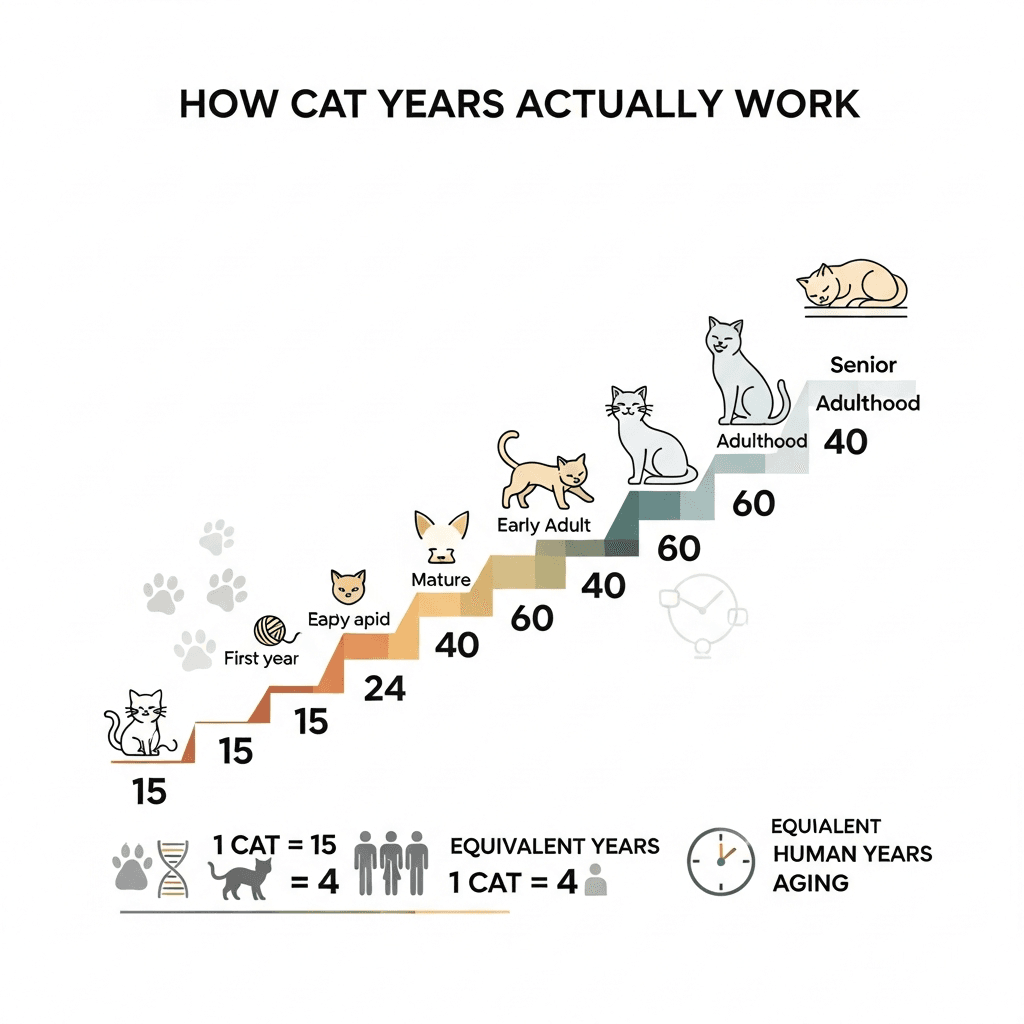
The "multiply by 7" rule is wrong for cats — even more wrong than it is for dogs. A 1-year-old cat is not 7 in human terms; it's 15, a sexually mature young adult. By age 2, your cat is 24 in human years. After that, each cat year adds only 4 human years. But here's the number that actually matters: indoor cats live 15-20 years on average, while outdoor cats average just 2-5 years. That's not a small difference — a UC Davis veterinary study found indoor cats live up to 3.5 times longer than outdoor cats. Where your cat lives is a bigger predictor of lifespan than breed, diet, or genetics.
At UseCalcPro, we built our cat age calculator after noticing something in the data: cat owners consistently overestimate young cats' ages and underestimate senior cats'. A 5-year-old cat isn't middle-aged — it's 36 in human years, still in its prime. A 12-year-old cat is 64, well into its senior years, and likely needs twice-yearly vet visits instead of annual checkups.
This guide covers the real science behind feline aging: why cats age more uniformly than dogs, what each of the 6 life stages means for care, the indoor-outdoor lifespan gap, and how to recognize the early signs of cognitive decline that affect over 50% of cats past age 15.
Check Your Cat's Age
Why the 7:1 Rule Is Even More Wrong for Cats
The 7:1 rule was never based on science for any animal. It originated as a rough marketing simplification in the 1950s: average human lifespan (~70 years) divided by average dog lifespan (~10 years) = 7. For cats, the math is even worse because cats don't age linearly at all.
The Real Formula
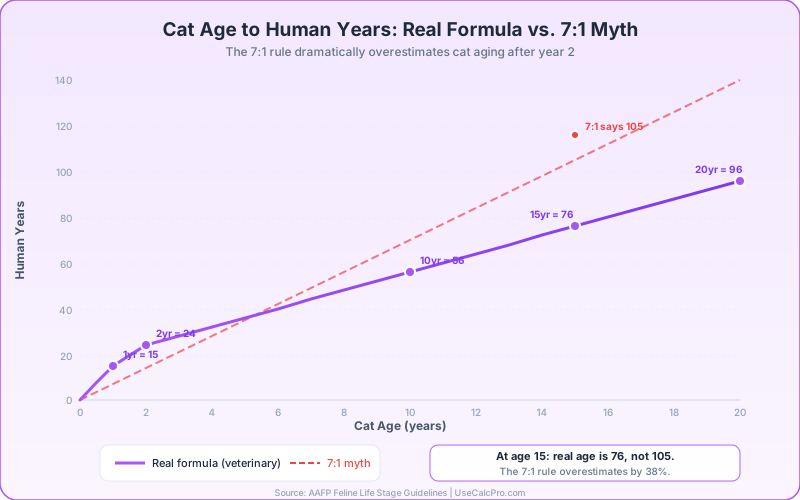
Veterinarians use a piecewise formula that reflects actual feline development:
- Year 1: 15 human years (sexual maturity, full-size skeleton)
- Year 2: +9 human years = 24 total (full physical and behavioral maturity)
- Year 3 and beyond: +4 human years per cat year
A 7-year-old cat is not 49 (as the 7:1 rule suggests). It's 24 + (5 x 4) = 44 human years — a middle-aged adult, not someone approaching 50.
Quick Reference Chart
| Cat Age | 7:1 Rule (Wrong) | Actual Human Age | Life Stage | What's Happening |
|---|---|---|---|---|
| 6 months | 3.5 | 10 | Kitten | Rapid growth, socialization window closing |
| 1 year | 7 | 15 | Junior | Sexual maturity, full size |
| 2 years | 14 | 24 | Young Adult | Fully mature physically and behaviorally |
| 5 years | 35 | 36 | Prime | Peak condition, highest activity level |
| 8 years | 56 | 48 | Mature | May start slowing, begin senior screenings |
| 10 years | 70 | 56 | Senior | Noticeable aging, biannual vet visits |
| 15 years | 105 | 76 | Geriatric | Significant aging, comfort-focused care |
| 20 years | 140 | 96 | Geriatric | Exceptional age, intensive monitoring |
The 7:1 rule overestimates young cats and dramatically overestimates old cats. Nobody seriously believes a 15-year-old cat is 105 — but the corrected formula puts it at a much more realistic 76.
How Cat Aging Differs from Dog Aging
If you've read our dog age guide, you know that dog aging varies dramatically by size: a 10-year-old Chihuahua is 56 in human years, while a 10-year-old Great Dane is 80. Dogs carry this burden because large breeds produce up to 28 times more IGF-1 growth hormone, which accelerates cellular aging.
Cats are fundamentally different. Cat aging is remarkably uniform across breeds, and here's why:
Size Consistency
Dogs range from 2 pounds (Chihuahua) to 200 pounds (English Mastiff) — a 100x weight variation. Cats range from roughly 5 pounds (Singapura) to 25 pounds (Maine Coon) — only a 5x variation. This narrow size range means IGF-1 levels don't vary enough between breeds to create the dramatic aging differences seen in dogs.
Less Genetic Diversity from Breeding
Dogs have been selectively bred for thousands of years into over 350 recognized breeds with wildly different body plans. Cats have experienced far less intensive selective breeding, keeping their genome closer to their wild ancestors. Fewer extreme genetic modifications means fewer breed-specific health problems and more consistent lifespans.
Why Cats Live Longer Than Dogs
The average cat lives 12-18 years; the average dog lives 10-13. Several factors contribute:
| Factor | Cats | Dogs | Impact |
|---|---|---|---|
| Body size range | 5-25 lbs | 2-200 lbs | Uniform aging in cats vs. size-dependent in dogs |
| Selective breeding intensity | Moderate | Extreme | Fewer genetic disorders in cats |
| Metabolic rate | Lower per kg | Higher per kg | Slower cellular aging |
| Lifestyle risk | Indoor option | Mostly outdoor access | Indoor cats avoid major mortality risks |
| Genetic diversity | Higher within breeds | Lower within breeds | More robust health |
Tip
While cat aging doesn't vary much by breed, some breeds do tend toward longer lives. Siamese, Burmese, and Russian Blue cats regularly live 15-20+ years. Breeds with extreme features (flat-faced Persians, folded-ear Scottish Folds) may have shorter lifespans due to associated health issues.
The Indoor-Outdoor Gap: A Decade of Difference
This is the single most important factor in your cat's lifespan — and the data is stark.
The Numbers
| Living Situation | Average Lifespan | Human Age at Death | Top Risks |
|---|---|---|---|
| Indoor only | 15-20 years | 76-96 human years | Obesity (60% prevalence), boredom, UTIs |
| Indoor/outdoor | 10-14 years | 56-72 human years | Cars, disease, fights, parasites |
| Outdoor only | 2-5 years | 24-36 human years | Cars (#1), predators, FeLV/FIV, weather, toxins |
According to UC Davis School of Veterinary Medicine, indoor cats live up to 3.5 times longer than outdoor cats. The ASPCA and multiple veterinary studies consistently confirm this gap.
Why the Gap Is So Large
Cars are the #1 cause of death for outdoor cats. This alone accounts for a massive portion of the lifespan difference.
Infectious disease is the #2 factor. Feline Leukemia Virus (FeLV) and Feline Immunodeficiency Virus (FIV) are transmitted through cat-to-cat contact — fights, bites, shared food bowls. Indoor-only cats have near-zero exposure risk.
Predators vary by region but include coyotes, foxes, birds of prey, and in some areas, larger cats. A cat's hunting instincts don't protect it against animals that hunt cats.
Toxins include antifreeze (which tastes sweet to cats and is lethal in small amounts), pesticides, rodenticides eaten by poisoned prey, and toxic plants.
The Indoor Cat Trade-Off
Keeping cats indoors adds years — but it creates its own health challenges. The Association for Pet Obesity Prevention reports that 60% of cats in the U.S. are overweight or obese, with indoor cats at higher risk due to reduced activity and boredom-related overeating.
Warning
Indoor doesn't automatically mean healthy. An indoor cat with no enrichment, unlimited food, and no vertical space is trading one set of risks for another. The solution isn't outdoor access — it's environmental enrichment.
The Enrichment Prescription
An enriched indoor environment counteracts the obesity and boredom risks:
- Vertical space: Cat trees, wall shelves, window perches. Cats need to climb — it's as fundamental as eating.
- Hunting simulation: Puzzle feeders, food-dispensing toys, interactive play with wand toys 15-20 minutes daily.
- Window access: A bird feeder outside a window provides hours of "cat TV."
- Catio: An enclosed outdoor space gives fresh air and stimulation with none of the risks. A basic catio costs $200-500 to build.
- Multiple litter boxes: One per cat plus one extra, in different locations. Stress from dirty or insufficient boxes causes urinary problems.
The 6 Life Stages of a Cat
International Cat Care and the American Association of Feline Practitioners recognize 6 distinct life stages, each with specific care needs:
Stage 1: Kitten (0-6 Months) — Human Age 0-10
The fastest growth phase. Kittens double their weight multiple times, develop motor skills, and go through a critical socialization window that closes around 7-8 weeks. What they learn to accept during this window — handling, other animals, noises — shapes their temperament for life.
Care priorities: Vaccination series (FVRCP at 6-8, 10-12, 14-16 weeks), deworming, socialization, kitten-formula food (higher protein and calories than adult food), spay/neuter planning.
Stage 2: Junior (7-12 Months) — Human Age 12-15
Adolescence. Your cat has adult-size bones but hasn't filled out yet. Energy levels peak, and behavioral testing of boundaries is common — expect furniture climbing, counter-surfing, and 3 AM zoomies.
Care priorities: Spay/neuter (ideally by 5-6 months), transition from kitten to adult food, establish play routines, continue socialization.
Stage 3: Prime (1-6 Years) — Human Age 15-40
Peak physical condition. This is the equivalent of a human's 20s and 30s. Your cat is fully mature, maximally active, and at lowest disease risk. Most cat owners underestimate how young their cat still is during this phase — a 4-year-old cat is only 32 in human years.
Care priorities: Annual vet exam, maintain healthy weight (this is when obesity often begins), dental cleanings if needed, keep up play and enrichment.
Stage 4: Mature (7-10 Years) — Human Age 44-56
The equivalent of a human's late 40s through mid-50s. Your cat may sleep slightly more, play slightly less, and start showing subtle changes. This is when preventive screening becomes critical because catching kidney disease, hyperthyroidism, or diabetes early dramatically improves outcomes.
Care priorities: Switch to twice-yearly vet visits, senior bloodwork panel (kidney values, thyroid, glucose), monitor weight changes in both directions, joint supplement if stiffness appears.
Stage 5: Senior (11-14 Years) — Human Age 60-72
Noticeable aging. Many cats remain active and comfortable in this stage with proper care, but age-related conditions become common: kidney disease (affects 30% of cats over 10), hyperthyroidism, arthritis, dental disease.
Care priorities: Senior-formula food (higher moisture, controlled phosphorus for kidney support), pain management for arthritis, easy access to litter boxes and food (no jumping required), heated beds.
Stage 6: Geriatric (15+ Years) — Human Age 76+
The golden years. Cats in this stage need comfort-focused care. Cognitive changes may appear (see next section). Quality of life becomes the primary consideration.
Care priorities: Vet visits every 3-4 months, quality-of-life assessments, comfort adaptations (ramps, low-sided litter boxes, warm sleeping spots), gentle interaction.
Cognitive Dysfunction: The Silent Age Disease
This is the section most cat owners need to read and few do. Feline cognitive dysfunction syndrome (CDS) is the cat equivalent of dementia, and its prevalence is staggering.
The Numbers
According to Cornell University's Feline Health Center:
- Over 25% of cats aged 11-14 show at least one sign of cognitive dysfunction
- Over 50% of cats aged 15+ show signs of cognitive dysfunction
- The condition is caused by beta-amyloid protein buildup in the brain — the same mechanism as Alzheimer's disease in humans
Signs to Watch For (DISHA)
Veterinarians use the DISHA acronym:
| Letter | Sign | Examples |
|---|---|---|
| D | Disorientation | Getting lost in familiar rooms, staring at walls, going to wrong side of door |
| I | Interaction changes | Clingy behavior OR withdrawal, not recognizing family members |
| S | Sleep-wake disruption | Sleeping all day, yowling at 3 AM, reversed day/night cycle |
| H | House soiling | Forgetting litter box location, urinating in unusual places |
| A | Activity changes | Aimless wandering, repetitive pacing, reduced grooming |
Important
Many owners dismiss these signs as "just getting old." They are not normal aging — they are symptoms of a progressive brain disease. Early intervention (environmental enrichment, dietary supplements, medication) can slow the progression significantly. Talk to your vet if you notice any DISHA signs.
What Helps
There is no cure for feline CDS, but several interventions slow progression:
- Environmental enrichment — puzzle feeders, new scents, gentle play
- Diet — antioxidant-rich foods, omega-3 fatty acids (fish oil), medium-chain triglycerides
- Supplements — SAMe (S-adenosylmethionine), vitamin E
- Consistency — keep furniture, litter boxes, and food bowls in the same locations
- Medication — your vet may prescribe selegiline or gabapentin in advanced cases
Signs Your Cat Is Aging: What to Watch For
Beyond cognitive changes, these physical signs indicate your cat is transitioning between life stages:
| Sign | What It Means | When to Act |
|---|---|---|
| Sleeping 16-20 hours (up from 12-16) | Normal aging, lower energy | Monitor; vet visit if sudden increase |
| Weight loss despite eating | Possible hyperthyroidism or kidney disease | Vet visit within 1-2 weeks |
| Weight gain despite same food | Metabolic slowdown, less activity | Switch to senior food, increase play |
| Cloudy eyes | Nuclear sclerosis (normal) or cataracts | Vet exam to distinguish |
| Jumping less, slower stairs | Arthritis (very common after age 10) | Joint supplement, vet assessment |
| Increased thirst/urination | Kidney disease or diabetes | Vet visit within 1 week |
| Bad breath, drooling | Dental disease (affects 70% of cats by age 3) | Dental exam and cleaning |
| Matted fur, less grooming | Pain, arthritis, or illness | Vet visit; assist with brushing |
The most dangerous changes are the subtle ones: gradual weight loss, slightly increased water intake, minor behavior shifts. These often indicate kidney disease, which is manageable if caught early but devastating if missed.
Frequently Asked Questions
Is 1 cat year really equal to 7 human years?
No, and the gap is larger than most people realize. A 1-year-old cat is approximately 15 in human years — a sexually mature adolescent, not a 7-year-old child. By age 2, your cat is 24 in human years, a fully mature adult. The 7:1 rule dramatically underestimates how fast cats mature in their first two years and overestimates aging after that. After age 2, the rate slows to about 4 human years per cat year, so a 10-year-old cat is 56 (not 70), and a 15-year-old is 76 (not 105). The formula was developed by the American Association of Feline Practitioners based on developmental and physiological milestones. Unlike dogs, where size creates huge variation (a Great Dane ages twice as fast as a Chihuahua), cat aging is remarkably consistent across breeds. A 10-year-old Maine Coon and a 10-year-old Siamese are both approximately 56 in human years.
How long do indoor cats live compared to outdoor cats?
The difference is dramatic and well-documented. Indoor cats live an average of 15-20 years, with many reaching their early 20s. Outdoor cats average just 2-5 years, though some survive longer in low-traffic rural areas. Indoor-outdoor cats fall in between at 10-14 years. The primary killers of outdoor cats are vehicles, predators (coyotes, birds of prey), infectious diseases (FeLV, FIV transmitted through cat fights), and toxins (antifreeze, pesticides, poisoned rodents). A UC Davis study found that indoor cats live up to 3.5 times longer than their outdoor counterparts. This doesn't mean indoor cats are automatically healthy — 60% of U.S. cats are overweight, with indoor cats at highest risk due to reduced activity. The solution is environmental enrichment: vertical spaces, puzzle feeders, daily interactive play, and ideally a catio for safe outdoor exposure.
What are the signs of aging in senior cats?
The most common signs of aging in cats over 10 years include increased sleeping (16-20 hours daily), reduced activity and jumping, gradual weight loss or gain, increased water consumption, changes in coat quality (matting, dullness, less grooming), dental problems (bad breath, difficulty eating), and behavioral changes (increased vocalization, confusion, altered litter box habits). The subtle signs are the most important: gradual weight loss despite normal appetite often indicates hyperthyroidism or kidney disease — both common in senior cats and both treatable when caught early. Increased thirst and urination point to kidney disease or diabetes. Reluctance to jump signals arthritis, which affects the majority of cats over 12 but is dramatically under-diagnosed because cats hide pain. Annual bloodwork starting at age 7 catches many of these conditions before symptoms become obvious. Use our Dog Age Calculator to compare aging patterns if you also have a dog.
At what age should I start senior cat care?
Veterinary guidelines recommend transitioning to senior care protocols at age 7 — which is only 44 in human years and catches many owners off guard. At age 7, switch from annual to twice-yearly veterinary visits and add a senior bloodwork panel that checks kidney function (BUN, creatinine, SDMA), thyroid levels (T4), blood glucose, and complete blood count. This isn't unnecessary testing — kidney disease affects 30% of cats over 10 and is irreversible but highly manageable when detected early through bloodwork changes. Diet adjustments should begin around age 7-10: senior cat food has higher moisture content (to support kidney function), controlled phosphorus levels, added joint-support ingredients, and often fewer calories to prevent obesity. By age 11, your cat enters the true "senior" stage (60 human years), and by 15 it's "geriatric" (76 human years). Many owners wait until their cat shows symptoms to begin senior care — by then, conditions like chronic kidney disease have often progressed significantly.
Do cats get dementia like humans?
Yes. Feline cognitive dysfunction syndrome (CDS) affects over 25% of cats aged 11-14 and more than 50% of cats over 15, according to Cornell University's Feline Health Center. The disease is caused by beta-amyloid protein accumulation in the brain — the same mechanism as Alzheimer's disease in humans. Symptoms follow the DISHA pattern: disorientation (getting lost in familiar rooms, staring at walls), interaction changes (becoming clingy or withdrawn), sleep-wake disruption (yowling at night, sleeping all day), house soiling (forgetting litter box location), and activity changes (aimless wandering, repetitive behavior). Many owners dismiss these signs as normal aging, but they represent actual brain deterioration that can be slowed with intervention. Treatment includes environmental enrichment, omega-3 fatty acids, antioxidant-rich diets, SAMe supplements, and in advanced cases, prescription medication. Early detection matters — cats diagnosed and treated at the first signs maintain quality of life significantly longer than those diagnosed late.
What is the oldest cat ever recorded?
The oldest verified cat in history was Creme Puff, a mixed-breed cat from Austin, Texas, who lived 38 years and 3 days (1967-2005), according to Guinness World Records. In human years, that's approximately 168 — an almost incomprehensible age. Creme Puff's owner, Jake Perry, also owned the previous record holder, Granpa Rex Allen, who lived to 34 years. Perry reportedly fed his cats an unusual diet including bacon, eggs, broccoli, and coffee with cream. As of late 2025, the oldest verified living cat is Flossie, born December 29, 1995, making her 30 years old (approximately 136 human years). While these are extreme outliers, cats living to 20+ years (96 human years) is increasingly common with modern veterinary care and indoor living. The factors most associated with feline longevity are: indoor lifestyle, maintaining healthy weight, regular veterinary care, dental health, and genetic luck. Mixed-breed cats tend to outlive purebreds due to greater genetic diversity. Check your own cat's age equivalent with our Cat Age Calculator.
Related Resources
- Dog Age Calculator — Convert dog years to human years with the size-adjusted formula
- Cat Food Calculator — Calculate daily feeding portions based on your cat's age and weight
- Pet Food Cost Calculator — Compare monthly feeding costs across brands and formulas
- Dog Feeding Calculator — Precise feeding amounts for dogs of any size and age
This guide provides general pet health information for educational purposes. Always consult your veterinarian for medical advice specific to your cat's individual health needs.
This article is provided for informational and educational purposes only. Content should not be considered professional financial, medical, legal, or other advice. Always consult a qualified professional before making important decisions. UseCalcPro is not responsible for any actions taken based on the information in this article.