What BMI Actually Measures (and What It Misses): The Science Behind the Number
Body Mass Index divides your weight by height squared to produce a single number between roughly 15 and 50. That number sorts you into one of four categories: underweight, healthy, overweight, or obese. But a 2024 Lancet Commission concluded that BMI alone should no longer be used to diagnose obesity, and the Pentagon adopted waist-to-height ratio as an official body composition standard in 2026.
At UseCalcPro, we've processed hundreds of thousands of BMI calculations. The data tells a clear story: users with identical BMI scores have wildly different body compositions. A 5'10" man at 200 lbs gets a BMI of 28.7 whether he's a competitive powerlifter at 12% body fat or a sedentary office worker at 32% body fat. Same number, completely different health profiles.
This guide explains what BMI actually captures, where it breaks down, and which newer metrics do a better job.
Check Your Numbers
What BMI Actually Captures
Belgian mathematician Adolphe Quetelet invented the formula in 1832 to study population-level weight trends, not individual health. The math is deliberately simple:
Metric: weight (kg) / height (m)^2
Imperial: [weight (lbs) / height (inches)^2] x 703
What the formula captures is a ratio of mass to surface area. It treats the human body as a uniform shape and assumes that weight above a certain ratio to height means excess fat. For populations, this assumption holds roughly true. For individuals, it falls apart in specific and predictable ways.
The World Health Organization established the standard categories that every doctor's office poster displays:
| BMI Range | Category |
|---|---|
| Below 18.5 | Underweight |
| 18.5 - 24.9 | Healthy weight |
| 25.0 - 29.9 | Overweight |
| 30.0+ | Obese |
These thresholds were drawn from studies of predominantly white European populations in the mid-20th century. That origin matters, as we'll see.
The Five Blind Spots
BMI has five specific failure modes, each backed by research. Understanding them tells you how much weight to give your own BMI number.
1. Muscle vs. Fat: The Athlete Problem
BMI cannot distinguish between lean mass and fat mass. A kilogram of muscle and a kilogram of fat register identically in the formula. Competitive natural bodybuilders routinely carry BMIs of 28-32 while at 5-10% body fat during competition, according to research published in the Journal of the International Society of Sports Nutrition. They are among the leanest humans alive, yet classified as "overweight" or "obese."
This isn't limited to extreme cases. Anyone who strength trains regularly, plays contact sports, or does physical labor will carry more muscle than the formula expects. A 2019 study of elite military personnel found that BMI misclassified 48% of the fittest soldiers as overweight.
Who this affects: Athletes, military personnel, construction workers, anyone who trains with weights 3+ times per week.
2. Ethnicity: The One-Size Problem
The standard BMI cutoffs were developed using data from white European populations. Research from a 2021 Lancet study involving 1.6 million people in England found that equivalent diabetes risk occurs at dramatically different BMI levels across ethnicities:
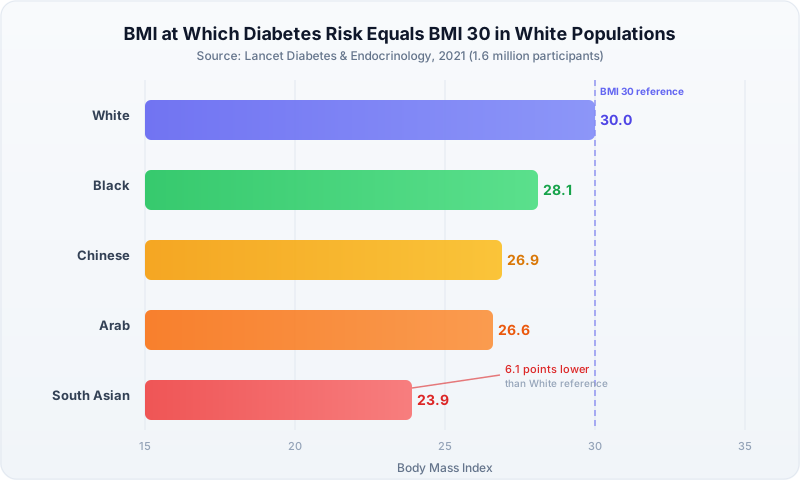
| Population | BMI for equivalent Type 2 diabetes risk |
|---|---|
| White | 30.0 (reference) |
| South Asian | 23.9 |
| Chinese | 26.9 |
| Arab | 26.6 |
| Black | 28.1 |
A South Asian person at BMI 24 faces the same diabetes risk as a white person at BMI 30. The standard "healthy" label at BMI 24 is actively misleading for roughly 2 billion people worldwide.
WHO recommends a lower obesity cutoff of 27.5 for South Asian and Chinese populations, but the Lancet data suggests even that doesn't go far enough.
Who this affects: Anyone of non-European ancestry, particularly South Asian, East Asian, and Middle Eastern populations.
3. Age: The Shifting Composition Problem
Body composition changes predictably with age. Between ages 30 and 70, the average person loses 20-30% of their skeletal muscle while gaining visceral fat. A 65-year-old and a 25-year-old at the same BMI have fundamentally different body compositions.
Research in the International Journal of Behavioral Nutrition and Physical Activity (2025) confirms that BMI systematically underestimates body fat in older adults. An elderly person with a "healthy" BMI of 23 might actually have an unhealthy proportion of fat to muscle.
Conversely, the "obesity paradox" observed in studies shows that older adults with mildly overweight BMIs (25-27) often have lower mortality rates than those at "healthy" BMIs. A systematic review in PMC found this pattern consistently in adults over 65, likely because the extra weight correlates with preserved muscle mass in aging populations.
Who this affects: Adults over 50, particularly those who have lost significant muscle mass.
4. Sex: The Distribution Problem
Women naturally carry 6-11% more body fat than men at the same BMI. But the health risks associated with body fat depend heavily on where it's stored, not just how much exists. Subcutaneous fat (under the skin, common in women's hips and thighs) carries far less metabolic risk than visceral fat (around organs, common in men's abdomens).
BMI captures neither the amount nor the location of fat. A woman with a BMI of 27 carrying subcutaneous fat in her thighs has a different risk profile than a man at BMI 27 carrying visceral fat around his liver, but both get the same "overweight" label.
Who this affects: Everyone, since BMI uses identical cutoffs regardless of sex.
5. The Obesity Paradox: When "Overweight" Lives Longer
A landmark 2013 CDC meta-analysis of 97 studies covering 2.88 million individuals found that overweight people (BMI 25-30) had a 6% lower all-cause mortality rate than those at "healthy" weight. This counterintuitive finding, dubbed the obesity paradox, has sparked intense scientific debate.
Later research clarified the picture. When studies control for smoking, pre-existing illness, and early deaths (which cause weight loss, not the other way around), the paradox largely disappears. But a key insight remains: BMI in the low-healthy range (18.5-21) can signal underlying health problems just as much as a high BMI. The healthiest BMI zone, after adjusting for confounders, is approximately 20-25 for non-smoking adults without chronic disease.
Who this affects: Anyone interpreting a borderline BMI result.
Three Alternatives That Measure What BMI Can't
Body Roundness Index (BRI)
Proposed in 2013 by mathematician Diana Thomas, BRI uses waist circumference and height to model the body as an ellipse. Unlike BMI, it captures central obesity — the visceral fat around your organs that drives metabolic disease.
The formula:
BRI = 364.2 - 365.5 x sqrt(1 - [(Waist in cm / 2pi)^2 / (0.5 x Height in cm)^2])
A 2024 JAMA investigation confirmed that BRI predicts cardiovascular disease and diabetes significantly better than BMI. UCLA Health reports that medical institutions are beginning to phase in BRI alongside BMI in clinical assessments.
Healthy BRI range: 1 to 5.5 (values above 6.9 indicate high mortality risk)
What you need: Just a tape measure and your height. Measure your waist at the navel while standing.
Waist-to-Height Ratio (WHtR)
The simplest alternative: divide your waist circumference by your height. Both measurements in the same unit.
The rule: Keep your waist below half your height.
A meta-analysis in PubMed covering 300,000+ participants found WHtR was a better predictor of cardiometabolic risk than both BMI and waist circumference alone. The Pentagon adopted WHtR as an official body composition standard in 2026, replacing BMI-only assessments for military fitness.
| WHtR | Interpretation |
|---|---|
| Below 0.4 | Possible underweight |
| 0.4 - 0.49 | Healthy |
| 0.5 - 0.59 | Increased risk |
| 0.6+ | High risk |
What you need: A tape measure. Takes 30 seconds.
Body Fat Percentage
The gold standard when accuracy matters. Measured via DEXA scan ($75-150), hydrostatic weighing, or estimated via skinfold calipers.
| Category | Men | Women |
|---|---|---|
| Essential fat | 2-5% | 10-13% |
| Athletic | 6-13% | 14-20% |
| Fit | 14-17% | 21-24% |
| Average | 18-24% | 25-31% |
| Obese | 25%+ | 32%+ |
Body fat percentage solves the muscle-vs-fat problem completely. A bodybuilder at 10% body fat is clearly not "overweight" regardless of what BMI says. The downside is accessibility — DEXA scans aren't free and calipers require practice for accuracy.
What Should You Actually Do With Your BMI?
BMI isn't useless. It's a fast, free screening tool that correlates with health outcomes at the population level. Here's a practical decision framework:
If your BMI is 18.5-24.9 and you're not an athlete or older adult: Your weight is likely in a healthy range. Check your waist-to-height ratio for a second opinion. If WHtR is also below 0.5, you're in good shape.
If your BMI is 25-29.9: Don't panic. Measure your waist-to-height ratio. If WHtR is under 0.5, your risk is likely lower than BMI suggests. If WHtR is over 0.5, the excess weight is probably abdominal and worth addressing.
If your BMI is 30+: This warrants attention regardless of other metrics. While some individuals carry excess weight safely (particularly athletes), most people at BMI 30+ benefit from consultation with a healthcare provider. BMI's false-positive rate drops significantly above 30.
If you're an athlete or strength train regularly: BMI is not for you. Use body fat percentage or WHtR instead. Your BMI will be artificially inflated by muscle mass.
If you're South Asian, East Asian, or Middle Eastern: Use lower cutoffs. A BMI of 23+ warrants the same attention as 25+ in European populations, and 27.5+ carries obesity-level risk.
The Future: Beyond Any Single Number
The 2024 Lancet Commission on obesity recommended that obesity should no longer be diagnosed with BMI alone. Instead, they proposed a multi-metric approach: BMI as initial screening, confirmed by WHtR or BRI, and supplemented by metabolic blood markers (fasting glucose, triglycerides, blood pressure).
No single number captures human health. BMI is a useful starting point — but knowing its blind spots turns it from a potentially misleading label into an actually useful data point.
Frequently Asked Questions
Why was BMI originally created for populations, not individuals?
Adolphe Quetelet developed what he called the "Quetelet Index" in 1832 to describe the "average man" across populations for sociological research. He explicitly stated the formula was not meant for individual medical diagnosis. It became a clinical tool in the 1970s when insurance companies needed a simple metric to assess policyholders. The mathematical convenience of height-squared scaling made it attractive for mass screening, even though its inventor never intended individual application. The formula has not changed since 1832 despite nearly two centuries of advancement in body composition science.
At what body fat percentage does BMI become unreliable?
BMI accuracy degrades significantly when body fat deviates from the population average for a given height-weight combination. For men under 15% or over 30% body fat, BMI misclassification rates exceed 40%. For women, the thresholds are under 22% or over 38%. A practical test: if your waist-to-height ratio and your BMI suggest different categories (one says healthy, the other says overweight), your BMI is likely the less accurate reading. Roughly 30% of people classified as "healthy" by BMI actually have body fat percentages in the obese range, a condition researchers call "normal weight obesity."
How do the new ethnicity-specific BMI cutoffs change clinical recommendations?
The Lancet 2021 data shows South Asian populations face equivalent diabetes risk at BMI 23.9 compared to BMI 30 in white populations, a difference of 6 full BMI points. Clinically, this means a South Asian patient at BMI 24 should receive the same screening and intervention recommendations that a white patient receives at BMI 30: glucose testing, lipid panels, blood pressure monitoring, and lifestyle counseling. Some health systems in the UK and Singapore have already adopted lower cutoffs, but most US healthcare providers still use the universal 25/30 thresholds because updated clinical guidelines haven't been formally issued by the CDC.
Can the Body Roundness Index actually replace BMI in clinical practice?
BRI faces two practical hurdles despite its superior predictive accuracy. First, waist circumference measurement is more variable than weight measurement because it depends on measurement technique, breathing phase, and examiner consistency. A study found inter-observer waist measurement variation of up to 4 cm, which can shift BRI by 0.5-1.0 points. Second, BRI lacks the 50+ years of epidemiological data that BMI has accumulated, meaning risk thresholds are less well-established. The most likely near-term outcome is BRI and WHtR being used alongside BMI rather than replacing it entirely. UCLA Health and several European hospital systems are already piloting dual-metric screening protocols.
What explains the obesity paradox, where overweight people sometimes live longer?
Three factors explain most of the paradox. First, reverse causation: serious illnesses like cancer and heart failure cause weight loss before diagnosis, making thin people appear sicker in studies that don't account for pre-existing conditions. Second, collider bias: studies that start with people already diagnosed with disease inadvertently select for overweight individuals who are otherwise healthier than their thin counterparts. Third, the "metabolically healthy overweight" phenotype: roughly 30% of people with BMI 25-30 have normal blood pressure, glucose, triglycerides, and inflammation markers. When researchers remove smokers, people with chronic disease, and early deaths from analysis, the survival advantage of being overweight drops to zero or reverses.
Is the BMI formula being updated or replaced in 2026?
No single replacement has been adopted universally, but the landscape is shifting. The Pentagon switched to waist-to-height ratio for military body composition assessments in 2026. The Lancet Commission recommended multi-metric diagnosis in 2024. BRI is being piloted in clinical settings. The most practical change for individuals: use WHtR (waist divided by height, target below 0.5) as a free, immediate second opinion alongside BMI. It takes 30 seconds with a tape measure and captures the central obesity information that BMI completely misses.
Related Resources
- TDEE Explained: How Daily Energy Expenditure Drives Weight Change - Understanding the calories behind weight management
- Body Fat Percentage: What the Ranges Actually Mean - Go beyond BMI with body composition analysis
- Ideal Weight Guide: What Science Says About Healthy Ranges - Research-backed weight targets by height and frame
- Calorie Deficit Complete Guide - Evidence-based approaches to weight loss
- Waist-to-Height Ratio Calculator - The 30-second alternative to BMI
This article is provided for informational and educational purposes only. Content should not be considered professional financial, medical, legal, or other advice. Always consult a qualified professional before making important decisions. UseCalcPro is not responsible for any actions taken based on the information in this article.
Try These Calculators
Check your BMI and see which weight category you fall into based on WHO standards. View health ranges, get personal recommendations, and track your metrics.
Measure your waist-to-height ratio to assess central obesity and cardiovascular risk. Enter waist and height for an instant WHtR score with health category.
Calculate your Body Roundness Index from height and waist circumference. BRI assesses body shape and visceral fat risk more accurately than BMI alone.
Look up your ideal body weight using Devine, Robinson, Miller, and Hamwi formulas. Compare results across all four clinical equations in a single report.
Horse blanket size chart and calculator by body measurement. Find the right fit and fill weight for turnout, stable, and sheet blankets by temperature range.