One Rep Max Calculator: How to Find Your 1RM for Any Lift
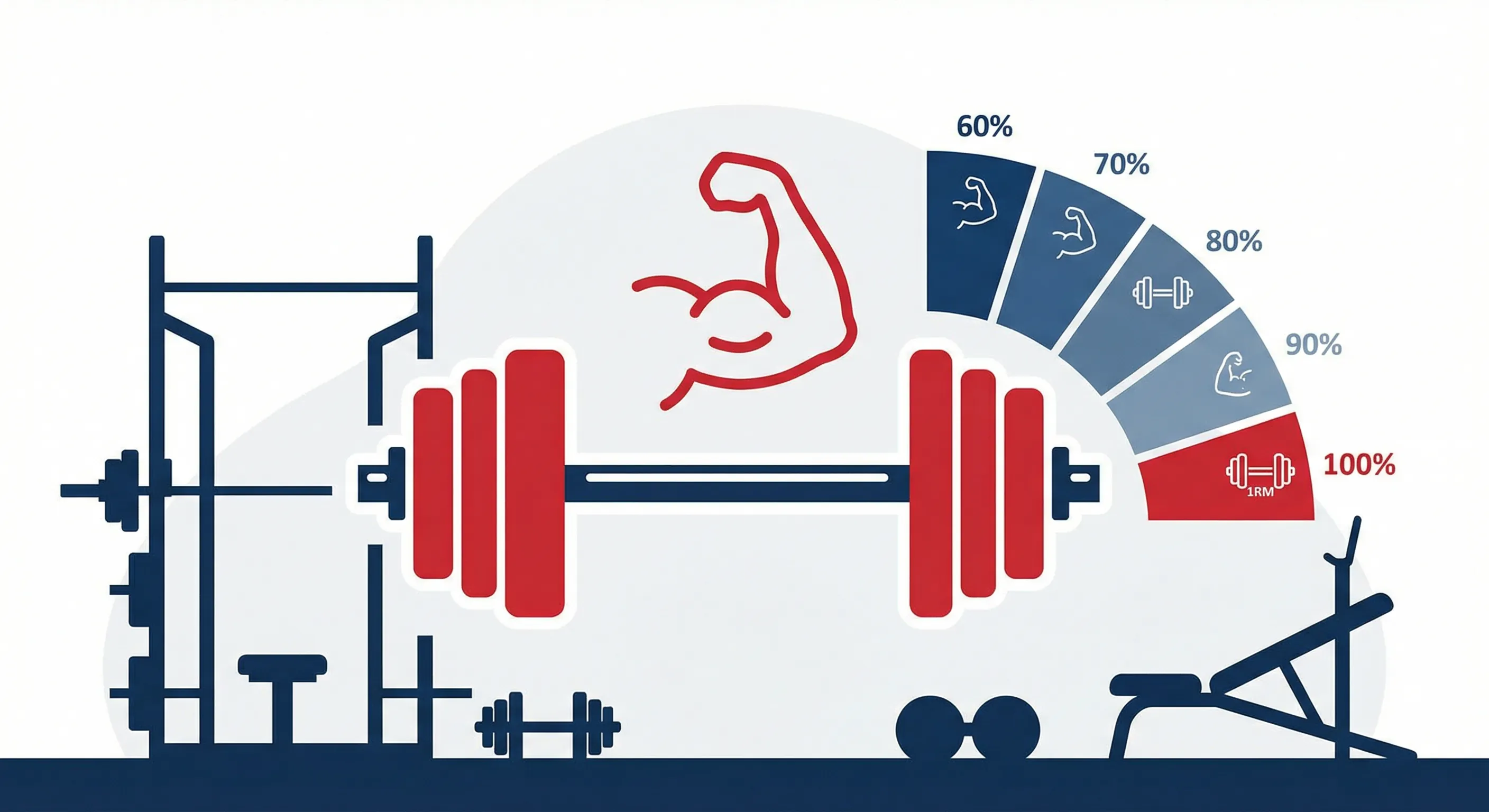
Your one rep max (1RM) is the maximum weight you can lift for a single repetition with proper form. Rather than actually testing your max (risky without experience), you can estimate it from submaximal lifts. If you can bench press 185 lbs for 5 reps, your estimated 1RM is approximately 208 lbs.
Knowing your 1RM changes how you program every workout. A lifter with several years of consistent training might land on estimated maxes like a 315-lb bench press, a 425-lb squat, and a 495-lb deadlift, all calculated from submaximal sets rather than risky true max attempts. Pairing 1RM-based programming with proper protein intake is often what pushes a bench press past a long-standing plateau — for example, breaking through a 300-lb sticking point after two years of stalling.
Use our One Rep Max Calculator to estimate your max from any weight and rep combination.
What Is One Rep Max (1RM)?
Your 1RM represents your maximum strength for a specific lift. It's the foundation for:
- Programming training weights (percentages of 1RM)
- Tracking strength progress over time
- Comparing strength between lifters (relative to bodyweight)
- Setting realistic goals for strength development
Why Estimate Instead of Test?
| Actual 1RM Testing | Estimated 1RM |
|---|---|
| High injury risk | Low risk |
| Requires spotters/safety | Can do alone |
| Very fatiguing | Part of normal training |
| Needs peak conditions | Anytime estimate |
| Infrequent testing | Track weekly |
Warning
1RM testing is risky for beginners. True max attempts require proper technique, adequate warm-up, safety equipment, and ideally spotters. Estimation from submaximal work is safer and nearly as accurate.
How to Calculate Your One Rep Max
The Brzycki Formula (Most Popular)
The most widely used 1RM estimation formula:
1RM = Weight × (36 / (37 - Reps))
Example (185 lbs for 5 reps):
1RM = 185 × (36 / (37 - 5))
1RM = 185 × (36 / 32)
1RM = 185 × 1.125
1RM = 208 lbs
The Epley Formula
Another common formula, particularly good for higher rep ranges:
1RM = Weight × (1 + (Reps / 30))
Same example:
1RM = 185 × (1 + (5 / 30))
1RM = 185 × 1.167
1RM = 216 lbs
Comparing Popular Formulas
Different formulas produce slightly different results:
| Formula | 185 lbs × 5 reps | Best For |
|---|---|---|
| Brzycki | 208 lbs | 1-10 rep range |
| Epley | 216 lbs | Higher rep ranges |
| Lander | 209 lbs | General purpose |
| O'Conner | 208 lbs | Simpler calculation |
Our calculator uses multiple formulas and averages them for the most accurate estimate.
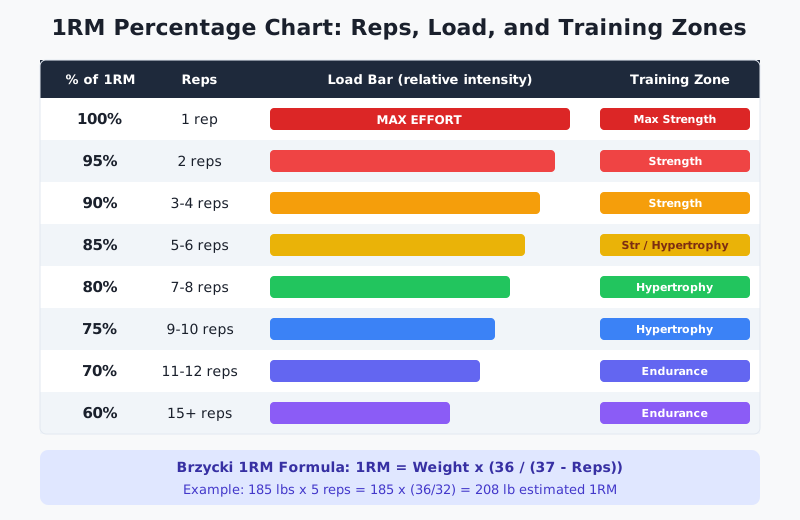
1RM Percentage Chart
Use percentages of your 1RM to program training:
| % of 1RM | Approx Reps | Training Goal |
|---|---|---|
| 100% | 1 | Max testing only |
| 95% | 2 | Strength/power |
| 90% | 3-4 | Strength |
| 85% | 5-6 | Strength/hypertrophy |
| 80% | 7-8 | Hypertrophy/strength |
| 75% | 9-10 | Hypertrophy |
| 70% | 11-12 | Hypertrophy/endurance |
| 65% | 13-15 | Muscular endurance |
| 60% | 16-20 | Endurance/warm-up |
| 50% | 20+ | Warm-up/recovery |
Example Training Weights
If your bench press 1RM is 225 lbs:
| % of 1RM | Weight | Reps |
|---|---|---|
| 95% | 214 lbs | 2 |
| 90% | 203 lbs | 3-4 |
| 85% | 191 lbs | 5-6 |
| 80% | 180 lbs | 7-8 |
| 75% | 169 lbs | 9-10 |
| 70% | 158 lbs | 11-12 |
Tip
For hypertrophy (muscle building), work in the 65-85% range. For pure strength, focus on 85-95%. Most programs cycle through ranges for well-rounded development.
How to Test Your Estimated 1RM
To get an accurate estimate, you need a clean set at a challenging weight:
Step 1: Choose Your Test Weight
Select a weight you can do for 3-8 reps. Fewer reps (3-5) gives more accurate estimates for strength-focused lifters; more reps (6-8) works for those focused on hypertrophy.
Step 2: Warm Up Properly
Sample warm-up for a 185 lb test set:
| Set | Weight | Reps | Purpose |
|---|---|---|---|
| 1 | Bar (45 lbs) | 10 | Movement pattern |
| 2 | 95 lbs | 8 | Light warm-up |
| 3 | 135 lbs | 5 | Moderate warm-up |
| 4 | 155 lbs | 3 | Heavy warm-up |
| 5 | 175 lbs | 1-2 | Final prep |
| Test | 185 lbs | AMRAP | As many reps as possible |
Step 3: Perform Your Test Set
- Use strict form throughout
- Stop when form breaks down
- Don't grind ugly reps just to add numbers
- Record the weight and clean reps completed
Step 4: Calculate
Plug your weight and reps into the formula or use our One Rep Max Calculator.
1RM Standards by Lift
Here are approximate 1RM standards for adult males by experience level:
Bench Press (Male)
| Bodyweight | Beginner | Intermediate | Advanced | Elite |
|---|---|---|---|---|
| 150 lbs | 110 lbs | 150 lbs | 200 lbs | 275 lbs |
| 175 lbs | 130 lbs | 175 lbs | 235 lbs | 315 lbs |
| 200 lbs | 150 lbs | 200 lbs | 265 lbs | 350 lbs |
Squat (Male)
| Bodyweight | Beginner | Intermediate | Advanced | Elite |
|---|---|---|---|---|
| 150 lbs | 135 lbs | 200 lbs | 280 lbs | 380 lbs |
| 175 lbs | 160 lbs | 235 lbs | 325 lbs | 435 lbs |
| 200 lbs | 185 lbs | 270 lbs | 370 lbs | 485 lbs |
Deadlift (Male)
| Bodyweight | Beginner | Intermediate | Advanced | Elite |
|---|---|---|---|---|
| 150 lbs | 155 lbs | 235 lbs | 335 lbs | 455 lbs |
| 175 lbs | 185 lbs | 275 lbs | 390 lbs | 520 lbs |
| 200 lbs | 215 lbs | 315 lbs | 440 lbs | 580 lbs |
Standards for Women
Women's 1RM standards are typically 50-70% of male standards for upper body lifts and 70-85% for lower body lifts. Relative strength (compared to bodyweight) is often more appropriate for comparison.
Info
These are guidelines, not requirements. Genetics, training age, limb lengths, and individual factors all affect strength. Focus on your personal progress rather than comparisons.
Using 1RM for Program Design
Linear Progression (Beginners)
Add weight each session while staying in your rep range:
Week 1: 135 lbs × 5 reps Week 2: 140 lbs × 5 reps Week 3: 145 lbs × 5 reps
When you can no longer add weight and hit target reps, recalculate 1RM.
Percentage-Based Programming
More advanced lifters use percentages:
Example 4-Week Strength Block:
| Week | Monday (Heavy) | Thursday (Volume) |
|---|---|---|
| 1 | 85% × 3 × 5 sets | 70% × 8 × 4 sets |
| 2 | 87% × 3 × 5 sets | 72% × 8 × 4 sets |
| 3 | 90% × 2 × 5 sets | 75% × 6 × 4 sets |
| 4 | Deload: 60% × 5 × 3 sets | Rest |
RPE-Based Training
Rate of Perceived Exertion (RPE) uses your daily performance:
| RPE | Description | Reps in Reserve |
|---|---|---|
| 10 | Absolute max | 0 reps left |
| 9 | Very hard | 1 rep left |
| 8 | Hard | 2-3 reps left |
| 7 | Moderate | 4+ reps left |
Advantage: Accounts for daily performance fluctuations without rigid percentages.
When to Retest Your 1RM
Signs Your Estimated 1RM Has Changed
- Hitting more reps than expected at current weights
- Weights feeling easier than prescribed RPE
- Completing all sets and reps easily
- 8+ weeks since last estimate
How Often to Estimate
| Training Level | Retest Frequency |
|---|---|
| Beginner | Monthly (rapid gains) |
| Intermediate | Every 8-12 weeks |
| Advanced | Every 12-16 weeks |
Tip
Don't chase 1RM increases obsessively. Strength gains aren't linear. Plateaus are normal and temporary. Focus on consistent training, not weekly max testing.
Common 1RM Mistakes
Mistake 1: Testing Too Often
Problem: Frequent maxing is fatiguing and injury-prone, plus it doesn't accurately reflect true max when fatigued.
Solution: Estimate from submaximal work. Save actual max attempts for competitions or every few months.
Mistake 2: Using High Rep Sets
Problem: Formulas become less accurate above 10 reps due to muscular endurance factors.
Solution: Test with weights you can do for 3-8 reps for the most accurate estimates.
Mistake 3: Counting Bad Reps
Problem: Including grinding, ugly reps inflates your estimate and doesn't reflect true strength.
Solution: Only count reps with good form. Stop when technique breaks down.
Mistake 4: Not Warming Up Properly
Problem: Cold muscles underperform. A rushed warm-up means lower reps and underestimated max.
Solution: Take 10-15 minutes to progressively warm up to your test weight.
How to Use Our One Rep Max Calculator
Our One Rep Max Calculator provides instant estimates:
- Enter the weight lifted — in pounds or kilograms
- Enter reps completed — clean reps with good form
- Get your estimated 1RM — calculated using multiple formulas
- View percentage breakdown — training weights for every percentage
The calculator also shows:
- Multiple formula results for comparison
- Training weight recommendations
- Rep ranges for different percentages
Frequently Asked Questions
How accurate is the one rep max calculator?
1RM calculators are most accurate in the 1-10 rep range, typically within 5% of your true max. Accuracy decreases with higher rep counts due to muscular endurance variables. Using the average of multiple formulas improves accuracy.
Can I calculate 1RM from high reps?
You can, but accuracy decreases significantly above 10 reps. A 20-rep set involves significant endurance factors that don't reflect maximal strength. Stick to 3-8 reps for reliable estimates.
How often should I test my 1RM?
Estimate your 1RM every 4-12 weeks depending on training level. Beginners see rapid changes (test monthly); advanced lifters can go 3-4 months between estimates. Actual max attempts should be rare.
What percentage of 1RM should I train at?
For strength: 80-95% of 1RM for 1-5 reps. For hypertrophy: 65-80% for 6-12 reps. For endurance: 50-65% for 12+ reps. Most programs include variety across these ranges.
Why is my actual max lower than my calculated max?
Common reasons: technique breaks down under maximal loads, you're not peaked for max attempts, mental factors, or your submaximal sets were done with extra reserves. Calculated maxes are estimates, not guarantees.
Should beginners use 1RM calculations?
Beginners benefit more from submaximal training in the 8-12 rep range with progressive overload. 1RM calculations become more useful once technique is solid and weights are meaningful.
Related Calculators
- Calories Burned Calculator — Track calories burned during workouts
- Protein Calculator — Calculate protein needs for muscle building
- Macro Calculator — Plan your nutrition for strength gains
- Macro Calculator Guide — Learn how to calculate macros for cutting and bulking
Conclusion
Your one rep max is a valuable training tool, but you don't need to actually test it frequently. Using submaximal sets and proven formulas gives you accurate estimates that you can use for programming without the injury risk of max attempts.
Use our One Rep Max Calculator to estimate your max and get percentage-based training weights instantly. Remember: the goal isn't to have a high number — it's to use that number to train smarter and get stronger over time. Pair your strength programming with proper nutrition by tracking your calories burned during sessions.
Strength standards and calculations are estimates for educational purposes. Individual results vary based on training experience, genetics, technique, and recovery. Consult a qualified coach or trainer for personalized programming.
This article is provided for informational and educational purposes only. Content should not be considered professional financial, medical, legal, or other advice. Always consult a qualified professional before making important decisions. UseCalcPro is not responsible for any actions taken based on the information in this article.
Try These Calculators
Estimate your one rep max from any submaximal lift using Epley, Brzycki, and Lander formulas. Get a full percentage chart for programming your training loads.
Select an activity, enter your weight and duration, and see exactly how many calories you burned. Covers running, walking, cycling, swimming, and more.
Check your BMI and see which weight category you fall into based on WHO standards. View health ranges, get personal recommendations, and track your metrics.
Estimate your VO2 max from resting and maximum heart rate. See your cardiovascular fitness level and how it compares to age-based benchmarks for your group.
Calculate your walking and running stride length from height and gender. Get steps per mile, steps per kilometer, and distance covered in 10,000 steps.