Calorie Deficit: Complete Guide to Losing Weight Safely and Effectively
Weight loss attempts often follow a familiar pattern: trying everything from keto to juice cleanses to the cabbage soup diet, losing weight, then gaining it back plus a few extra pounds.
The science of energy balance changes that pattern. Not a fad. Not a shortcut. Just math that actually works. A sustainable calorie deficit can produce results like 35 pounds lost over 8 months and kept off long-term, because the underlying math -- not willpower -- is what holds.
This guide lays out that calorie deficit explanation clearly, from the ground up.
How Many Calories to Lose Weight?
Calculate Your Daily Calories →
Use our free calorie calculator to instantly determine your daily calorie needs for weight loss, maintenance, or muscle gain. You can also check your TDEE (Total Daily Energy Expenditure) for more detailed insights.
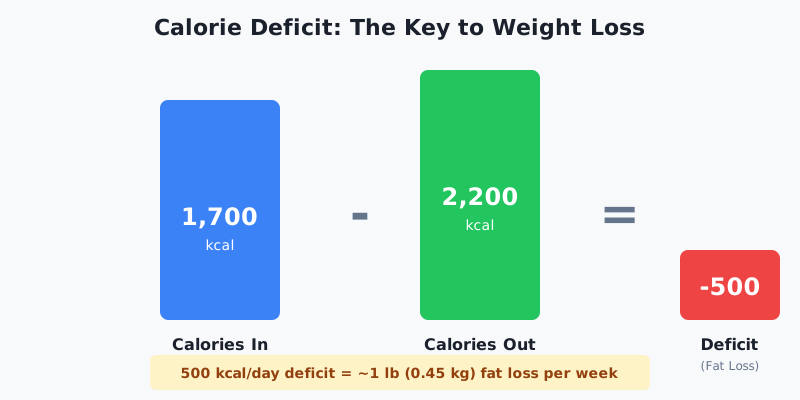
A calorie deficit occurs when you consume fewer calories than your body burns. To lose 1 pound (0.45 kg) of body fat per week, you need a deficit of approximately 500 calories per day (3,500 calories per week). For example, if your body burns 2,200 calories daily, eating 1,700 calories creates a 500-calorie deficit, resulting in steady, sustainable weight loss.
Tip
Start with a moderate deficit of 300-500 calories per day. Cutting 1,200 calories right out of the gate is a common mistake -- it typically leads to exhaustion, irritability, and quitting within a few weeks. A 450-calorie deficit feels far more sustainable by comparison and is much easier to stick with.
What is a Calorie Deficit?
A calorie deficit is the foundation of all weight loss. According to the National Institutes of Health, when you consume fewer calories than your body needs for daily functions and activities, it must use stored energy (primarily body fat) to make up the difference.
Your body burns calories through three main processes:
- Basal Metabolic Rate (BMR): Calories burned at complete rest (60-70% of total)
- Thermic Effect of Food (TEF): Calories burned digesting food (10% of total)
- Physical Activity: Calories burned through movement and exercise (20-30% of total)
For a detailed explanation of how your body burns calories at rest, see our guide: Understanding Your BMR (Basal Metabolic Rate)
The combination of these three factors is your Total Daily Energy Expenditure (TDEE) - the total number of calories you burn in a day. To lose weight, you must consume fewer calories than your TDEE.
How to Calculate Your Calorie Deficit
Calculating the right calorie deficit involves two steps: finding your TDEE and subtracting an appropriate amount.
Step 1: Calculate Your TDEE
Your TDEE (Total Daily Energy Expenditure) represents all calories burned in a day. For a complete guide on calculating your TDEE, see: TDEE Calculator: How to Calculate Your Daily Calorie Burn
Quick TDEE Estimate:
| Activity Level | Multiplier | Example (BMR 1,600) |
|---|---|---|
| Sedentary (desk job, little exercise) | BMR × 1.2 | 1,920 calories |
| Lightly Active (1-3 workouts/week) | BMR × 1.375 | 2,200 calories |
| Moderately Active (3-5 workouts/week) | BMR × 1.55 | 2,480 calories |
| Very Active (6-7 workouts/week) | BMR × 1.725 | 2,760 calories |
| Extremely Active (athlete) | BMR × 1.9 | 3,040 calories |
Step 2: Choose Your Deficit Level
Once you know your TDEE, subtract calories to create your deficit:
| Deficit Level | Daily Deficit | Weekly Loss | Best For |
|---|---|---|---|
| Small | 250 calories | 0.5 lb (0.23 kg) | Long-term sustainability, athletes |
| Moderate | 500 calories | 1 lb (0.45 kg) | Most people, balanced approach |
| Aggressive | 750 calories | 1.5 lb (0.68 kg) | Short-term, supervised programs |
| Extreme | 1,000+ calories | 2+ lb (0.9 kg) | Not recommended for most people |
Example Calculation
Let's calculate the ideal deficit for Sarah, a 35-year-old woman:
- Weight: 170 lbs (77 kg)
- Height: 5'5" (165 cm)
- Activity: Lightly active (works out 3x/week)
- BMR: 1,480 calories
- TDEE: 1,480 × 1.375 = 2,035 calories
For 1 lb/week weight loss:
- Target calories: 2,035 - 500 = 1,535 calories/day
Important
Never go below 1,200 calories (women) or 1,500 calories (men) without medical supervision. Very low calorie diets can cause nutrient deficiencies, muscle loss, and metabolic slowdown.
How Much Weight Can You Lose?
Weight loss rate depends on your deficit size and starting point. Here's what realistic progress looks like:
Safe Weekly Weight Loss Rates:
- 1% of body weight per week is the maximum recommended for most people
- A 200 lb person: up to 2 lbs/week
- A 150 lb person: up to 1.5 lbs/week
Realistic Timeline:
| Starting Weight | Goal | Weekly Loss | Time to Goal |
|---|---|---|---|
| 200 lbs → 170 lbs | 30 lbs | 1-1.5 lbs | 20-30 weeks |
| 180 lbs → 160 lbs | 20 lbs | 1 lb | 20 weeks |
| 160 lbs → 145 lbs | 15 lbs | 0.5-1 lb | 15-30 weeks |
Info
The scale isn't everything. Water weight, muscle gain, hormonal fluctuations, and digestive contents can cause daily weight swings of 2-5 lbs. Focus on weekly averages and long-term trends.
Creating Your Deficit: Eat Less vs. Move More
You can create a calorie deficit through diet, exercise, or a combination of both.
Option 1: Diet Only
500-calorie deficit through eating less:
- Skip the 300-calorie morning latte
- Choose grilled chicken (200 cal) instead of fried (400 cal)
- Use a smaller plate to reduce portions by 20%
Pros: Faster results, doesn't require gym time Cons: Can feel restrictive, may lose more muscle
Option 2: Exercise Only
500-calorie deficit through exercise:
- 60 minutes of brisk walking: 300 calories
- 30 minutes of running: 400 calories
- 45 minutes of cycling: 350 calories
Pros: Can eat more, builds muscle, improves fitness Cons: Time-consuming, easy to overeat, can increase hunger
Option 3: Combined Approach (Recommended)
500-calorie deficit through diet + exercise:
- Eat 300 fewer calories
- Burn 200 extra calories through exercise
Pros: Most sustainable, preserves muscle, flexible approach Cons: Requires tracking both food and activity
Tip
The 80/20 rule works well for most people. Get 80% of your deficit from diet and 20% from exercise. This makes weight loss more manageable without excessive food restriction or workout demands.
What to Eat in a Calorie Deficit
When calories are limited, food quality becomes crucial. Focus on foods that keep you full and satisfied.
High-Satiety Foods (Eat More)
| Food Category | Examples | Why They Work |
|---|---|---|
| Lean Protein | Chicken, fish, eggs, Greek yogurt | Keeps you full longer, preserves muscle |
| Vegetables | Broccoli, spinach, peppers, zucchini | High volume, very low calories |
| Whole Grains | Oats, quinoa, brown rice | Fiber slows digestion |
| Legumes | Lentils, beans, chickpeas | Protein + fiber combination |
| Fruits | Berries, apples, oranges | Natural sweetness, fiber |
For detailed guidance on protein intake during weight loss, see: Protein Intake Guide: How Much Protein Do You Really Need?
Low-Satiety Foods (Limit)
| Food Category | Examples | Why to Limit |
|---|---|---|
| Liquid Calories | Sodas, juices, alcohol | No satiety, easy to overconsume |
| Ultra-Processed | Chips, cookies, fast food | Engineered to make you eat more |
| Refined Carbs | White bread, pastries | Spike blood sugar, then crash |
| High-Fat Snacks | Cheese, nuts (in excess) | Calorie-dense, easy to overeat |
Sample Day at 1,500 Calories
| Meal | Food | Calories |
|---|---|---|
| Breakfast | 2 eggs, 1 slice whole wheat toast, 1 cup spinach | 280 |
| Snack | Greek yogurt (150g) with berries | 150 |
| Lunch | Grilled chicken salad with olive oil dressing | 400 |
| Snack | Apple with 1 tbsp almond butter | 170 |
| Dinner | Salmon (150g), roasted vegetables, quinoa (½ cup) | 500 |
| Total | 1,500 |
For a complete guide on tracking your macronutrients, see: Macro Tracking Guide: Count Macros for Better Results
Common Mistakes and How to Avoid Them
Mistake 1: Deficit Too Large
Problem: Cutting too many calories leads to muscle loss, metabolic adaptation, extreme hunger, and eventual binging.
Solution: Start with a moderate 300-500 calorie deficit. If you're constantly hungry, tired, or losing more than 1% of body weight weekly, reduce your deficit.
Mistake 2: Not Counting Accurately
Problem: Studies show people underestimate calorie intake by 30-50%. That "500-calorie" meal might actually be 800 calories.
Solution: Use a food scale for at least 2 weeks to learn portion sizes. Track everything, including cooking oils, sauces, and beverages.
Mistake 3: Weekend Overeating
Problem: A 500-calorie daily deficit (Mon-Fri) can be wiped out by two days of overeating (Sat-Sun).
Weekly Example:
- Monday-Friday: 1,500 cal × 5 = 7,500 calories
- Saturday: 2,800 calories (party, drinks)
- Sunday: 2,500 calories (brunch, comfort food)
- Weekly total: 12,800 calories
- Daily average: 1,829 calories (no deficit!)
Solution: Plan for flexibility. Save calories during the week for weekend events, or practice moderation rather than restriction.
Mistake 4: Ignoring Protein
Problem: Low protein intake during a deficit leads to muscle loss, slower metabolism, and increased hunger.
Solution: Aim for 0.7-1g of protein per pound of body weight. A 160 lb person needs 112-160g of protein daily.
Warning
Muscle loss slows your metabolism permanently. Protecting muscle mass during weight loss is crucial for long-term success. Prioritize protein and resistance training.
Mistake 5: Expecting Linear Progress
Problem: Weight loss isn't linear. Plateaus, fluctuations, and stalls are normal and don't mean your diet isn't working.
Solution: Focus on 4-week averages, not daily weigh-ins. If you've truly stalled for 3+ weeks, adjust calories down by 100-200 or increase activity slightly.
When to Adjust Your Deficit
Your calorie needs decrease as you lose weight. A 200 lb person burns more calories than a 160 lb person doing the same activities.
Signs You Need to Adjust
- Weight loss has stalled for 3+ weeks (and you're tracking accurately)
- You've lost 10+ lbs since starting
- Your activity level has changed significantly
How to Recalculate
- Recalculate your BMR with your new weight
- Multiply by activity factor to get new TDEE
- Subtract your deficit for new target calories
Example:
- Starting: 180 lbs, TDEE 2,400, eating 1,900 (500 deficit)
- After 20 lbs lost: 160 lbs, new TDEE ~2,200
- New target: 1,700 calories for same 500-calorie deficit
For help determining your goal weight, see: Ideal Weight Guide: How to Find Your Target Weight
Maintaining Your Progress
Weight maintenance is where most diets fail. After reaching your goal, you must transition carefully.
Reverse Dieting
Instead of immediately returning to higher calories, add them back gradually:
- Week 1-2: Add 100 calories
- Week 3-4: Add another 100 calories
- Continue until reaching maintenance TDEE
This approach helps prevent rapid weight regain and gives your metabolism time to adjust.
Long-Term Habits
- Continue tracking (at least periodically) to stay aware
- Keep protein high to maintain muscle
- Stay active - exercise prevents weight regain
- Weigh yourself weekly to catch small gains early
- Have a plan for when weight creeps up
Success
Maintenance is a lifelong practice, not a destination. People who maintain weight loss successfully treat it as an ongoing process, not something they "finish."
Frequently Asked Questions
How long does it take to see results from a calorie deficit?
You may notice changes in 1-2 weeks, but visible results typically take 4-8 weeks. Water weight changes can mask fat loss initially, so take progress photos and measurements alongside weighing yourself.
Can you lose weight without counting calories?
Yes, but it's less precise. Strategies like portion control, mindful eating, and eliminating processed foods can create a natural deficit. However, counting calories is more reliable for consistent results.
Is 1,200 calories enough?
For most adults, 1,200 calories is the absolute minimum and often too low. Very low calorie diets should only be followed under medical supervision. Most women should aim for 1,400-1,600 minimum; men should aim for 1,600-1,800 minimum.
Why am I not losing weight in a calorie deficit?
Common reasons include: inaccurate calorie tracking, underestimating portions, not counting liquid calories, weekend overeating, or metabolic adaptation. Try tightening your tracking accuracy before cutting calories further.
Should I eat back exercise calories?
Generally, no. Exercise calorie estimates are often inflated by 20-50%. If you do eat back some calories, start with eating only half of what your tracker estimates you burned.
How do I know if my deficit is too aggressive?
Warning signs include: constant hunger, fatigue, irritability, poor sleep, hair loss, loss of menstrual cycle (women), decreased strength in the gym, and thinking about food constantly.
Conclusion
A calorie deficit is the foundation of weight loss, but the key is creating a sustainable deficit you can maintain. Start with a moderate 300-500 calorie deficit, prioritize protein to preserve muscle, and adjust as you progress.
Use our Calorie Calculator to determine your personalized daily calorie target. Combine this with our TDEE Calculator for a complete picture of your energy needs.
Remember: the best deficit is one you can stick to long-term. Consistency over months will always beat perfection over days.
This article is provided for informational and educational purposes only. Content should not be considered professional financial, medical, legal, or other advice. Always consult a qualified professional before making important decisions. UseCalcPro is not responsible for any actions taken based on the information in this article.
Try These Calculators
Find out how many calories you need each day for weight loss, maintenance, or muscle gain. Personalized TDEE results using the Mifflin-St Jeor equation.
Set your calorie deficit and get protein, carb, and fat targets tuned for fat loss. Adjusts macros to preserve muscle while cutting with IIFYM flexibility.
Calculate your cat's daily calorie needs based on weight, age, body condition, and activity level. Get dry food cups, wet food cans, and protein targets.
Calculate how many treats your dog can have per day using the 10% calorie rule. Get daily treat limits by weight, homemade treat calories, and safe portions.
Find out how many calories your dog or cat needs each day. Enter pet weight, age, and activity level to get daily feeding amounts in cups, grams, and kcal.