Pizza Dough by Weight: Hydration, Fermentation & Style Guide for Home Ovens
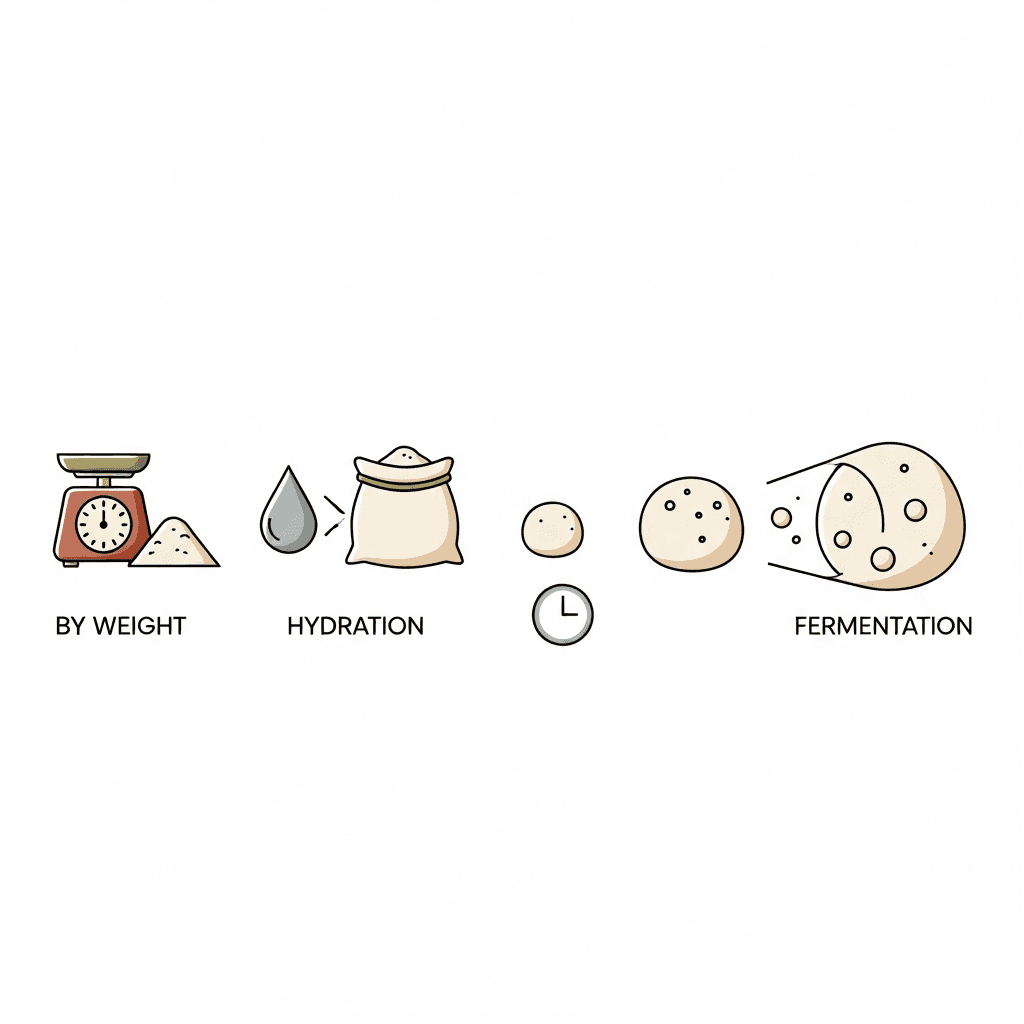
Pizza dough is a four-ingredient formula where small percentage changes produce dramatically different results. A 12-inch Neapolitan pizza needs 250g of dough at 62% hydration, while the same size New York slice requires 280g at 63% hydration with added oil and sugar. The difference between a puffy, charred Neapolitan rim and a foldable New York slice isn't talent or a secret recipe — it's baker's percentage math. Cold-fermenting that dough for 24-72 hours in your fridge then develops flavor compounds that same-day dough simply cannot produce, including reduced glycemic response according to a 2025 PMC study on Neapolitan pizza digestibility.
At UseCalcPro, we built our pizza dough calculator after watching thousands of home bakers guess at ingredient amounts with cup measurements — and consistently end up with dough that's either too wet to shape or too dry to stretch. One cup of flour can swing by 30 grams depending on how you scoop, which shifts hydration by 5% or more. That's the difference between a workable dough and a sticky mess.
This guide covers the science behind each number: what hydration does to crumb structure, how fermentation time and temperature interact to build flavor, which flour to choose for each style, and how to diagnose and fix the most common dough problems.
Calculate Your Recipe
Baker's Percentages: How the Math Works
Baker's percentage is the professional standard for writing dough formulas. Flour is always 100%, and every other ingredient is expressed as a percentage of flour weight. A Neapolitan recipe with 62% hydration means 62 grams of water for every 100 grams of flour — regardless of batch size.
This system exists because it scales perfectly. Making 2 pizzas or 20, the ratios stay identical. You just set your flour weight and multiply.
The Formula
Step 1: Determine total dough weight. Multiply dough ball weight by the number of pizzas:
4 Neapolitan pizzas at 12 inches = 250g x 4 = 1,000g total dough
Step 2: Calculate flour weight. Divide total dough by the sum of all baker's percentages:
Neapolitan total percentage = 100 + 62 + 3 + 0.3 = 165.3% Flour = 1,000 x (100 / 165.3) = 605g
Step 3: Calculate each ingredient by multiplying flour weight by its percentage:
Water = 605 x 0.62 = 375g Salt = 605 x 0.03 = 18g Yeast = 605 x 0.003 = 1.8g
Baker's Percentages by Pizza Style
Each style has a distinct formula optimized for its characteristic texture and baking method:
| Ingredient | Neapolitan | New York | Thin & Crispy | Deep Dish | Sicilian |
|---|---|---|---|---|---|
| Flour | 100% | 100% | 100% | 100% | 100% |
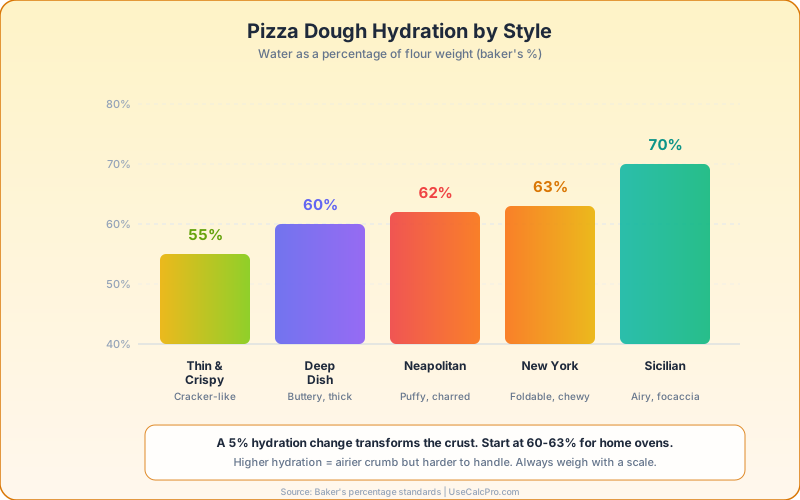
| Water | 62% | 63% | 55% | 60% | 70% |
| Salt | 3% | 2.5% | 2% | 2% | 2% |
| Yeast | 0.3% | 0.5% | 1% | 1% | 1% |
| Oil | 0% | 3% | 3% | 8% | 5% |
| Sugar | 0% | 2% | 0% | 1% | 0% |
| Total | 165.3% | 171% | 161% | 172% | 178% |
Tip
Why does Neapolitan use only 0.3% yeast? Because it cold-ferments for 24-72 hours. Less yeast + more time = more complex flavor. If you're making same-day dough, bump yeast to 1% and let it rise 2-4 hours at room temperature.
Hydration: The Number That Controls Your Crust
Hydration percentage is the single most impactful variable in your dough. A change of just 5 percentage points transforms the result.
What Each Hydration Range Produces
55-58% hydration creates a stiff, dry dough that rolls easily and bakes into a crispy, cracker-like crust. This is thin crust territory. The dough holds its shape aggressively and is the most forgiving to work with — perfect for beginners.
60-63% hydration is the classic pizza range. Neapolitan and New York styles live here. The dough is pliable enough to stretch by hand but firm enough to hold toppings without sagging. You get moderate air bubbles in the rim (cornicione) and a pleasant chew.
65-70% hydration produces softer, more open textures. Sicilian pizza uses 70%, creating a focaccia-like crumb with large irregular holes. This range requires more handling skill — the dough sticks to surfaces and needs generous flour or oil for shaping.
Above 70% enters artisan bread territory. The dough behaves more like a batter and demands stretch-and-fold techniques rather than traditional kneading. You won't typically see this in pizza unless you're making a pan-style with very long fermentation.
Why Water Changes Crust Texture
The mechanism is gluten geometry. Gluten proteins form a mesh network when hydrated. At low hydration, this mesh is tight and dense — gas bubbles from fermentation can't expand much before hitting resistance, producing a compact crumb. At higher hydration, protein strands are farther apart, allowing gas bubbles to inflate larger before the structure constrains them.
Higher hydration also increases enzymatic activity. More water means more amylase activity, breaking down starch into sugars that feed yeast. This is why high-hydration doughs ferment faster than low-hydration doughs at the same temperature.
Fermentation: Where Flavor Happens
A same-day pizza dough that rises in 2 hours tastes like flour and salt. The same dough cold-fermented for 48-72 hours develops complex, nutty, slightly tangy flavors that transform the eating experience. The science behind this is now well-documented.
The Temperature-Flavor Connection
Your dough contains yeast and enzymes that work at different rates depending on temperature:
Room temperature (75-85F / 24-29C): Yeast is highly active, producing CO2 rapidly. Fermentation finishes in 2-4 hours. Flavor development is minimal because enzymes don't have enough time to break down starches and proteins into flavorful compounds.
Cold fermentation (38-40F / 3-4C): Yeast activity drops by roughly 90%, but enzymatic activity only drops by 50-60%. This mismatch is the key. The enzymes get far more time relative to yeast activity, breaking down complex starches into simple sugars and proteins into amino acids — all of which contribute to flavor and browning.
According to PizzaBlab's fermentation science analysis, every hour of fermentation at 20C is roughly equivalent to six hours at 4C. So a 48-hour cold ferment produces about 8 hours' worth of enzymatic flavor development.
Fermentation Time by Style
| Style | Method | Time | Yeast | Flavor Profile |
|---|---|---|---|---|
| Neapolitan | Cold (fridge) | 24-72 hours | 0.3% | Complex, nutty, slightly tangy |
| New York | Cold (fridge) | 24 hours | 0.5% | Moderate complexity, hint of sweetness from sugar |
| Thin & Crispy | Room temp | 2-4 hours | 1% | Clean, neutral — lets toppings dominate |
| Deep Dish | Room temp | 6-8 hours | 1% | Mild, buttery from oil, subtle yeast flavor |
| Sicilian | Cold (fridge) | 12-24 hours | 1% | Open crumb, focaccia-like, olive oil aroma |
Important
Always remove cold-fermented dough from the fridge 1-2 hours before shaping. Cold dough is tight and resistant — it will spring back and tear if you try to stretch it straight from the fridge.
The Digestibility Bonus
A 2025 study published in PMC examined Neapolitan pizza dough fermented with different microbial agents at various leavening times (0h, 4h, 8h, 16h, 24h, and 48h). The results showed that longer fermentation significantly improved protein digestibility and increased free amino acid content. A separate 2023 PMC study on sourdough Pizza Pinsa Romana found that 48-hour fermentation resulted in the lowest predicted glycemic index and the highest content of beneficial GABA (gamma-amino butyric acid).
In practical terms: longer fermentation doesn't just taste better — it makes the pizza easier to digest and reduces blood sugar spikes.
Choosing the Right Flour
Flour selection is the second most important decision after hydration. The key variable is protein content, which determines how much gluten the flour develops.
Flour Comparison by Pizza Style
| Flour Type | Protein | Best For | Price (approx.) | Notes |
|---|---|---|---|---|
| Italian 00 (Caputo Pizzeria) | 11-12% | Neapolitan | $8-12 per 2.2 lb | Finely ground, low ash, designed for 800F+ ovens |
| Bread flour (King Arthur) | 12.7% | New York | ~$5 per 5 lb | Strong gluten, great chew, handles long ferment |
| All-purpose flour | 10-11% | Thin crust, same-day | ~$4 per 5 lb | Moderate gluten, crisper result |
| Whole wheat (partial) | 13-14% | Flavor blend | ~$5 per 5 lb | Use 10-20% blend with white flour for nutty flavor |
The protein-texture relationship: Higher protein creates stronger gluten, which means chewier, more elastic crust. Lower protein creates a more tender, crispier crust. Neapolitan 00 flour seems counterintuitive — it has moderate protein but very fine grind, which produces a soft, pillowy crust that chars beautifully at extreme temperatures.
Tip
Don't have 00 flour? Blend 50/50 bread flour and all-purpose. The resulting protein content (about 11.5%) approximates 00 flour's behavior in a home oven.
Why Cup Measurements Fail
A "cup" of flour can weigh anywhere from 120g to 160g depending on how you scoop it:
- Spooned and leveled: ~120g (the lightest method)
- Dip and sweep: ~140g (most common at home)
- Packed or scooped from bottom of bag: ~160g (the heaviest)
That 40-gram swing on a 2-pizza batch changes your hydration by approximately 6-8 percentage points. At 62% target hydration, you could accidentally end up at 55% (too dry, cracks when stretching) or 70% (too wet, sticks to everything).
Always weigh your ingredients. A basic kitchen scale costs $10-15 and eliminates the single biggest source of inconsistency in home pizza making.
Dough Ball Weights by Size and Style
The amount of dough per pizza varies significantly by style and diameter. These are the standard weights that produce authentic proportions:
| Size | Neapolitan | New York | Thin Crust | Deep Dish |
|---|---|---|---|---|
| 10" (personal) | 180g | 200g | 150g | — |
| 12" (standard) | 250g | 280g | 210g | 400g |
| 14" (large) | 320g | 370g | 270g | 550g |
| 16" (extra-large) | 400g | 470g | 340g | 700g |
Deep dish uses substantially more dough because the crust lines the sides of a deep pan, not just the bottom. A 14-inch deep dish at 550g is nearly double the dough of a 14-inch thin crust at 270g.
Sicilian pizza uses a standard pan size: approximately 425g of dough per pan, yielding a thick, airy, focaccia-style base.
Homemade vs. Delivery: The Cost Breakdown
One practical reason to make pizza at home: it costs a fraction of delivery.
According to King Arthur Baking's 2024 analysis, the ingredient cost for a basic cheese pizza is roughly $3-5. A comparable delivery pizza costs $19-30 once you add delivery fees and tip. Tom's Guide's side-by-side test found a delivered 18-inch New York pizza cost $29.81 total.
| Homemade (12") | Delivery (12") | |
|---|---|---|
| Dough ingredients | $1.50-2.00 | — |
| Sauce + cheese + toppings | $2.00-3.00 | — |
| Total per pizza | $3.50-5.00 | $15-25 |
| Per person (serves 2-3) | $1.50-2.50 | $5-12 |
| Monthly (1x/week) | $14-20 | $60-100 |
The dough itself is the cheapest part. Five pounds of bread flour ($5) makes roughly 12-15 twelve-inch pizzas. The main expense is quality mozzarella and toppings.
Troubleshooting: Common Dough Problems and Fixes
Overproofed Dough
Signs: Dough has more than doubled in size, large visible bubbles on surface, deformed shape, sour or alcoholic smell. The finger poke test: press your finger into the dough — if the indentation stays and doesn't spring back, it's overproofed.
Fix: Gently deflate (knock back) the dough, reshape into a ball, and let it proof again. The second rise will be faster, so watch it closely. The resulting pizza will still be good — slightly more tangy and with less oven spring, but perfectly edible.
Prevention: Use less yeast. If your dough consistently overproofs, reduce yeast by 20-30% and extend the rise time. Longer, slower proofing is always more forgiving than fast proofing.
Underproofed Dough
Signs: Dough hasn't expanded much, very few bubbles, feels dense and tight. The finger poke test: the indentation springs back immediately and completely.
Fix: Give it more time. If you're on a schedule, move the dough to a warmer spot (near the oven, on top of the fridge) to accelerate fermentation. You can also briefly warm cold-fermented dough by leaving it at room temperature for 2-3 hours.
Prevention: Ensure your yeast is fresh. Check the expiration date and test by dissolving in warm water with a pinch of sugar — it should foam within 10 minutes.
Dough Tears When Stretching
Causes: Too cold (straight from fridge), underproofed, too low hydration, or over-kneaded (tight gluten network that hasn't relaxed).
Fix: Let the dough rest at room temperature for 30-60 minutes, covered. If it still tears, fold it back into a ball and wait another 20 minutes. Gluten relaxes over time.
Dough Sticks to Everything
Causes: Hydration too high for your skill level, or insufficient flour on your work surface.
Fix: Use semolina flour (coarser grain) on your work surface and pizza peel instead of regular flour. Semolina acts like tiny ball bearings and prevents sticking without drying out the dough surface. For very wet doughs, lightly oil your hands instead of flouring them.
Dense, Flat Crust with No Rise
Causes: Dead yeast, water too hot (killed the yeast, above 120F/49C), insufficient fermentation time, or dough degassed during shaping.
Fix: Verify yeast is alive. Use water at 75-80F (24-27C) — warm to the touch but not hot. Handle shaped dough gently to preserve gas bubbles. When stretching, work from the center outward and leave the outer inch untouched to preserve the rim.
Baking Temperature and Equipment
Your oven temperature matters as much as the dough formula. Each style has an optimal range:
| Style | Temperature | Time | Equipment | Key Detail |
|---|---|---|---|---|
| Neapolitan | 800-900F (425-480C) | 60-90 seconds | Pizza oven (Ooni, Roccbox) | Leopard-spotted char on bottom |
| New York | 500-550F (260-290C) | 8-12 minutes | Home oven + pizza steel/stone | Preheat steel for 45+ minutes |
| Thin & Crispy | 475-500F (245-260C) | 8-10 minutes | Home oven + pizza steel/stone | Bottom rack for crispier base |
| Deep Dish | 425-450F (220-230C) | 20-25 minutes | Cast iron or deep pan | Oil the pan generously |
| Sicilian | 450-500F (230-260C) | 15-20 minutes | Sheet pan, oiled | Bake until edges are golden |
Warning
A pizza stone takes 45-60 minutes to fully preheat. A pizza steel takes 30-45 minutes. Putting pizza on an under-heated surface is the #1 cause of undercooked, soggy bottoms. Use an infrared thermometer to verify surface temperature if possible.
Budget equipment priority: If you can only buy one thing, get a pizza steel ($50-70). It conducts heat 18x faster than a ceramic stone and produces dramatically better bottom browning in a standard home oven. Use our Recipe Converter to scale any recipe, and the Unit Converter if you need to switch between grams and ounces.
Frequently Asked Questions
What is the best hydration for pizza dough in a home oven?
For most home ovens (500-550F maximum), 60-63% hydration produces the best results. This range creates dough that's manageable to stretch by hand, holds toppings without sagging, and develops good browning during the longer bake time that home ovens require. Neapolitan-style 62% works exceptionally well on a preheated pizza steel. If you're a beginner, start at 60% and increase by 1-2% as you gain confidence handling the dough. Higher hydration (65-70%) works for pan pizzas and Sicilian styles where you press the dough into an oiled pan rather than stretching it free-form. Going below 55% produces a cracker-like crust that some people enjoy for thin-style pizza but lacks the characteristic chew most people associate with great pizza. The key is matching hydration to both your style preference and your skill level — wet dough is harder to work with but produces lighter, airier results.
How long should I cold ferment pizza dough for maximum flavor?
The sweet spot for cold fermentation is 48-72 hours. At 24 hours, you get mild improvement over same-day dough — slightly better extensibility and a hint of developed flavor. At 48 hours, the difference becomes pronounced: deeper wheat flavors, subtle tanginess, and noticeably easier stretching because enzymes have partially broken down the gluten network. At 72 hours, flavor complexity peaks with nutty, almost sourdough-like characteristics. Beyond 72 hours, you risk over-fermentation even in the cold — the dough may become excessively acidic and lose its structure. The scientific explanation: cold temperature slows yeast activity by about 90% but only slows enzymatic activity by 50-60%, according to fermentation science research. This mismatch gives enzymes more time relative to gas production, producing more flavor compounds per unit of rise. Use 0.3% yeast for 72-hour ferments and 0.5% for 24-hour ferments.
Can I use all-purpose flour instead of 00 flour for Neapolitan pizza?
Yes, but the result will be different. Italian 00 flour has a protein content of 11-12% and an extremely fine grind, which produces the characteristic soft, pillowy Neapolitan crumb that puffs dramatically in a 900F oven. All-purpose flour (10-11% protein) will produce a slightly crispier, less elastic crust. The real issue is oven temperature: authentic Neapolitan pizza requires 800-900F for 60-90 seconds. In a standard home oven at 500-550F, 00 flour actually performs worse than bread flour because the longer bake time dries out its delicate structure. For home ovens, bread flour (12-13% protein) is actually a better choice — it develops stronger gluten that holds up during the 8-12 minute bake. If you want to approximate 00 flour's behavior in a home oven, blend bread flour and all-purpose 50/50 for about 11.5% protein. Reserve true 00 flour for when you have access to a dedicated pizza oven that reaches 800F or higher.
How do I know if my pizza dough is properly proofed?
Use the finger poke test, which is the standard method used in professional pizzerias worldwide. Gently press your index finger about half an inch into the dough surface and observe how it responds. If the indentation springs back immediately and completely, the dough is underproofed — it needs more time. If the indentation springs back slowly and partially (leaving a slight depression), the dough is perfectly proofed and ready to shape. If the indentation stays and doesn't spring back at all, the dough is overproofed. Visual cues also help: properly proofed dough will have roughly doubled in size, with small bubbles visible on the surface. The dough should feel pillowy and slightly jiggly when you move the container. It should have a pleasant yeasty aroma — not a strong sour or alcoholic smell, which indicates over-fermentation. Temperature affects timing dramatically: the same dough that takes 6 hours to proof at 70F may take only 3 hours at 80F.
Why does my homemade pizza crust taste bland?
Bland pizza crust almost always means insufficient fermentation time. Same-day dough that rises in 1-2 hours produces CO2 for leavening but doesn't develop significant flavor compounds. The fix is simple: switch to cold fermentation. Even 24 hours in the fridge transforms the flavor by giving enzymes time to convert starches into sugars and proteins into amino acids. These compounds are responsible for both flavor and Maillard browning — the reason well-fermented dough produces a more golden, complex-tasting crust. Two other common causes: not enough salt (salt enhances flavor perception — use 2-3% of flour weight, not a "pinch"), and an under-heated oven. Higher temperature creates more Maillard reaction on the crust surface, which is where most of the flavor lives. Preheat your pizza steel or stone for at least 45 minutes at your oven's maximum temperature. Finally, brush the shaped crust rim with olive oil before baking — this promotes browning and adds richness. Try our Bread Dough Calculator to experiment with enriched dough variations.
How much money does making pizza at home actually save?
A homemade 12-inch cheese pizza costs approximately $3.50-5.00 in ingredients, compared to $15-25 for a comparable delivery pizza (including delivery fees and tip). For a family making pizza once per week, that's roughly $40-80 in monthly savings. The dough itself costs almost nothing — a 5-pound bag of bread flour ($5) produces about 12-15 twelve-inch pizzas, making the dough cost per pizza roughly $0.35-0.40. The biggest expense is quality mozzarella ($4-6 per pound), which covers about 2-3 pizzas. Over a year of weekly pizza nights, a family saves $500-1,000 versus ordering delivery. Even accounting for a one-time $50-70 investment in a pizza steel and a $15 kitchen scale, you break even in about 3-4 weeks. The quality argument is even stronger: with 48-72 hour cold fermentation and fresh ingredients, homemade pizza consistently outperforms chain delivery in both taste and texture. Use our Recipe Cost Calculator to track your exact per-pizza cost with your local ingredient prices.
Related Resources
- Sourdough Calculator — Calculate sourdough starter and bread ingredient amounts using baker's percentages
- Bread Dough Calculator — Scale any bread recipe with precise flour, water, salt, and yeast calculations
- Recipe Converter — Instantly scale recipe ingredients up or down
- Recipe Cost Calculator — Calculate the true cost per serving of any recipe
This guide provides general baking information for educational purposes. Ingredient weights and fermentation times may vary based on your specific flour, kitchen temperature, and altitude. Always use a kitchen scale for consistent results.
This article is provided for informational and educational purposes only. Content should not be considered professional financial, medical, legal, or other advice. Always consult a qualified professional before making important decisions. UseCalcPro is not responsible for any actions taken based on the information in this article.
Try These Calculators
Calculate exact flour, water, salt, and yeast amounts for homemade pizza dough. Covers Neapolitan, New York, thin crust, deep dish, and Sicilian styles.
Calculate food dehydrator time, temperature, dried yield weight, and electricity cost for fruits, vegetables, jerky, and herbs. Free drying time chart.
Calculate dry beans, starter culture, vinegar, and incubation time for homemade tempeh. Compare DIY cost vs store-bought and get a full prep timeline.
Calculate cold smoke time, temperature limits, and salt cure amounts for salmon, cheese, bacon, and nuts. Includes cure durations and smoke source info.
Calculate brine concentration, salt amount, smoking time, and temperature for hot-smoked fish. Covers salmon, trout, mackerel, catfish, and tuna types.