How to Calculate Cost Per Wear for Fashion Purchases: 2026 Data & Averages
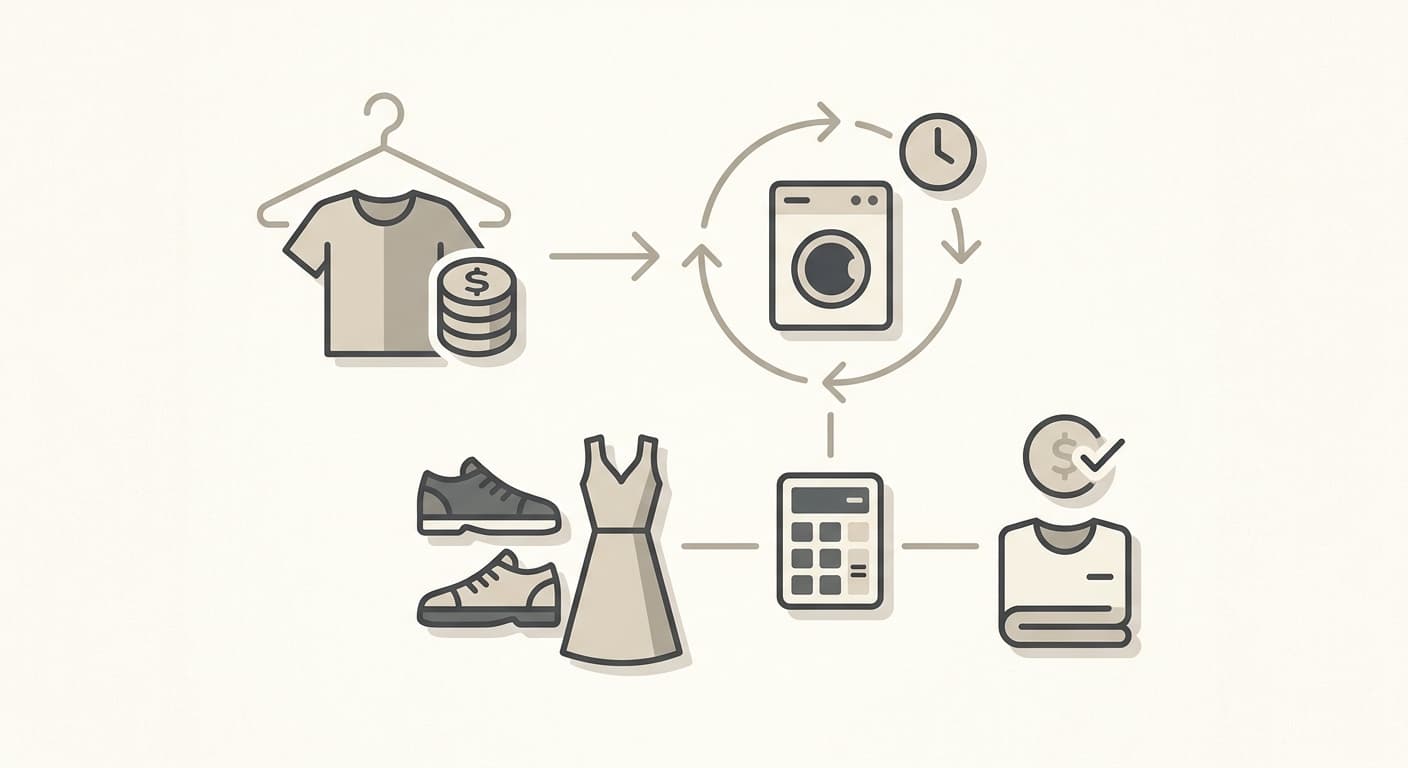
Cost per wear (CPW) is the purchase price divided by the total number of times you wear an item: an $80 pair of jeans worn 360 times costs just $0.47 per wear, while a $120 trendy dress worn 18 times costs $11.67 per wear. That single number turns "expensive" and "cheap" upside down, because the price tag tells you what you paid once and CPW tells you what each outfit actually costs. Run your own items through our Cost Per Wear Calculator before your next purchase.
A well-documented pattern in fashion economics is that shoppers reliably overpay for the things they wear least and underpay for the things they wear daily. The most common mistake is judging a $300 coat as "too much" while happily replacing $25 trend tops four times a season. The coat, worn 720 times over five winters, lands at $0.85 per wear. The four tops, worn maybe seven times each, land near $3.57. The "expensive" item is the cheaper one.
This guide shows the exact formula, walks through worked examples for jeans, jackets, and shoes, compares renting versus buying, and pits expensive fashion against fast fashion using 2026 prices. Every number reconciles, so you can check the math yourself.
The Cost Per Wear Formula
Cost per wear has a simple version and a complete version. The simple version answers the question fast. The complete version is what you should actually use before a big purchase, because care and resale change the answer.
Simple formula: CPW = Purchase Price ÷ Total Wears
Complete formula: CPW = (Purchase Price + Total Care Costs − Resale Value) ÷ Total Wears
Total wears is the lever that matters most. You estimate it by multiplying how often you wear the item by how long it lasts: Total Wears = Wears Per Month × Lifespan in Months. A jacket worn 8 times a month for 4 years is 8 × 48 = 384 wears. Get this number roughly right and the rest follows.
| Term | What It Means | Example |
|---|---|---|
| Purchase Price | What you paid, including tax and shipping | $80 |
| Total Wears | Wears per month × lifespan in months | 360 |
| Total Care Costs | Laundry, dry cleaning, repairs over the lifespan | $90 |
| Resale Value | What you recover when you sell it | $0 |
| Cost Per Wear | (Price + Care − Resale) ÷ Wears | $0.47 |
Tip
A cost per wear under $5 is generally a good buy. Under $1 is exceptional value, and anything over $10 signals an item you either overpaid for or rarely wear. Use $5/wear as your fast-fashion break-even line.
Worked Examples: Jeans, Jackets, and Shoes
These are the three categories most people calculate, so here is the full math for each. Care costs and resale are folded in where they matter.
Everyday Jeans: $0.47 Per Wear
A good pair of jeans is the highest-value item in most wardrobes because you wear it constantly and it costs almost nothing to maintain.
- Purchase price: $80
- Wears: 15 per month × 24 months = 360 wears
- Care: $0.25 per wear (cold home wash) × 360 = $90
- Resale: $0
- Total cost: $80 + $90 − $0 = $170
- CPW = $170 ÷ 360 = $0.47 per wear
At under $0.50 per wear, those jeans are cheaper per use than almost anything else you own. This is why buying a second pair of a jean you already love is one of the safest fashion purchases you can make.
A Quality Jacket: $0.85 Per Wear
Outerwear scares people because of the sticker price, but a coat worn through an entire season for several years is a bargain per wear.
- Purchase price: $300
- Wears: 12 per month × 60 months (5 years) = 720 wears
- Care: $0.50 per wear (occasional dry clean, averaged) × 720 = $360
- Resale: $50
- Total cost: $300 + $360 − $50 = $610
- CPW = $610 ÷ 720 = $0.85 per wear
Even with $360 in lifetime care, the coat lands at $0.85 because the denominator is huge. Compare that to a $120 dress worn once a month for 18 months with $5-per-wear dry cleaning: total wears are just 18, total cost is $120 + $90 = $210, and CPW = $210 ÷ 18 = $11.67. Same approximate purchase price as a mid-range coat, but 14 times the cost per wear.
Shoes: It Depends Entirely on Frequency
Shoes split sharply between daily drivers and occasion pairs.
- Everyday sneakers: $120, worn 20 times a month for 18 months = 360 wears, care ~$0. CPW = $120 ÷ 360 = $0.33 per wear.
- Leather boots: $350, worn ~8 times a month for ~4 years = 400 wears, plus $240 in resoling and conditioning over their life. Total = $350 + $240 = $590. CPW = $590 ÷ 400 = $1.48 per wear.
- Wedding/occasion heels: $90, worn 3 times total. CPW = $90 ÷ 3 = $30.00 per wear.
| Item | Price | Wears | Care | Resale | CPW |
|---|---|---|---|---|---|
| Everyday jeans | $80 | 360 | $90 | $0 | $0.47 |
| Quality winter coat | $300 | 720 | $360 | $50 | $0.85 |
| Everyday sneakers | $120 | 360 | $0 | $0 | $0.33 |
| Leather boots | $350 | 400 | $240 | $0 | $1.48 |
| Trendy dress | $120 | 18 | $90 | $0 | $11.67 |
| Occasion heels | $90 | 3 | $0 | $0 | $30.00 |
The pattern is unmistakable: frequency beats price every time. The cheapest item on the list per wear is the $120 sneaker, not the $80 jeans, because the sneaker gets worn more often relative to its lifespan.
Expensive vs. Fast Fashion: The Break-Even Math
The fast fashion argument is that cheap clothes save money. The data says otherwise once you divide by wears. Fast fashion garments are worn an average of seven times before being discarded, a figure tied to Ellen MacArthur Foundation research. Quality basics routinely hit 150 or more wears.
Here is the break-even comparison for a jacket bought three ways. Care is held proportional, and the designer row shows the effect of resale.
| Jacket Tier | Price | Wears | Resale | Net Cost | CPW |
|---|---|---|---|---|---|
| Fast fashion | $50 | 15 | $0 | $50 | $3.33 |
| Quality brand | $200 | 120 | $0 | $200 | $1.67 |
| Designer | $800 | 200 | $0 | $800 | $4.00 |
| Designer + resale | $800 | 200 | $400 | $400 | $2.00 |
The $200 quality jacket beats the $50 fast-fashion jacket on cost per wear ($1.67 vs $3.33) despite costing four times as much, because it survives eight times as many wears. The designer jacket only beats fast fashion once you factor in resale, dropping from $4.00 to $2.00 per wear when you recover half its price.
A second comparison shows the same logic for everyday tees, including care:
| Tee | Price | Wears | Care | Total | CPW |
|---|---|---|---|---|---|
| $30 fast-fashion tee | $30 | 20 | $5 | $35 | $1.75 |
| $80 quality tee | $80 | 150 | $37.50 | $117.50 | $0.78 |
The $80 tee costs $0.78 per wear versus $1.75 for the $30 tee. You pay $50 more upfront and save more than half per wear, because quality cotton survives 150 washes while fast-fashion cotton thins out after 20.
Warning
Cost per wear can be weaponized to justify buying things you do not need. "It's only $2 a wear if I wear it 100 times" only holds if you actually wear it 100 times. Before buying, be honest about whether the item fits your real life, not your aspirational one. For the psychology behind this trap, see our guide on impulse spending.
The 30 Wears Rule
The simplest gut-check for any purchase is the 30 wears rule, popularized by sustainability advocate Livia Firth through her #30Wears campaign. Before buying, ask: "Will I wear this at least 30 times?" If the honest answer is no, walk away.
At 30 wears, the math is forgiving for reasonably priced items:
- A $60 item at 30 wears = $2.00 per wear (acceptable)
- A $90 item at 30 wears = $3.00 per wear (acceptable)
- A $150 item at 30 wears = $5.00 per wear (the upper limit)
Anything above $150 needs more than 30 wears to clear the $5 benchmark. A $300 coat needs 60 wears to hit $5/wear, which is easy across a few winters. A $400 occasion dress needs 80 wears to hit $5, which almost never happens, so occasion wear is where rental makes sense.
Cost Per Wear for Rented vs. Purchased Clothing
Renting changes the formula because you never own the item, so there is no resale and no long tail of wears to amortize against. Cost per wear for rented clothing is simply the rental fee divided by the wears you get from that rental.
Rent the Runway's 2026 subscription starts around $94 a month for roughly five items. If you wear each of those five items twice in the month, that is 10 wears for $94, or $9.40 per wear. If you only wear each item once, the same $94 buys five wears at $18.80 per wear.
| Approach | Cost | Wears | CPW | Best For |
|---|---|---|---|---|
| Rental subscription | $94/mo | 10 | $9.40 | Frequent events, trying styles |
| Rental, single occasion | $94/mo | 5 | $18.80 | Light rotation |
| Buy a $400 occasion dress | $400 | 4 | $100.00 | Rarely worn formalwear |
| Buy a $400 versatile dress | $400 | 80 | $5.00 | Wear-anywhere staples |
Renting wins decisively for occasion pieces. A $400 gown you wear four times costs $100 per wear if you buy it, but renting comparable dresses puts each wear at $9 to $19. Buying only wins when the garment is versatile enough to cross the 30 to 80 wear threshold, at which point ownership drops to $5 per wear or less. The rule of thumb: rent what you wear rarely, buy what you wear constantly.
Important
Rental cost per wear assumes you actually wear the rented items. The single biggest waste in a clothing subscription is paying $94 for a month you barely touch. Treat the subscription like a gym membership: if your monthly CPW creeps above the cost of just buying the staple, pause it. Map the spend against your monthly plan with the Budget Calculator.
Cost Per Wear for Expensive Fashion Items
Expensive does not mean a bad cost per wear. Expensive plus rarely worn means a bad cost per wear. The two factors that rescue a high price tag are frequency and resale.
Designer leather goods and classic styles can run for 10 to 20 years, and the strongest brands hold their value. A $2,500 classic flap bag that retains 85% of its value has an effective cost of $375 after resale. Worn 300 times over five years, that is $375 ÷ 300 = $1.25 per wear — lower than most fast-fashion handbags once you account for the replacements fast fashion forces.
The danger zone for expensive fashion is the trend-driven, occasion-only purchase: a $1,200 sequined gown worn twice is $600 per wear, full stop. No resale market and no repeat wears can save it. Before any purchase over $100, check the resale value on eBay or Poshmark; a strong resale market is a signal of durable demand and directly lowers your true cost per wear. To pre-fund a planned investment piece, set a target with the Savings Goal Calculator.
| Expensive Item | Price | Resale | Net | Wears | CPW |
|---|---|---|---|---|---|
| Classic designer bag | $2,500 | $2,125 | $375 | 300 | $1.25 |
| Designer trench coat | $1,200 | $400 | $800 | 200 | $4.00 |
| Investment leather boots | $600 | $0 | $600 | 500 | $1.20 |
| Trend sequined gown | $1,200 | $0 | $1,200 | 2 | $600.00 |
Cost Per Wear for Outdoor Clothing
Outdoor and technical clothing is where cost per wear earns its keep, because a single high-quality piece often replaces several cheap ones and survives abuse that destroys fast fashion. A $250 waterproof shell that lasts 8 years of regular hiking is a different animal than a $40 rain jacket that delaminates after two seasons.
Take a hardshell hiking jacket: $250, worn 4 times a month across the year (48 wears annually) for 8 years = 384 wears. Care is minimal, roughly $40 total in tech-wash and re-waterproofing over its life. Total = $290, so CPW = $290 ÷ 384 = $0.76 per wear. The $40 budget jacket, worn the same way but replaced every 2 years, costs $160 over the same 8 years for the same wears, landing at $160 ÷ 384 = $0.42 per wear on paper — but it leaks, layers poorly, and rarely survives the full season, so the real-world wears are lower and the comparison flips.
| Outdoor Item | Price | Lifespan | Wears | Care | CPW |
|---|---|---|---|---|---|
| Hardshell hiking jacket | $250 | 8 yrs | 384 | $40 | $0.76 |
| Insulated puffer | $180 | 6 yrs | 300 | $20 | $0.67 |
| Merino base layer | $90 | 5 yrs | 250 | $25 | $0.46 |
| Hiking boots | $200 | 5 yrs | 250 | $80 | $1.12 |
| Budget rain jacket | $40 | 2 yrs | 96 | $0 | $0.42 |
The takeaway for outdoor gear: durability and warmth-to-weight matter more than price, because a piece that keeps you comfortable gets worn far more often. A merino base layer at $0.46 per wear is one of the best values in any closet, indoor or outdoor, because it is worn constantly and resists odor between washes.
How to Use Cost Per Wear When Shopping
Put the framework to work in four steps. This is the same sequence the calculator runs, so you can sanity-check any result by hand.
- Estimate honest wears. Multiply realistic wears per month by lifespan in months. Be conservative — most people overestimate.
- Add care costs. Home laundry runs $0.25 to $0.75 per load; dry cleaning runs $3 to $15 per garment. Multiply by expected cleanings.
- Subtract resale. Quality denim resells for 30 to 50% of retail; designer leather holds 40 to 90%. Check eBay or Poshmark for the actual figure.
- Divide and compare. (Price + Care − Resale) ÷ Wears. Compare against your $5/wear ceiling and the fast-fashion alternative.
For a fuller spending framework that puts clothing in context against the rest of your budget, the 50/30/20 budget rule is a useful companion: clothing falls under "wants," and cost per wear is how you make those wants efficient.
Frequently Asked Questions
How do you calculate cost per wear for fashion purchases?
Divide the total cost of the item (purchase price plus care costs minus resale value) by the total number of times you wear it; for example, an $80 pair of jeans worn 360 times with $90 in lifetime care costs $170 total, or $0.47 per wear.
What is cost per wear for rented vs. purchased clothing?
Rented clothing costs the rental fee divided by wears — about $9.40 per wear if you wear five items twice on a $94 monthly Rent the Runway plan — while a purchased $400 versatile dress worn 80 times costs $5.00 per wear, so rent rarely worn pieces and buy frequently worn staples.
How does cost per wear work for expensive fashion items?
Expensive items can beat fast fashion on cost per wear when they last and resell: a $2,500 designer bag retaining 85% of its value has an effective cost of $375, and worn 300 times that is just $1.25 per wear, but a $1,200 gown worn twice costs $600 per wear because nothing offsets it.
What is the cost per wear for outdoor clothing?
A $250 hardshell hiking jacket worn 384 times over 8 years with $40 in care costs $0.76 per wear, and a $90 merino base layer worn 250 times costs $0.46 per wear, making technical outdoor pieces some of the best per-wear values when they are durable and worn often.
What is the cost per wear for jeans and jackets?
An $80 pair of everyday jeans worn 360 times costs $0.47 per wear, and a $300 quality winter jacket worn 720 times over five years with $360 in care and $50 resale costs $0.85 per wear — both well under the $5-per-wear benchmark for a good buy.
What is a good cost per wear for clothing?
A cost per wear under $5 is a good buy, under $1 is exceptional value (everyday basics worn 100-plus times), and anything over $10 is below average, typically caused by infrequent use or expensive dry cleaning relative to wears.
What is the 30 wears rule?
The 30 wears rule, popularized by Livia Firth, says only buy a garment if you will wear it at least 30 times; at 30 wears a $60 item costs $2.00 per wear and a $150 item costs $5.00 per wear, which is the upper limit for a smart purchase.
Related Articles
- Impulse Spending: How to Stop Wasting $5,400 a Year — The psychology behind the purchases that wreck your cost per wear, and how to interrupt them.
- 50/30/20 Budget Rule Calculator — Where clothing fits in a balanced budget and how to cap "wants" spending.
- Sublimation Cost Per Print in 2026 — The same cost-per-unit logic applied to a small fashion-adjacent business.
Related Calculators
- Cost Per Wear Calculator — Enter price, care costs, wear frequency, and resale to get the true cost per wear of any item instantly.
- Price Per Unit Calculator — Compare unit prices to find the best value before you buy.
- Budget Calculator — Plan monthly clothing spend against income and savings goals.
- Savings Goal Calculator — Pre-fund an investment wardrobe piece with a target and timeline.
- Discount Calculator — Work out the real sale price before factoring it into cost per wear.
This article provides general information for educational purposes. Actual prices, care costs, and resale values vary by item, brand, region, and condition. Run your own numbers before any major purchase.
Sources: Project Cece — How Many Times Do We Wear Our Clothes?, The Sustainable Edit — The 30 Wears Campaign, Rent the Runway — Clothing Subscription Pricing, U.S. Bureau of Labor Statistics — Apparel Data in Fashion.
This article is provided for informational and educational purposes only. Content should not be considered professional financial, medical, legal, or other advice. Always consult a qualified professional before making important decisions. UseCalcPro is not responsible for any actions taken based on the information in this article.