Congee Rice to Water Ratio: The Complete Chart (2026 Guide)
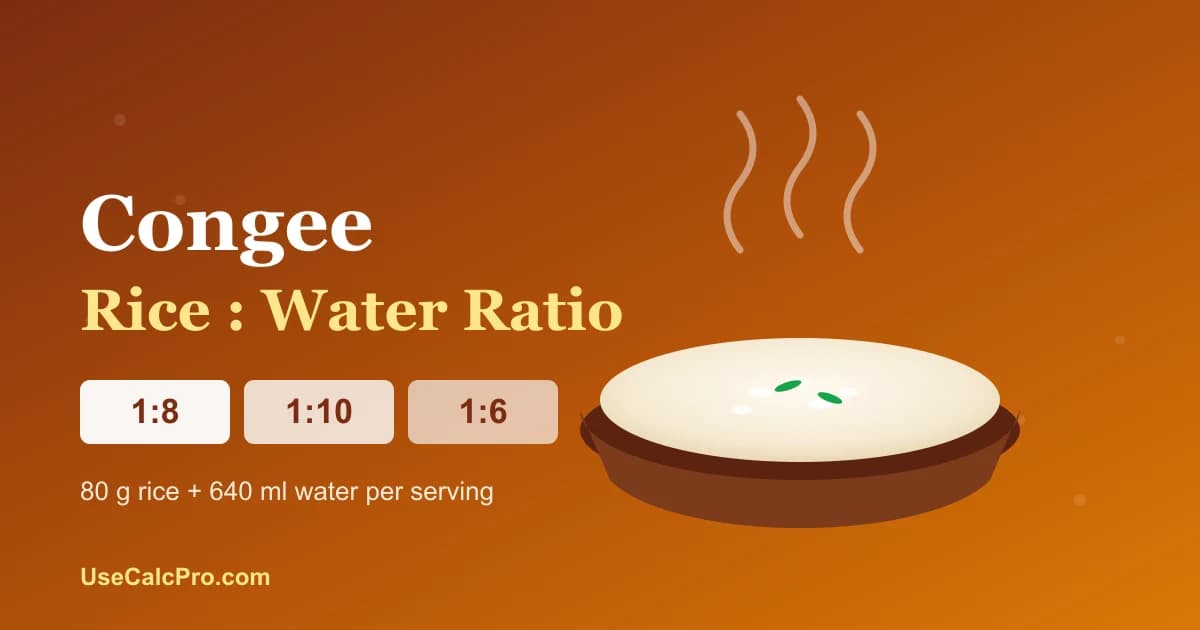
The congee rice to water ratio runs from 1:5 to 1:10 by volume, and the everyday default is 1:8 — one part rice to eight parts water, or 80 grams of dry rice and 640 ml of water per serving. Thin Cantonese jook uses 1:10, thick Teochew congee uses 1:6, and Japanese okayu sits at 1:5. The thinner you want it, the more water you add to the same 80 grams of rice. Drop your serving count and thickness into our Congee Calculator and it returns the exact rice and water in grams and milliliters.
A common first mistake is treating congee like steamed rice — 1 cup of rice to 2 cups of water — which ends in a pot of paste that needs thinning with 3 extra cups of boiling water halfway through. Congee is not steamed rice with extra liquid; it needs roughly four to five times more water than the 1:2 ratio used for a rice cooker. Shifting to the 1:8 band, a 320-gram batch of rice feeds four people with a silky texture every time.
This guide is the ratio reference, not a general recipe. It gives you exact rice-and-water amounts for every thickness, every rice type, and every batch size, plus how the numbers shift between a stovetop, a rice cooker, and an Instant Pot. For protein amounts and topping ideas, the calculator handles those alongside the ratio.
The Core Congee Ratio: What 1:8 Actually Means
The ratio is rice to water by volume, and 80 grams of dry rice per serving is the universal starting point. You pick a thickness, multiply 80 grams by the water number, and that is your water in milliliters. Medium congee at 1:8 is 80 g × 8 = 640 ml of water per serving. Thin Cantonese jook at 1:10 is 80 g × 10 = 800 ml. The rice amount never changes — only the water does.
Congee water (ml) = servings × 80 g rice × thickness ratio
So four servings of medium congee is 4 × 80 × 8 = 2,560 ml of water over 320 grams of rice. According to The Woks of Life congee guide, restaurant-style jook lands around a 1:8 to 1:10 ratio, which matches the medium-to-thin band most home cooks settle into. The 1:5 okayu end of the scale comes from Just One Cookbook's rice porridge method, where the goal is a thick, spoonable Japanese breakfast rather than a pourable soup.
Important
Congee thickens dramatically as it cools and as it sits — the rice keeps drinking water. Cook it slightly thinner than your target, because a 1:8 pot will firm up toward 1:6 by the time it reaches the table. When reheating leftovers, add 2–3 tablespoons of water per serving to bring it back.
Congee Ratio by Thickness (the Chart to Bookmark)
This is the master table. Every row holds 80 grams of dry rice per serving constant and changes only the water. Cook times assume a heavy-bottomed pot at a low simmer with a stir every 10 minutes.
| Style | Ratio (rice:water) | Water per serving | Cook time | Texture |
|---|---|---|---|---|
| Thin — Cantonese jook | 1:10 | 800 ml | 60 min | Silky, pourable, drinks like soup |
| Medium — standard | 1:8 | 640 ml | 50 min | Creamy with some grain structure |
| Thick — Teochew | 1:6 | 480 ml | 45 min | Visible whole grains, porridge-like |
| Very thick — Japanese okayu | 1:5 | 400 ml | 30 min | Spoonable, rice-pudding body |
Read the water column as the only variable. The same 80 grams of rice becomes a thin soup at 800 ml or a thick porridge at 400 ml — a 2× swing in water across the range. Cantonese jook is cooked long and hard so the grains burst completely; Teochew congee is cooked shorter so the grains stay intact and float in a lighter broth, which is why it pairs with braised meats and pickles instead of dissolving into them.
Tip
If you can only remember one number, remember 1:8 and 80 grams. One serving is 80 grams of rice and 640 ml of water. Scale both linearly and you can hit any batch size without the chart.
Scaling Congee by Servings
Here is the medium 1:8 ratio scaled to common batch sizes. Rice is 80 grams per serving; water is 640 ml per serving. The pot column is the minimum capacity you need, because congee foams and climbs as it simmers.
| Servings | Dry rice | Water (1:8 medium) | Minimum pot |
|---|---|---|---|
| 1 | 80 g | 640 ml | 1.5 L |
| 2 | 160 g | 1,280 ml | 2 L |
| 4 | 320 g | 2,560 ml | 4 L |
| 6 | 480 g | 3,840 ml | 5–6 L |
| 8 | 640 g | 5,120 ml | 6–8 L |
The math reconciles in both directions: 8 servings is 8 × 80 = 640 grams of rice and 8 × 640 = 5,120 ml of water, which is exactly double the 4-serving row. If you want those eight servings thinner, swap the ratio: 640 g × 10 = 6,400 ml of water for thin Cantonese jook. The rice column stays at 640 grams either way — only the water grows.
Warning
Never fill a pot more than two-thirds full with congee. The 8-serving batch is over 5.7 liters of rice and water combined, and starchy congee foams up as it heats. A 4-liter pot will boil over within the first 10 minutes. Size up before you scale up.
Congee Ratio by Rice Type
Not all rice releases starch the same way, so the same 1:8 ratio gives different bodies depending on the grain. The table below adjusts the medium 640 ml-per-serving baseline for the most common congee rices. The percentage is how much to nudge the water.
| Rice type | Water adjustment | Water per serving (medium) | Notes |
|---|---|---|---|
| Long-grain (jasmine) | Baseline | 640 ml | The classic; breaks down into a clean, creamy base |
| Broken rice (jasmine broken) | Baseline | 640 ml | Teochew favorite; cooks ~10 min faster, very smooth |
| Short-grain (sushi/Calrose) | −10% | 576 ml | Higher starch; thickens itself, so pull back water |
| Glutinous (sticky) rice | −15% | 544 ml | Extremely thick; usually blended, not used alone |
| Brown rice | +20% | 768 ml | Needs ~25 extra minutes; nuttier, never fully silky |
The adjustments are simple multipliers on 640 ml: short-grain is 640 × 0.90 = 576 ml, glutinous is 640 × 0.85 = 544 ml, and brown rice is 640 × 1.20 = 768 ml. Short-grain rices like sushi or Calrose carry more amylopectin starch, so they thicken the pot on their own — keep the same rice weight but cut the water 10% or you will overshoot into Teochew territory. Brown rice is the outlier: the bran layer resists breaking down, so it needs both more water and more time, and it never reaches the glassy smoothness of polished white rice. For plain steamed-rice ratios on these same grains, our Rice Calculator covers the non-porridge side.
Stovetop vs. Rice Cooker vs. Instant Pot
The ratio you start with depends on how much water boils away. A stovetop loses water to evaporation over an hour of simmering, so it takes the full ratio. A sealed rice cooker or Instant Pot loses almost none, so you cut the water back. The table uses medium 1:8 at one serving (640 ml stovetop baseline) so you can scale it.
| Equipment | Water per serving | Total time | How to run it |
|---|---|---|---|
| Stovetop | 640 ml | 50 min | Low simmer, stir every 10 min, lid ajar |
| Rice cooker (porridge setting) | 576 ml (−10%) | 60–90 min | Use the "porridge"/"okayu" cycle, walk away |
| Instant Pot (high pressure) | 544 ml (−15%) | 30 min | 20 min high pressure + 10 min natural release |
For a four-serving batch, that means 2,560 ml on the stovetop, 2,560 × 0.90 = 2,304 ml in a rice cooker, and 2,560 × 0.85 = 2,176 ml in an Instant Pot — the same 320 grams of rice in all three. The Instant Pot is the biggest time-saver, cutting a 50-minute simmer to 30 minutes including the pressure release, but it gives you the least control over final thickness because you cannot stir or taste mid-cook. If you want to fine-tune texture at the table, the stovetop wins.
Tip
Two restaurant shortcuts that work in any vessel: freeze the dry rice overnight in a zip-lock bag so the ice crystals crack the grains and cut 15 minutes off the simmer, and always start the rice in boiling water, never cold — cold water lets the grains clump and cook unevenly.
A Worked Example, Start to Finish
Say you are making medium congee with century egg and pork for four people. Four servings at 80 grams is 320 grams of dry rice. At the 1:8 medium ratio, water is 320 × 8 = 2,560 ml. Protein follows the same per-serving logic: 80 grams of thinly sliced pork per bowl is 4 × 80 = 320 grams, plus two century eggs per serving diced into the last 10 minutes. Simmer for 50 minutes, stirring every 10, and the rice will burst into a creamy base while the pork poaches in the residual heat.
Now move that exact batch to an Instant Pot. Hold the rice at 320 grams, but cut the water 15% for the sealed environment: 2,560 × 0.85 = 2,176 ml. Run 20 minutes on high pressure with a 10-minute natural release. You land at the same medium thickness in 30 minutes instead of 50, because nothing evaporated. The only number that changed is the water; the rice and protein are identical. That is the whole logic of congee — pick the rice weight first, then let the ratio and the equipment decide the water.
How Congee Compares to Other Rice Ratios
Congee's 1:8 default is roughly four times wetter than steamed rice and sits in its own lane among rice dishes. The contrast is the fastest way to feel how much water porridge actually needs.
| Dish | Rice:water ratio | Water per 80 g rice | Result |
|---|---|---|---|
| Steamed long-grain rice | 1:1.5 | 120 ml | Separate, fluffy grains |
| Risotto (gradual) | ~1:4 | 320 ml | Creamy but al dente |
| Medium congee | 1:8 | 640 ml | Creamy porridge |
| Thin Cantonese jook | 1:10 | 800 ml | Pourable rice soup |
Steamed rice at 1:1.5 keeps every grain intact; congee at 1:8 deliberately destroys that structure to thicken the liquid with released starch. That is why you cannot "thin out" steamed rice into congee by adding water at the end — the starch has to cook out of the grain slowly from the start. For brothy rice cousins built on stock rather than plain water, see our Ramen Broth Calculator and Pho Broth Calculator, which handle liquid-to-aromatics ratios instead.
Frequently Asked Questions
Congee rice to water ratio?
The congee rice to water ratio is 1:8 by volume for standard medium congee — one part rice to eight parts water, or 80 grams of dry rice to 640 ml of water per serving. Thin Cantonese jook uses 1:10 (800 ml), thick Teochew uses 1:6 (480 ml), and Japanese okayu uses 1:5 (400 ml). Keep the rice at 80 grams per serving and change only the water to move between thicknesses.
How much rice do I need per person for congee?
Plan on 80 grams of dry rice per serving, which is the base the Congee Calculator uses across every thickness. That works out to 320 grams for four people and 640 grams for eight. Because congee expands so much, 80 grams of dry rice yields a generous full bowl once cooked.
What is the ratio for thin Cantonese jook versus thick Teochew congee?
Thin Cantonese jook is 1:10 (800 ml of water per 80 grams of rice) and cooks about 60 minutes into a silky, pourable porridge, while thick Teochew congee is 1:6 (480 ml per 80 grams) and cooks about 45 minutes so the grains stay whole and visible. Jook dissolves into a smooth base; Teochew stays loose and brothy for braised toppings.
Can I make congee in a rice cooker or Instant Pot?
Yes — use a rice cooker's "porridge" or "okayu" setting with about 10% less water (less evaporation), or an Instant Pot at 20 minutes high pressure plus a 10-minute natural release with about 15% less water. A four-serving medium batch needs 2,304 ml in a rice cooker or 2,176 ml in an Instant Pot, versus 2,560 ml on the stovetop, all on the same 320 grams of rice.
How do I fix congee that is too thick or too thin?
For congee that is too thick, stir in boiling water 2–3 tablespoons at a time until it loosens — congee thickens as it cools, so thin it slightly past your target. For congee that is too thin, simmer uncovered to evaporate water, or add a small slurry of cooked rice mashed with a little hot water; do not add raw rice late, as it will not break down in time.
Does the type of rice change the water ratio?
Yes — short-grain rices like sushi or Calrose release more starch, so cut the water about 10% (576 ml per serving at medium); brown rice needs roughly 20% more water (768 ml) and 25 extra minutes; long-grain jasmine and broken rice use the baseline 640 ml. For plain-rice ratios on these grains, the Rice Calculator covers the steamed side.
Related Articles
- Butter to Oil Conversion for Baking — Another by-weight kitchen ratio where eyeballing volumes quietly throws the whole recipe off.
- 9-Inch Pie Crust in Grams — How precise gram measurements beat the cup-and-spoon guess for consistent results.
- Sourdough Hydration & Starter Guide — A flour-and-water ratio dish where, like congee, the liquid percentage decides the entire texture.
Related Calculators
- Congee Calculator — Enter servings and thickness, get exact rice, water, protein, and cook time for jook, Teochew, or okayu.
- Rice Calculator — Rice-to-water ratios for steamed rice across long-grain, short-grain, jasmine, and brown.
- Ramen Broth Calculator — Liquid, aromatics, and seasoning ratios for Japanese ramen broth.
- Pho Broth Calculator — Bone, water, and spice ratios for Vietnamese pho at any pot size.
This article provides general information for educational purposes. Cooking times and ratios vary with your stove, pot, and rice; taste and adjust as you go.
This article is provided for informational and educational purposes only. Content should not be considered professional financial, medical, legal, or other advice. Always consult a qualified professional before making important decisions. UseCalcPro is not responsible for any actions taken based on the information in this article.
Try These Calculators
Calculate rice and water amounts for congee by thickness and serving count. Covers Cantonese, Teochew, and Japanese okayu styles with topping recommendations.
Calculate the exact rice-to-water ratio, dry rice amounts, and cooking times for any rice type. Covers basmati, jasmine, brown, wild, sushi, and more.
Calculate exact sushi rice, water, and sushi vinegar amounts for maki, nigiri, temaki, chirashi, and onigiri. Get dry rice cups and nori sheets needed.
Calculate biryani ingredients by serving count: basmati rice, water, meat, saffron strands, and fried onions. Hyderabadi, Lucknowi, Kolkata, and Sindhi styles.
Calculate exact amounts of dye powder, soda ash, and water needed for your tie-dye projects. Perfect ratios for fiber reactive, all-purpose, and natural dyes.