Cost Difference: Fully Insulated Sunroom vs Non-Insulated (2026 Data)
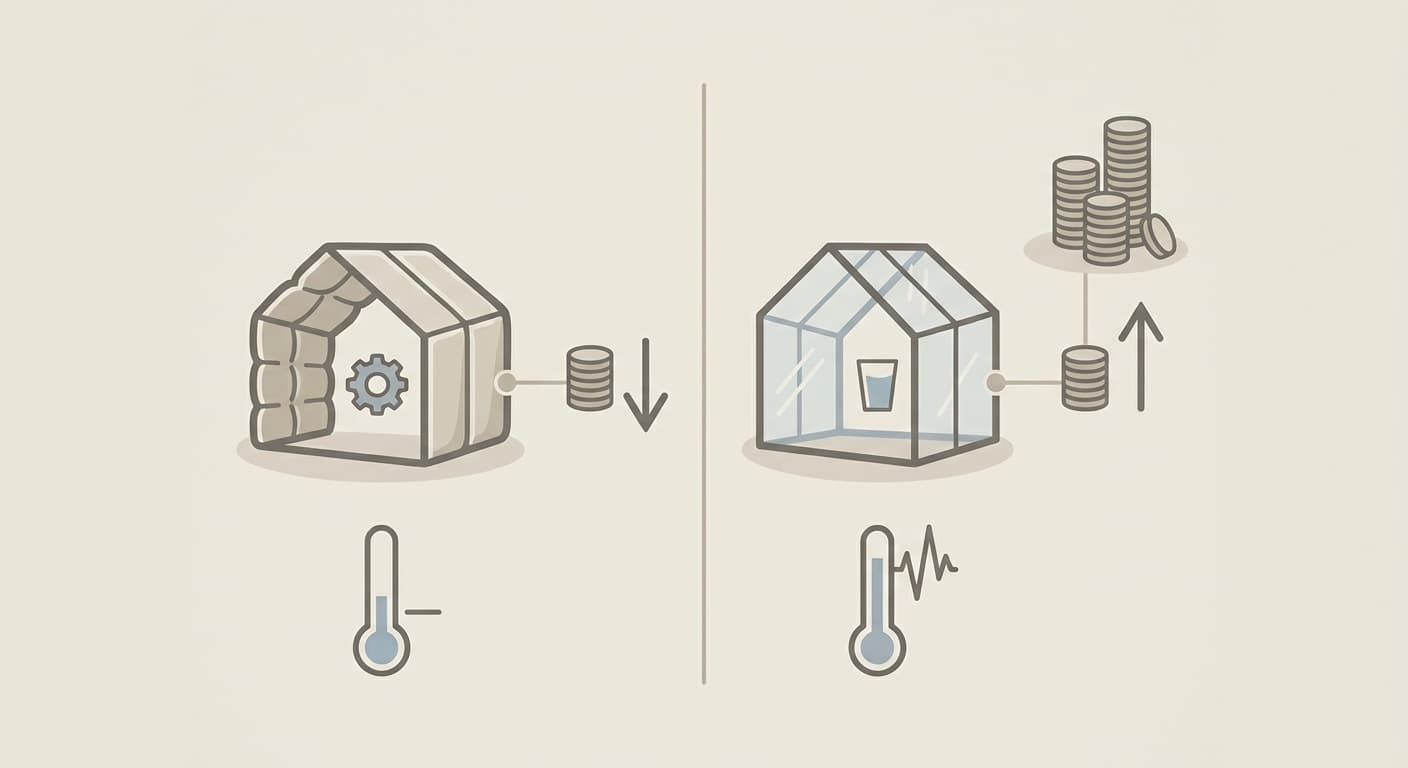
A fully insulated four-season sunroom costs $200-$400 per square foot installed in 2026, while a non-insulated three-season room costs $80-$230 per square foot -- a difference of roughly $120-$170 per square foot, or $24,000-$34,000 more on a typical 200-square-foot build. The insulated version adds framed-and-insulated walls, double-pane low-E glass, an insulated roof, and an HVAC tie-in. The non-insulated version is glass walls on a frame with no climate control. Use the Sunroom Addition Cost Calculator to price your own footprint before you read on.
On the last sunroom I scoped, a homeowner asked me why two bids on the "same" 14-by-14 room came in at $26,000 and $61,000. The answer was insulation. The cheap bid was a three-season shell at about $130 per square foot; the expensive one was a fully insulated four-season build at about $310 per square foot. That $35,000 gap is not contractor markup -- it is roughly 50% more material, a $3,000-$8,000 HVAC line, and the framing required to make the room count as living space under code.
This article breaks down the exact cost difference line by line, then shows where each dollar goes and when the insulated premium pays for itself.
Insulated vs Non-Insulated Sunroom: The Core Cost Difference
The single biggest number to anchor on: insulation roughly doubles the price per square foot. A non-insulated three-season room runs $80-$230 per square foot installed. A fully insulated four-season room runs $200-$400 per square foot. That is the entire ballgame for budgeting, and every other line item flows from it.
The dollar gap scales with size. The table below re-derives the total cost at four common footprints by multiplying the per-square-foot range by the area. Read the right-most column as the extra cash a fully insulated build demands over the non-insulated equivalent at the same size.
| Size | Non-insulated (3-season) | Fully insulated (4-season) | Extra cost to insulate |
|---|---|---|---|
| 100 sq ft | $8,000 - $23,000 | $20,000 - $40,000 | $12,000 - $17,000 |
| 150 sq ft | $12,000 - $34,500 | $30,000 - $60,000 | $18,000 - $25,500 |
| 200 sq ft | $16,000 - $46,000 | $40,000 - $80,000 | $24,000 - $34,000 |
| 300 sq ft | $24,000 - $69,000 | $60,000 - $120,000 | $36,000 - $51,000 |
Source: Angi 2026 sunroom data ($80-$230/sq ft three-season; $200-$400/sq ft four-season) and HomeGuide 2026. Totals = per-sq-ft range x area.
Each row reconciles by multiplication. At 200 square feet: $80 x 200 = $16,000 and $230 x 200 = $46,000 for non-insulated; $200 x 200 = $40,000 and $400 x 200 = $80,000 for insulated. The extra-cost column is the difference at each bound -- $40,000 minus $16,000 = $24,000 on the low end, $80,000 minus $46,000 = $34,000 on the high end.
Important
The "fully insulated vs non-insulated" choice is identical to the "four-season vs three-season" choice in the trade. A four-season room is, by definition, the fully insulated version with HVAC. A three-season room is the non-insulated version. Contractors and county assessors use those labels, so this guide uses them interchangeably.
For a deeper line-item breakdown of either tier on its own, the Sunroom Addition Cost Calculator lets you toggle between three-season and four-season and adjust by region.
What You Actually Pay For When You Insulate
The extra $24,000-$34,000 on a 200-square-foot insulated room is not one upgrade -- it is five. Insulating a sunroom means upgrading the walls, the glass, the roof, the climate control, and the framing all at once. Skip any one of them and the room is no longer truly four-season.
Here is where each chunk of the premium goes, derived against a representative $50,000 fully insulated 200-square-foot build versus a $28,000 non-insulated room of the same size.
| Upgrade to insulate | Cost add over non-insulated | Why it is required |
|---|---|---|
| Insulated walls + vapor barrier | $4,000 - $9,000 | Framed cavity, batt or spray foam, drywall finish |
| Double-pane low-E glass (vs single-pane) | +15-25% of glass cost | Cuts heat loss; mandatory for year-round comfort |
| Insulated roof panel (vs shingle/single skin) | $2,000 - $6,000 | Stops the biggest heat-loss surface |
| HVAC tie-in or mini-split | $3,000 - $8,000 | Heat and cool the room year-round |
| Code-compliant framing + electrical | $2,000 - $5,000 | Required to classify as living space |
Line-item ranges from Angi 2026 sunroom data and HomeGuide 2026; glass premium per low-E manufacturer pricing.
Tip
Low-E glass is the one upgrade you should never value-engineer out of an insulated build. Low-E coatings can cut heating and cooling costs by up to 30%, per glass manufacturers, by reflecting interior heat back inside in winter and solar heat outward in summer. Spending the extra 15-25% on glass protects every other dollar you put into insulation.
Walls: the foundation of the difference
A non-insulated three-season room often has glass or single-skin panels running floor to roofline, with framing members and nothing in between. A fully insulated room has framed walls with an insulated cavity (fiberglass batts or spray foam), a vapor barrier, and an interior drywall finish. That wall assembly alone adds $4,000-$9,000 on a 200-square-foot room and is what lets the space hold a temperature.
HVAC: the line that surprises people
The single most under-budgeted item is climate control. A three-season room has none -- you rely on the weather. A four-season room needs a permanent heat and cooling source: either an extension of your home's existing system ($3,000-$8,000) or a dedicated mini-split heat pump ($3,500-$6,500). On a far-from-the-air-handler sunroom, a dedicated mini-split is usually the cleaner and cheaper option. The Mini-Split vs Central AC Cost guide walks through that decision in detail.
Operating Cost: The Difference Does Not End at Install
The cost difference between insulated and non-insulated does not stop when the crew leaves. A non-insulated room is essentially free to "operate" -- because you cannot heat or cool it, you simply do not use it in January or August. A fully insulated room has a real monthly energy cost, but it is also usable 365 days a year.
A typical conditioned sunroom costs $0.50-$1.50 per day to run, depending on local electricity rates and how hard you push the climate control. That works out to $15-$45 per month, or roughly $180-$540 per year. The insulation itself pulls that number down: a well-insulated sunroom with low-E glass reduces heating costs 10-20% compared to a poorly insulated one, per industry energy data.
| Cost type | Non-insulated (3-season) | Fully insulated (4-season) |
|---|---|---|
| Install (200 sq ft) | $16,000 - $46,000 | $40,000 - $80,000 |
| Daily operating | ~$0 (not conditioned) | $0.50 - $1.50/day |
| Annual operating | ~$0 | $180 - $540/yr |
| Usable months/year | 7 - 9 | 12 |
| Counts as home sq ft | No | Yes |
Operating range: Lifestyle Remodeling 2026 sunroom guide. Annual = daily x 365. Usable-months and living-space classification reflect general industry and building-code convention for three- vs four-season rooms.
The annual figure reconciles directly: $0.50 x 365 = $182.50 (round to ~$180), and $1.50 x 365 = $547.50 (round to ~$540). That is the price of year-round use, and it is small relative to the install gap.
Warning
A non-insulated room that you later try to heat with a space heater is the worst of both worlds. Single-pane glass and uninsulated walls bleed heat so fast that a 1,500-watt space heater running 8 hours a day in a cold climate can add $40-$80 to a winter electric bill while still leaving the room uncomfortable. If you want winter use, insulate up front -- retrofitting insulation into a finished three-season room costs more than building it right the first time.
When the Insulated Premium Is Worth It
The $24,000-$34,000 difference is justified or wasteful depending entirely on how you will use the room. Insulation pays off in three specific situations and is a waste of money in others.
Insulate (go four-season) when:
- You live in a cold or hot climate and want the room usable in winter and summer, not just spring and fall.
- You want the square footage to count toward your home's listed living area for resale -- four-season rooms typically recoup 30-50% of cost at resale versus 20-40% for three-season.
- The room will hold furniture, electronics, or plants that cannot survive temperature swings.
Skip insulation (go three-season) when:
- You live in a mild climate where 7-9 months of use covers most of your year.
- The room is a screened-in-feel relaxation space, not an extension of your daily living area.
- Budget is the hard constraint and you would rather have the room now than wait two years for the four-season budget.
The resale math matters more than most buyers realize. A fully insulated room that adds 200 square feet of listed, heated living area can lift an appraisal, while a three-season room is usually appraised as a porch or bonus space. That said, four-season square footage triggers property-tax reassessment -- typically $400-$2,000 more per year -- which a non-insulated room usually avoids.
Tip
If your home already has a structurally sound deck, converting it to a three-season room saves 20-30% over new construction. You can insulate later, but plan the foundation and framing for the four-season load up front if there is any chance you will upgrade. Price the deck base first with the Deck Building Cost Calculator.
Two Worked Scenarios
Numbers in isolation are abstract, so here are two real-shaped budgets that show how the cost difference plays out at opposite ends of the decision.
Scenario 1: Mild-climate three-season room (skip insulation)
A homeowner in the South wants a 150-square-foot glass room off the kitchen for morning coffee, used roughly March through November. They choose non-insulated three-season at the middle of the range, about $150 per square foot.
- Build: 150 sq ft x $150 = $22,500
- HVAC: $0 (none)
- Annual operating: $0
- Total first-year cost: $22,500
Insulating this room would push it to roughly $300 per square foot, or $45,000 -- a $22,500 increase for winter use they would rarely want. For this buyer, skipping insulation is the right call and saves more than the cost of the room itself.
Scenario 2: Cold-climate four-season room (insulate)
A homeowner in the Northeast wants a 200-square-foot room used year-round as a home office, with a dedicated mini-split. They choose fully insulated four-season at about $300 per square foot.
- Build: 200 sq ft x $300 = $60,000
- Included: insulated walls, double-pane low-E glass, insulated roof, mini-split, code framing
- Annual operating: ~$365 (at $1.00/day)
- Resale recoup (40%): ~$24,000 of value added
The non-insulated version would cost about $26,000 (200 sq ft x $130), but it would be unusable for the Northeast winter when this owner most wants an indoor-feeling, light-filled office. Here the $34,000 premium buys 12-month usability, resale value, and comfort. The Home Renovation Estimator helps bundle a four-season room like this into a broader remodel budget.
Cutting the Cost Difference Without Cutting Corners
If you want four-season performance but the full premium is out of reach, there are legitimate ways to narrow the gap -- and one trap to avoid.
The smartest savings is a deck conversion: build or reuse a structurally sound deck as the foundation and floor, which saves 20-30% versus pouring a new foundation. A dedicated mini-split instead of extending central ducting often saves $1,000-$3,000 on the HVAC line. Choosing an insulated panel roof over a glass roof saves $5,000-$15,000 while actually improving thermal performance. Compare the cheapest enclosed alternative entirely with the Screen Porch Cost Calculator if four-season is simply not in the budget.
The trap: do not let a contractor sell you a "four-season" room with three-season components -- single-pane glass, skipped vapor barrier, no real HVAC -- at four-season pricing. A bid 20%+ below the others on the same scope usually hides exactly this. Insist on the glass spec (double-pane low-E) and HVAC scope in writing.
Warning
Building a four-season room without a permit can force a costly retroactive legalization or kill a home sale during disclosure. Four-season rooms count as living space and are inspected as such. Always confirm the contractor -- not you -- pulls the permit.
Frequently Asked Questions
What is the cost difference between a fully insulated sunroom and a non-insulated one?
A fully insulated (four-season) sunroom costs $200-$400 per square foot versus $80-$230 for a non-insulated (three-season) room, a gap of roughly $120-$170 per square foot, which works out to $24,000-$34,000 more on a typical 200-square-foot build.
What is the cost difference between a fully insulated sunroom and a standard sunroom?
A "standard" sunroom usually means a non-insulated three-season room, so the difference is the same: a fully insulated build costs roughly twice as much per square foot, adding $12,000-$17,000 on a small 100-square-foot room and $36,000-$51,000 on a large 300-square-foot room.
Is an insulated sunroom worth the extra cost?
An insulated sunroom is worth the $24,000-$34,000 premium if you live in a climate with real winters or summers and want year-round use, because it adds listed living square footage that recoups 30-50% at resale versus 20-40% for a non-insulated room.
How much does it cost to heat and cool an insulated sunroom?
A fully insulated sunroom costs $0.50-$1.50 per day to operate, or about $180-$540 per year, and a well-insulated room with low-E glass runs 10-20% cheaper to heat than a poorly insulated one.
Can I add insulation to a non-insulated sunroom later?
You can, but retrofitting insulation, vapor barrier, an insulated roof, and an HVAC tie-in into a finished three-season room typically costs more than building it as four-season from the start, so plan the foundation and framing for the four-season load up front if there is any chance you will upgrade.
Does a non-insulated sunroom raise my property taxes?
A non-insulated three-season room usually does not trigger reassessment because it is not conditioned living space, while a fully insulated four-season room counts as heated square footage and typically raises annual property tax by $400-$2,000.
Which is cheaper to operate over 10 years, insulated or non-insulated?
A non-insulated room costs nearly nothing to operate but is unusable for several months a year, while a fully insulated room costs about $1,800-$5,400 in energy over 10 years ($180-$540 per year) in exchange for 12-month use and resale value.
Related Articles
- Spray Foam vs. Blown-In Insulation Cost 2026 — Compare the insulation materials that go inside a four-season sunroom's walls and roof.
- Mini-Split vs. Central AC Cost 2026 — Decide how to climate-control an insulated four-season room.
- How Much Does a Pergola Cost in 2026? — A far cheaper open-air alternative if you do not need an enclosed, conditioned room.
Related Calculators
- Sunroom Addition Cost Calculator — Price a three-season or four-season room by size and region.
- Screen Porch Cost Calculator — The cheapest enclosed alternative if four-season is over budget.
- Deck Building Cost Calculator — Price the deck base a sunroom can sit on to save 20-30%.
- Home Renovation Estimator — Bundle a four-season sunroom into a broader remodel budget.
This article provides general information for educational purposes. Costs vary by region, contractor, and material choices. Consult a licensed home-addition contractor for a quote on your specific project.
This article is provided for informational and educational purposes only. Content should not be considered professional financial, medical, legal, or other advice. Always consult a qualified professional before making important decisions. UseCalcPro is not responsible for any actions taken based on the information in this article.
Try These Calculators
Estimate 2026 sunroom addition cost by type, size, and region. Three-season rooms $15,000-$35,000; insulated four-season builds $30,000 to $80,000 and up.
Estimate 2026 vinyl siding cost by home size, grade, and region. Builder, standard, premium, and insulated vinyl ranges $4 to $12 per sq ft installed.
Estimate 2026 garage door replacement cost by size, material, and insulation. Single-car doors run $844-$3,498; double-car doors $2,435-$4,522 installed.
Estimate 2026 brick wall build cost by height, length, and type. A 6 ft by 30 ft freestanding wall runs $5,400 to $13,500 installed including footing.
Estimate 2026 exterior paint cost per gallon and total material spend. Behr $28-$55, Benjamin Moore $45-$95, Sherwin-Williams $60-$120 per gallon (2 coats).