VA vs Conventional vs FHA vs USDA Mortgage Rates (2026 Comparison)
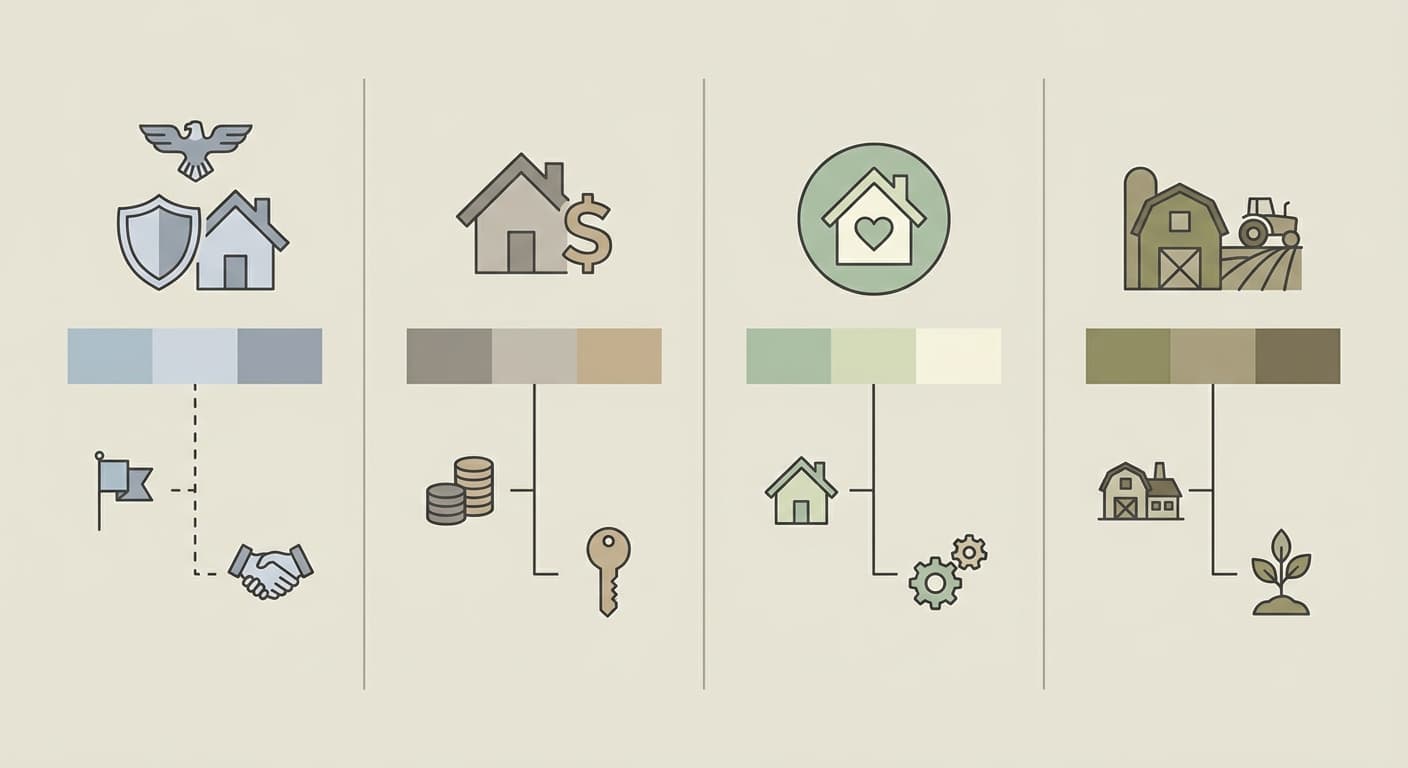
Government-backed loans carry the lowest note rates in 2026. VA and USDA mortgage rates typically run 0.25-0.50% below a comparable 30-year conventional rate, FHA lands roughly even with or slightly under conventional on the note rate, and conventional sits at the top of the range for average-credit borrowers. On a $400,000 loan, the gap between a 6.875% conventional rate and a 6.25% VA rate is about $165 a month and roughly $59,000 in interest over 30 years. But the note rate is only half the story. Mortgage insurance, funding fees, and guarantee fees change which loan is actually cheapest, so you have to compare APR and total cost, not just the advertised rate.
This guide is about one thing: how the interest rate differs across the four major loan programs and what that rate gap costs you over time. If you want a full breakdown of eligibility, credit-score minimums, down-payment rules, and which program you qualify for, read our companion guide, Mortgage Types Comparison: FHA vs VA vs Conventional Loans. Here we stay focused on rates, APR, points, and lifetime interest.
Before you compare lender quotes, run your scenario through the FHA Loan Calculator to see how the rate and mortgage insurance interact on an FHA loan, then compare it against a conventional payment using the Mortgage Calculator.
Why Government-Backed Loans Price Lower
The reason VA, USDA, and FHA loans carry lower note rates than conventional loans comes down to risk. When a loan is backed by a federal guarantee, the lender's loss exposure if you default is far smaller, so they can offer a lower rate. A VA loan is partially guaranteed by the Department of Veterans Affairs. A USDA loan is guaranteed by the U.S. Department of Agriculture's Rural Development program. An FHA loan is insured by the Federal Housing Administration.
A conventional loan has no government guarantee. Instead, the lender prices in the risk directly, which is why conventional rates run higher for borrowers with average credit and why a strong credit score matters far more on a conventional loan than on a government-backed one. According to Freddie Mac's Primary Mortgage Market Survey, conventional 30-year fixed rates are the benchmark the whole market quotes against, and government programs price relative to it.
The trade-off: government-backed loans recover that lower rate through insurance or fees. FHA charges a mortgage insurance premium (MIP), USDA charges a guarantee fee, and VA charges a one-time funding fee. So a lower note rate does not automatically mean a lower total cost. That is the central tension of this comparison.
Side-by-Side Rate Comparison
The table below shows typical 2026 ranges for a 30-year fixed mortgage for a borrower with average-to-good credit. Note rate is the interest rate used to calculate your principal and interest payment. APR folds in mortgage insurance, fees, and most closing costs, which is why the APR column tells you more than the note rate alone.
| Loan Type | Typical Note Rate | Relative to Conventional | Mortgage Insurance / Fee | APR Tends To Be |
|---|---|---|---|---|
| Conventional | 6.625-7.00% | Baseline | PMI if down payment < 20% | Close to note rate with 20% down |
| FHA | 6.375-6.75% | About 0.00-0.25% lower | MIP: 1.75% upfront + 0.55%/yr | Higher than note rate (MIP) |
| VA | 6.125-6.50% | About 0.25-0.50% lower | Funding fee: 1.25-3.30% once | Close to note rate (no monthly MI) |
| USDA | 6.125-6.50% | About 0.25-0.50% lower | 1.00% upfront + 0.35%/yr | Slightly above note rate |
A few things to read carefully. The lowest note rates are VA and USDA. But VA has no monthly mortgage insurance at all, while USDA has a small 0.35% annual fee, so VA usually wins on APR among the low-rate options. FHA's note rate is competitive, but its 0.55% annual MIP often runs for the life of the loan when you put less than 10% down, which pushes the effective APR above conventional in many cases. Conventional looks expensive on the note rate but becomes the cheapest option once you cross 20% equity and drop PMI entirely.
What the Rate Gap Actually Costs
Rate differences sound small as percentages and feel large as dollars. Here is the principal-and-interest math on a $400,000 loan over a 30-year fixed term, calculated with the standard amortization formula:
| Note Rate | Monthly P&I | Total Paid (360 mo) | Total Interest |
|---|---|---|---|
| 7.000% (conventional, weaker credit) | $2,661.21 | $958,036 | $558,036 |
| 6.875% (conventional, average) | $2,627.72 | $945,979 | $545,979 |
| 6.500% (FHA / conventional, good credit) | $2,528.27 | $910,177 | $510,177 |
| 6.250% (VA / USDA) | $2,462.87 | $886,633 | $486,633 |
The gap between the 6.875% average conventional rate and the 6.25% VA/USDA rate is $164.85 per month. Over the full 360-month term, that is $59,346 in additional interest on the conventional loan, holding the $400,000 loan amount constant. That is the pure rate effect, before any mortgage insurance or fees enter the picture.
This is exactly why the note rate alone can mislead you. A VA loan at 6.25% with no monthly mortgage insurance is dramatically cheaper than a conventional loan at 6.875% with PMI. But the same VA rate compared against a conventional loan where you put 20% down and the borrower has a 760 credit score that earns 6.50% is a much smaller real-world gap, because the conventional borrower has no PMI either. Always compare the full payment, not just the rate.
How Mortgage Insurance and Fees Change the Math
The note rate gap favors government loans. Insurance and fees claw some of it back. Here is how each program's add-on works on a $300,000 loan so you can compare the mechanisms directly.
FHA — Mortgage Insurance Premium (MIP). FHA charges an upfront MIP of 1.75% of the loan amount, which is $5,250 on a $300,000 loan and is usually rolled into the balance. It also charges an annual MIP of 0.55% for most 30-year loans with the minimum down payment, which is $1,650 a year, or about $137.50 per month. With less than 10% down, that monthly MIP lasts the life of the loan. This is the single biggest reason an FHA loan with a low note rate can still have a higher APR than conventional.
VA — Funding Fee. VA loans have no monthly mortgage insurance at all. Instead there is a one-time funding fee. For a first-use, zero-down purchase it is 2.15% of the loan, which is $6,450 on a $300,000 loan, and it can be financed into the balance. Subsequent uses run higher, up to 3.30%. Veterans with a service-connected disability are exempt from the funding fee entirely, which makes a VA loan the cheapest option on the board for many of them. Because there is no recurring mortgage insurance, the VA APR stays close to its note rate.
USDA — Guarantee Fee. USDA charges a 1.00% upfront guarantee fee, which is $3,000 on a $300,000 loan and is typically financed, plus a 0.35% annual fee, which is $1,050 a year, or about $87.50 per month. That annual fee is lower than FHA's MIP, so a USDA loan with the same note rate as FHA generally has a lower effective cost, though USDA is limited to eligible rural and suburban areas and income caps apply.
Conventional — PMI. Private mortgage insurance applies only when your down payment is under 20%, and unlike FHA's MIP it can be cancelled once you reach 20% equity. PMI rates vary with credit score and down payment, typically 0.3-1.5% of the loan annually. The key difference is that PMI is temporary and FHA MIP often is not, which can flip the long-term cost comparison in conventional's favor.
For a side-by-side on how MIP, PMI, funding fees, and the rest of your payment stack up line by line, see What's Really In Your Mortgage Payment?.
APR vs Interest Rate: Why You Compare APR
The interest rate (the note rate) determines your monthly principal-and-interest payment. The APR is a broader number that includes the note rate plus mortgage insurance, origination fees, discount points, and most other lender charges, expressed as a single annualized percentage. Federal Truth in Lending rules require lenders to disclose APR precisely so borrowers can compare offers on an equal footing.
Here is why this matters for cross-program shopping. An FHA loan quoted at 6.50% might carry an APR of 7.3% or higher once the 1.75% upfront MIP and 0.55% annual MIP are baked in. A VA loan quoted at 6.25% with only a financed funding fee and no monthly insurance might show an APR of 6.45%. The VA loan's APR is far lower even though the note-rate gap is only 0.25%, because the FHA loan carries a much heavier insurance load. When two lenders quote the same note rate, the one with the lower APR is the cheaper loan. When you compare across programs, APR is the only fair comparison.
Buying Down Your Rate With Points
Discount points let you pay cash upfront to lower your note rate, and the math is the same regardless of loan program. One point equals 1% of the loan amount. As a rough rule, one point buys down the rate by about 0.25%, though the exact buydown varies by lender and market.
On a $400,000 loan, paying one point costs $4,000 and might drop your rate from 6.875% to 6.625%. That lowers the monthly P&I from $2,627.72 to $2,561.24, a savings of $66.48 per month. Dividing the $4,000 cost by the $66.48 monthly savings gives a breakeven of about 60 months, or five years. If you will keep the loan and the rate longer than five years, buying the point pays off. If you plan to sell or refinance sooner, you lose money on the point.
Points are especially worth modeling on government loans because the buydown stacks on top of an already-low note rate. Run your own buydown scenarios in the Mortgage Points Calculator before committing cash at closing. For VA borrowers specifically, the VA Loan Calculator shows how the funding fee and a rate buydown interact on the same loan.
Which Loan Has the Lowest Rate for You
Putting the rate logic together:
- Eligible veterans and active military: A VA loan almost always wins on rate and total cost. The note rate runs 0.25-0.50% below conventional, there is no monthly mortgage insurance, and disabled veterans skip the funding fee. This is the cheapest financing on the market for those who qualify.
- Buyers in eligible rural and suburban areas under the income cap: A USDA loan matches VA on note rate and carries only a modest 0.35% annual fee with zero down. If you qualify geographically and by income, it is hard to beat on rate.
- Average credit, low down payment, not eligible for VA or USDA: FHA gives you a competitive note rate and easier qualifying, but watch the APR. The lifetime MIP can make it more expensive than conventional over a long hold, so model the total cost, not just the rate.
- Good-to-excellent credit with 20% down: Conventional has the highest headline note rate but no mortgage insurance, and strong credit narrows the rate gap considerably. Over a long hold with PMI cancelled at 20% equity, conventional is frequently the cheapest path on total cost.
The right answer depends on your credit, down payment, eligibility, and how long you will hold the loan. Compare the full payment and APR across at least two programs you qualify for before you lock a rate. If you are deciding whether to refinance from one program into another, our Mortgage Refinance Guide covers when an FHA-to-conventional switch makes sense to drop the lifetime MIP.
Frequently Asked Questions
Are VA loan rates really lower than conventional rates in 2026?
Yes. VA loan note rates typically run 0.25-0.50% below a comparable 30-year conventional rate in 2026 because the loan carries a partial federal guarantee that lowers the lender's risk. On a $400,000 loan, moving from a 6.875% conventional rate to a 6.25% VA rate cuts the monthly principal-and-interest payment from $2,627.72 to $2,462.87, a savings of about $165 per month and roughly $59,000 in interest over the full 30-year term. The advantage is even larger in practice because VA loans carry no monthly mortgage insurance, while a low-down-payment conventional loan adds PMI on top of the higher rate. The one cost VA borrowers do pay is a one-time funding fee of 1.25-3.30% of the loan, though veterans with a service-connected disability are exempt. Compare the full APR, not just the note rate, to see the true gap.
Why is the FHA APR higher than its interest rate?
FHA's APR runs noticeably above its note rate because of mortgage insurance. FHA charges an upfront mortgage insurance premium of 1.75% of the loan amount plus an annual MIP of 0.55% for most 30-year loans with the minimum down payment. On a $300,000 loan, that annual MIP is about $137.50 per month, and with less than 10% down it usually lasts the life of the loan. APR folds those insurance costs into a single annualized percentage, so an FHA loan quoted at a 6.50% note rate can show an APR above 7.3%. This is exactly why you compare APR across loan programs rather than the advertised rate. A VA loan with a lower note rate and no monthly insurance will show a much lower APR than an FHA loan even when the note rates look similar.
Do USDA loans have lower rates than conventional loans?
USDA loan note rates are competitive with VA and typically run 0.25-0.50% below conventional, again because of the federal guarantee through the USDA Rural Development program. USDA loans also allow zero down payment. The cost USDA recovers is a 1.00% upfront guarantee fee (about $3,000 on a $300,000 loan, usually financed) and a 0.35% annual fee (about $87.50 per month on that loan). That annual fee is lower than FHA's 0.55% MIP, so a USDA loan with the same note rate as FHA generally costs less over time. The catch is eligibility: the property must be in a USDA-designated rural or suburban area, and your household income must fall under the program's limit for your county. If you meet both, USDA offers one of the lowest effective rates available.
How much does buying down my mortgage rate with points cost?
One discount point equals 1% of the loan amount and as a rule of thumb lowers your note rate by about 0.25%, though the exact buydown varies by lender. On a $400,000 loan, one point costs $4,000 and might drop the rate from 6.875% to 6.625%, cutting the monthly principal-and-interest payment by $66.48, from $2,627.72 to $2,561.24. Dividing the $4,000 cost by the $66.48 monthly savings gives a breakeven of about 60 months, or five years. If you keep the loan longer than the breakeven period, the point saves you money; if you sell or refinance sooner, it does not pay off. Points work on every loan program, so you can stack a buydown on top of an already-low VA or USDA rate. Model your own scenario in the Mortgage Points Calculator before paying for points at closing.
Should I compare interest rate or APR when shopping across loan types?
Compare APR when shopping across different loan programs, and compare the note rate only when two lenders are quoting the same loan type with the same fees. APR includes the note rate plus mortgage insurance, origination charges, and discount points, expressed as one annualized number, which makes it the only fair way to compare an FHA loan against a VA loan against a conventional loan. A lower note rate with heavy mortgage insurance, as on many FHA loans, can produce a higher APR than a slightly higher note rate with no insurance, as on many VA loans. Federal Truth in Lending rules require lenders to disclose APR on the Loan Estimate so you can do this comparison directly. Look at the APR and the total payment together: APR tells you the all-in cost rate, and the monthly payment tells you what you actually pay each month.
Does my credit score affect government-backed loan rates the same way it affects conventional rates?
No, and this is one of the most useful facts in rate shopping. On a conventional loan, your credit score has a large effect on the rate because the lender prices your default risk directly, so the difference between a 620 and a 760 score can be a full percentage point or more. On government-backed loans (VA, FHA, USDA), the federal guarantee or insurance absorbs much of that risk, so the rate is far less sensitive to your exact credit score. A borrower with a mid-600s score will often get a much better rate on an FHA or VA loan than on a conventional loan, while a borrower with excellent credit and 20% down may do better on conventional once PMI is off the table. This is why the same borrower can get very different "best" answers depending on their credit profile, and why you should request quotes for every program you qualify for.
Rate ranges reflect typical 2026 conditions for average-to-good-credit borrowers on a 30-year fixed mortgage; conventional benchmark from Freddie Mac's Primary Mortgage Market Survey. FHA MIP figures from HUD/FHA mortgagee guidance; VA funding fee schedule from the Department of Veterans Affairs; USDA guarantee fee from USDA Rural Development. All payment, interest, and breakeven figures calculated with the standard amortization formula. APR disclosure is governed by federal Truth in Lending rules. Actual rates vary by lender, credit score, down payment, loan amount, and location — request a Loan Estimate from multiple lenders before locking.
This article is provided for informational and educational purposes only. Content should not be considered professional financial, medical, legal, or other advice. Always consult a qualified professional before making important decisions. UseCalcPro is not responsible for any actions taken based on the information in this article.