What's Really In Your Mortgage Payment? The Complete Breakdown
Opening a first mortgage statement is a common source of sticker shock. The lender quotes $1,847/month. The actual payment? $2,634. That extra $787 covers property taxes, insurance, and PMI that often go unexplained during closing.
When you get a mortgage quote, that monthly number isn't just about paying back the loan. Your actual payment includes taxes, insurance, and fees that can add hundreds of dollars to your bill. Let's break down exactly what you're paying for — and how to avoid that kind of surprise.
Calculate Your True Monthly Payment
Use our mortgage calculator to see all the components of your payment, including taxes, insurance, and PMI:
The Four Parts of Your Payment (PITI)
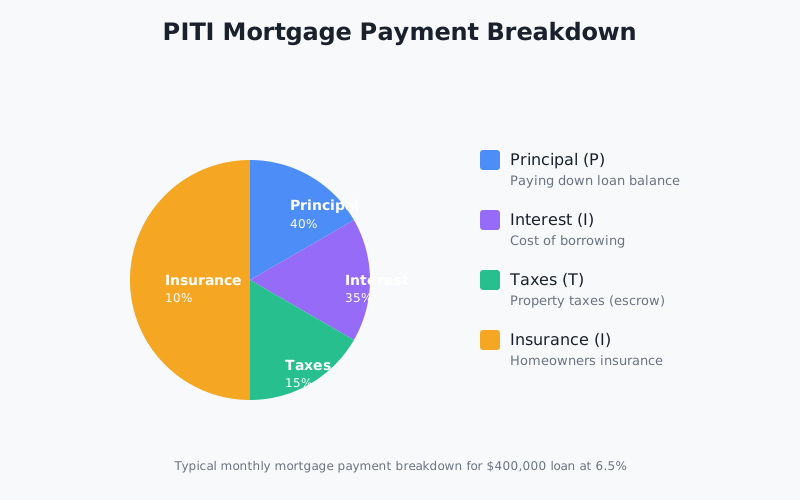
Your mortgage payment is often called "PITI" — an acronym for its four main components:
- Principal — paying down your loan balance
- Interest — the cost of borrowing money
- Taxes — property taxes held in escrow
- Insurance — homeowners insurance (plus PMI if applicable)
Let's dive into each one.
1. Principal and Interest: The Core Payment
This is the foundation — paying back what you borrowed plus the lender's profit. According to the Consumer Financial Protection Bureau (CFPB), understanding how your payment is structured helps you make informed decisions about your loan.
How It's Calculated
The monthly payment uses this amortization formula, which is the standard calculation method used by lenders nationwide:
M = P × [r(1+r)^n] / [(1+r)^n – 1]
Where:
- M = Monthly payment
- P = Loan principal (home price minus down payment)
- r = Monthly interest rate (annual rate ÷ 12)
- n = Total number of payments (years × 12)
The Amortization Flip
Here's something most buyers don't realize: in the early years, most of your payment goes to interest, not principal.
Example: $400,000 loan at 6.5% for 30 years
| Year | Interest Paid | Principal Paid | Balance Reduction |
|---|---|---|---|
| 1 | $25,800 (91%) | $2,500 (9%) | Slow |
| 15 | $14,000 (50%) | $14,000 (50%) | Equal |
| 30 | $1,500 (5%) | $26,800 (95%) | Fast |
This is why building equity feels painfully slow at first — and why extra payments early in the loan have the biggest impact.
15-Year vs 30-Year: The Real Difference
| Metric | 15-Year | 30-Year |
|---|---|---|
| Monthly Payment | $3,484 | $2,528 |
| Total Interest | $227,000 | $510,000 |
| Interest Savings | $283,000 | — |
Tip
Can't afford the 15-year payment? Get a 30-year mortgage but make extra payments when you can. You'll save interest without being locked into the higher required payment.
Interest Rate Sensitivity
Small rate changes have massive long-term effects:
- 0.25% higher rate = ~$17,000 more interest over 30 years
- 0.5% higher rate = ~$35,000 more interest
- 1% higher rate = ~$72,000 more interest
Important
Always shop multiple lenders. A 0.25% rate difference might seem trivial, but it's worth $17,000+ over the life of your loan. Get at least 3-5 quotes.
2. Property Taxes: The Hidden Variable
Property taxes are collected monthly by your lender and held in escrow until the annual bill is due.
Why Taxes Vary So Much
Property tax rates depend on:
- State — New Jersey averages 2.5%, Hawaii just 0.3%
- County — Can vary 50%+ within the same state
- School district — Better schools often mean higher taxes
- Property assessment — What the county thinks your home is worth
Real Examples
| Location | Home Value | Tax Rate | Annual Tax | Monthly |
|---|---|---|---|---|
| Texas suburb | $400,000 | 2.1% | $8,400 | $700 |
| California coast | $800,000 | 1.1% | $8,800 | $733 |
| New Jersey | $500,000 | 2.5% | $12,500 | $1,042 |
Warning
Don't trust calculator defaults! Most online calculators use 1.0-1.1% for taxes. If you're in Texas, New Jersey, or Illinois, your actual rate could be 2x higher. Always look up the specific property's tax history on the county assessor's website.
The Lender's Safety Margin
When qualifying you for a loan, lenders often estimate taxes conservatively:
- California lenders commonly use 1.25% (higher than actual)
- This protects them but can affect how much you qualify for
3. Homeowners Insurance: Location Matters
Your lender requires insurance to protect their investment (your home is their collateral).
Typical Costs
| Risk Level | Monthly Cost | Annual Cost |
|---|---|---|
| Low risk (midwest) | $65–$100 | $780–$1,200 |
| Average | $100–$150 | $1,200–$1,800 |
| High risk (coastal, wildfire) | $200–$400+ | $2,400–$4,800+ |
What Affects Your Premium
- Location — Flood zones, wildfire areas, hurricane regions
- Home age — Older homes cost more to insure
- Construction — Wood frame vs. brick/concrete
- Deductible — Higher deductible = lower premium
- Credit score — Yes, insurers check this too
Warning
California and Florida buyers beware: Insurance markets in these states are volatile. Some areas have seen premiums double in recent years. Get actual quotes before assuming you can afford a home in high-risk zones.
The Calculator Trap
Most mortgage calculators default to $30–$50/month for insurance. That's wildly optimistic for many areas.
Before you fall in love with a home:
- Get a real insurance quote for that specific property
- Check if it's in a flood zone (requires separate flood insurance)
- Ask the seller what they currently pay
4. Mortgage Insurance: The Down Payment Penalty
If you put down less than 20%, you'll pay extra for mortgage insurance.
Conventional Loans: PMI
Private Mortgage Insurance (PMI) protects the lender if you default.
| Down Payment | Credit Score | Typical PMI Rate | Monthly Cost* |
|---|---|---|---|
| 3% | 760+ | 0.3% | $100 |
| 5% | 720–759 | 0.5% | $167 |
| 10% | 680–719 | 0.8% | $267 |
| 15% | 640–679 | 1.2% | $400 |
*Based on $400,000 loan
Tip
PMI isn't forever. Once you reach 20% equity (through payments or appreciation), you can request PMI removal. At 22% equity, lenders must remove it automatically.
FHA Loans: MIP
FHA loans have their own version called Mortgage Insurance Premium (MIP). According to FHA guidelines, current MIP rates are:
- Upfront fee: 1.75% added to loan balance
- Annual premium: 0.55% (paid monthly)
- Duration: Usually for the life of the loan if down payment was under 10%
For the most current FHA MIP rates, check the official HUD website.
Example: $400,000 FHA loan with 3.5% down
- Upfront MIP: $6,790 added to balance
- Monthly MIP: $177/month
- Total over 30 years: $70,000+ in insurance alone
Important
FHA isn't always cheaper. While FHA allows lower down payments and credit scores, the lifetime MIP can cost more than conventional PMI that eventually disappears. Run the numbers both ways.
5. HOA Fees: The Invisible Expense
If you're buying a condo, townhouse, or home in a planned community, HOA fees are part of your real monthly cost.
Typical HOA Costs
| Property Type | Monthly Fee Range |
|---|---|
| Basic suburban HOA | $50–$100 |
| Townhouse community | $100–$250 |
| Condo (urban) | $200–$500 |
| Luxury condo | $500–$1,500+ |
What HOAs Cover
- Exterior maintenance
- Common area upkeep
- Amenities (pool, gym, security)
- Reserve fund for major repairs
- Sometimes water, trash, cable
Warning
HOA fees aren't in your mortgage payment. You pay these separately, but lenders count them when calculating your debt-to-income ratio. A $400 HOA fee reduces how much house you qualify for.
Extra Payments: What Actually Happens
There's a common misconception about making extra mortgage payments.
What Extra Payments DO
- Reduce your principal balance faster
- Shorten your loan term (potentially by years)
- Save significant interest over time
- Build equity faster
What Extra Payments DON'T Do
- Lower your required monthly payment
- Change your payment due date
- Reduce next month's minimum payment
Tip
Want a lower monthly payment? You need to either refinance or request a "recast." A recast requires a large lump-sum payment (usually $10,000+) and a fee, but it re-amortizes your loan for a lower monthly bill without refinancing costs.
The Real Cost: A Complete Example
Let's put it all together for a typical purchase:
Scenario: $425,000 home, 10% down, 6.5% rate, 30 years
| Component | Monthly | Annual |
|---|---|---|
| Principal & Interest | $2,419 | $29,028 |
| Property Tax (1.5%) | $531 | $6,375 |
| Homeowners Insurance | $140 | $1,680 |
| PMI (0.5%) | $159 | $1,913 |
| Total PITI | $3,249 | $38,996 |
| HOA (if applicable) | $175 | $2,100 |
| True Monthly Cost | $3,424 | $41,096 |
That's $1,005/month beyond just principal and interest — or 41% more than the "mortgage payment" you might see advertised.
This gap catches almost every first-time buyer off guard. It is common enough that buyers occasionally consider backing out at closing when they see the real number, especially after already selling a previous home.
Avoiding Calculator Mistakes
Online mortgage calculators can be dangerously inaccurate. The Federal Reserve recommends verifying all calculations with actual lenders before making financial decisions. Here's how to get real numbers:
Common Calculator Problems
- Taxes too low — Many default to 1.0%, actual rates often 1.5–2.5%
- Insurance too low — $35/month default vs. $150+ reality
- PMI missing — Some calculators ignore it entirely
- HOA excluded — Never included automatically
How to Calculate Accurately
- Property taxes: Look up the specific property on the county assessor website (most counties provide online databases)
- Insurance: Get a quote from an insurance agent for that address — rates vary significantly by location
- PMI: Ask lenders for rate sheets based on your credit score — rates can vary by 0.5% or more between lenders
- HOA: Check listing details or ask the seller — this is often overlooked but can add hundreds monthly
Use our Mortgage Calculator with accurate inputs for each field to see your true monthly cost. For a deeper dive into mortgage calculations, see our complete mortgage calculator guide.
Frequently Asked Questions
What is PITI in a mortgage?
PITI stands for Principal, Interest, Taxes, and Insurance — the four main components of a typical mortgage payment. Principal reduces your loan balance, interest is the cost of borrowing, taxes cover property taxes, and insurance includes homeowners insurance plus PMI if applicable. Your lender collects all four in one monthly payment and holds taxes and insurance in an escrow account, paying these bills on your behalf when due. On a $350,000 home, PITI typically adds $400-$800 beyond the basic principal and interest payment.
How much of my payment goes to principal?
In the early years of a 30-year mortgage, only about 10-15% of your payment goes toward principal, while 85-90% goes to interest. This ratio gradually shifts due to amortization. By year 15, the split is roughly 50/50. In the final years, 90%+ of each payment reduces your principal balance. For example, on a $300,000 loan at 6.5%, your first payment puts just $354 toward principal, but payment #300 puts $1,750 toward principal. This is why making extra payments early in your loan saves the most interest.
Can I avoid PMI with less than 20% down?
Some options exist: VA loans (no PMI for eligible veterans), lender-paid PMI (higher rate instead), or piggyback loans (80-10-10 structure). Each has trade-offs worth discussing with a lender. For more details on VA loan benefits, see our complete guide to mortgage types.
Why is my escrow payment changing?
Escrow adjusts annually based on actual tax and insurance bills. If taxes increased or your insurance premium rose, your escrow — and total payment — increases too. Lenders also maintain a cushion (typically 2 months' worth of payments), which can cause fluctuations. According to CFPB regulations, lenders must provide an annual escrow analysis statement explaining any changes.
Should I pay extra on my mortgage?
It depends on your interest rate and other financial goals. At 6%+ rates, extra payments provide a guaranteed "return." At lower rates, investing the money might yield better returns. Also consider having an emergency fund first.
Related Articles
- Mortgage Calculator: Complete Guide — Learn how mortgage calculations work, understand different loan types, and discover strategies to save money on your home loan
- Mortgage Refinance Guide — Learn when refinancing makes sense and how to calculate your potential savings
- First-Time Homebuyer Guide — Complete step-by-step guide for first-time buyers, including down payment and mortgage options
- Down Payment Guide — Everything about down payments, minimum requirements, and assistance programs
- Mortgage Types Comparison — Compare FHA, VA, conventional, and USDA loans to find the best option
Related Calculators
- Mortgage Calculator — Calculate your complete PITI payment with all components
- Mortgage Refinance Calculator — See if refinancing saves money based on current rates
- Home Equity Calculator — Track your equity growth over time
- Closing Cost Calculator — Estimate upfront costs when buying a home
- FHA Loan Calculator — Compare FHA vs conventional loan options
- Rent vs Buy Calculator — Should you rent or buy? Calculate the true costs
This guide provides general information for educational purposes. Consult with a mortgage professional for advice specific to your situation.
This article is provided for informational and educational purposes only. Content should not be considered professional financial, medical, legal, or other advice. Always consult a qualified professional before making important decisions. UseCalcPro is not responsible for any actions taken based on the information in this article.
Try These Calculators
Figure out your monthly mortgage payment with principal, interest, taxes, and insurance included. See total cost and amortization schedule side by side.
Enter your home price, down payment, and loan type to estimate closing costs. See lender fees, title fees, government fees, and prepaid items broken out.
Calculate FHA loan payments including MIP (mortgage insurance premium). Estimate monthly payments, down payment, and total costs for FHA mortgages. Compare.
Calculate your rental property's operating expense ratio and get a full cost breakdown by category. Compare per-unit expenses against industry benchmarks.
Estimate 2026 homeowners insurance annual premium by dwelling coverage, ZIP, home age, roof age, construction, and deductible. National avg $2,550, FL $5,940+.