Down Payment Guide: How Much You Need and How to Save It
Down payments commonly range from 5% on a first home to 10%, and up to 25% or more on a later purchase. The size of the down payment affects everything — not just the monthly payment, but negotiating power, stress levels, and long-term wealth.
The down payment is often the biggest barrier to homeownership. But here's what most guides won't tell you: the "right" down payment isn't always 20%. This guide explains when to put down less, when to wait for more, and how to weigh the trade-offs when buying today.
Calculate Your Down Payment Impact
See how your down payment affects your monthly payment:
What is a Down Payment?
A down payment is the upfront cash you pay toward your home purchase. The rest is financed through your mortgage. According to the Consumer Financial Protection Bureau (CFPB), down payments typically range from 3% to 20% of the home's purchase price.
Example: $400,000 home
- 3% down: $12,000
- 10% down: $40,000
- 20% down: $80,000
Minimum Down Payment Requirements
Conventional Loans
| Down Payment | PMI Required? | Best For |
|---|---|---|
| 3% | Yes | First-time buyers |
| 5% | Yes | Buyers with good credit |
| 10% | Yes | Buyers wanting lower PMI |
| 20% | No | Buyers avoiding PMI |
Minimum: 3% for qualified buyers (some programs allow a lower percentage)
FHA Loans
| Credit Score | Minimum Down Payment |
|---|---|
| 580+ | 3.5% |
| 500-579 | 10% |
Minimum: 3.5% for borrowers with credit scores of 580+
Learn more about FHA loans and requirements.
VA Loans
Down Payment: 0% required
Available to eligible veterans and active-duty service members. No PMI required.
USDA Loans
Down Payment: 0% required
Available for properties in eligible rural areas. Income limits apply.
For a complete comparison, see our Mortgage Types Comparison Guide.
Why 20% Down Payment?
Benefits of 20% Down
- No PMI: Private Mortgage Insurance adds $100-$300/month until you reach 20% equity
- Lower monthly payment: Smaller loan = lower payment
- Better interest rates: Lenders often offer better rates for larger down payments
- More equity: Start with more ownership stake in your home
- Stronger offer: Sellers prefer buyers with larger down payments
Example: $400,000 home
- 10% down ($40,000): $360,000 loan, PMI required
- 20% down ($80,000): $320,000 loan, no PMI
Monthly payment difference: $200-$400 less with 20% down (including PMI savings)
Tip
Don't wait for 20% if you're ready to buy. Consider a buyer who debates waiting another 2 years to save 20% for a second home. In that time, home prices in the area rise 18% — the buyer ends up paying $65,000 more for the same house. Sometimes PMI is cheaper than waiting.
Down Payment Impact on Monthly Payment
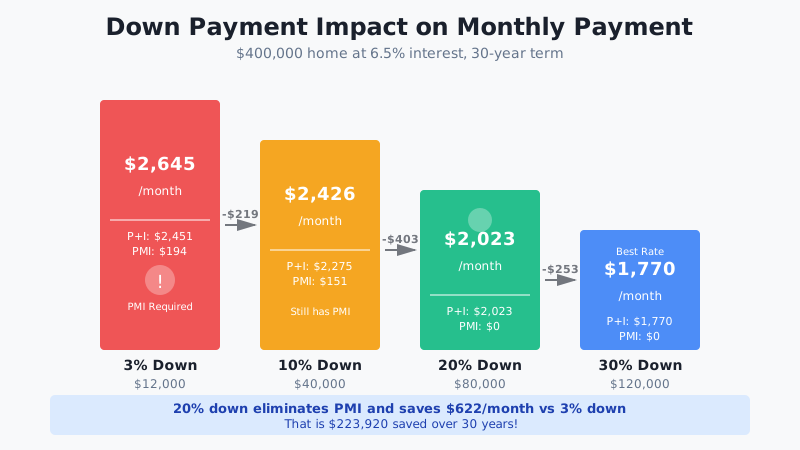
How Down Payment Affects Your Payment
| Home Price | Down Payment | Loan Amount | Monthly Payment* | PMI |
|---|---|---|---|---|
| $400,000 | 3% ($12,000) | $388,000 | $2,450 | $194 |
| $400,000 | 10% ($40,000) | $360,000 | $2,275 | $150 |
| $400,000 | 20% ($80,000) | $320,000 | $2,023 | $0 |
*Based on 6.5% interest rate, 30-year term. Payment includes principal and interest only.
Use our Mortgage Calculator to calculate your specific scenario.
Down Payment Assistance Programs
Federal Programs
FHA Loans
- Down payment as low as 3.5%
- Can use gift funds from family
- Lower credit score requirements
VA Loans
- 0% down payment required
- No PMI
- Available to eligible veterans
USDA Loans
- 0% down payment required
- For rural and suburban properties
- Income limits apply
State and Local Programs
Many states offer down payment assistance:
Types of Assistance:
- Grants: Free money (don't repay)
- Forgivable loans: Forgiven after living in home for set period
- Deferred loans: Repay when you sell or refinance
- Low-interest loans: Second mortgage with favorable terms
Example Programs:
- California: CalHFA programs offer up to 3% assistance
- Texas: TSAHC offers down payment assistance
- Florida: Florida Housing offers various programs
Check HUD's list of state programs for your area.
Employer Programs
Some employers offer:
- Down payment matching programs
- Low-interest loans
- Homebuyer education and counseling
Check with your HR department.
Non-Profit Programs
Organizations like:
- Habitat for Humanity
- Local housing nonprofits
- Community development organizations
How to Save for a Down Payment
Strategy 1: Set a Target Amount
Calculate your target:
- Determine home price range
- Calculate down payment (3.5% - 20%)
- Add closing costs (2% - 5%)
- Add moving expenses ($1,000 - $5,000)
- Add emergency fund buffer
Example: $375,000 home
- 10% down: $37,500
- Closing costs: $11,250
- Moving: $3,000
- Buffer: $5,000
- Total needed: $56,750
Strategy 2: Create a Savings Plan
The 50/30/20 Rule:
- 50%: Needs (housing, food, utilities)
- 30%: Wants (entertainment, dining out)
- 20%: Savings and debt repayment
For down payment savings, aim for:
- 20% of income to savings
- Or specific monthly amount ($500, $1,000, etc.)
Strategy 3: Cut Expenses
Quick wins:
- Cancel unused subscriptions
- Cook at home more
- Reduce dining out
- Cut cable/streaming services
- Shop around for insurance
- Refinance high-interest debt
Example: Saving $750/month = $9,000/year = $45,000 in 5 years — enough for a 10% down payment on a $450,000 home
Strategy 4: Increase Income
Options:
- Ask for a raise
- Take on side work
- Sell unused items
- Rent out a room
- Start a side business
Strategy 5: Use Windfalls
Put unexpected money toward your down payment:
- Tax refunds
- Bonuses
- Gifts
- Inheritance
- Work reimbursements
Strategy 6: High-Yield Savings Account
Keep your down payment in a high-yield savings account:
- Earn interest while saving
- FDIC insured
- Easy access when needed
- Current rates: 4-5% APY
Down Payment vs. Other Priorities
Should You Pay Off Debt First?
It depends:
Pay debt first if:
- High-interest debt (credit cards > 15%)
- Debt-to-income ratio too high for mortgage approval
- Debt payments prevent saving
Save for down payment first if:
- Low-interest debt (student loans, car loans)
- Can do both simultaneously
- Home prices rising faster than you can save
Should You Use Retirement Savings?
Generally not recommended, but:
401(k) Loan:
- Borrow up to $50,000 or 50% of balance
- Repay with interest to yourself
- No early withdrawal penalty
- Must repay if you leave job
IRA Withdrawal:
- First-time buyers can withdraw $10,000 penalty-free
- Still pay income tax
- Reduces retirement savings
Roth IRA:
- Can withdraw contributions (not earnings) penalty-free
- Better option than traditional IRA
Warning
Think carefully before using retirement savings. You're sacrificing future retirement security for current home purchase. Consider all options first.
Common Down Payment Mistakes
Mistake 1: Not Saving Enough
Don't forget closing costs, moving expenses, and emergency fund. Down payment alone isn't enough.
Mistake 2: Using All Your Savings
Keep an emergency fund (3-6 months expenses) separate from your down payment. Unexpected expenses happen.
Mistake 3: Not Researching Assistance Programs
Many buyers don't know about down payment assistance. Research state, local, and employer programs.
Mistake 4: Waiting for Perfect Conditions
Home prices and interest rates change. If you're ready financially, don't wait indefinitely for 20% down.
Mistake 5: Not Understanding PMI
PMI adds to your monthly payment until you reach 20% equity. Factor this into your budget.
Learn more about PMI and how it works.
Frequently Asked Questions
What's the minimum down payment I need?
The minimum down payment varies by loan type: Conventional loans require just 3% for first-time buyers ($12,000 on a $400,000 home), FHA loans require 3.5% with a 580+ credit score ($14,000), and VA and USDA loans offer 0% down payment options for eligible borrowers. However, putting less than 20% down requires private mortgage insurance (PMI), which adds $100-$300 monthly to your payment. Many financial experts recommend saving at least 10% down to balance affordability with lower monthly costs.
Can I use gift money for a down payment?
Yes, for most loan types. The donor must provide a gift letter stating the money is a gift (not a loan). There are limits and documentation requirements.
How long does it take to save for a down payment?
Depends on:
- Your savings rate
- Home price in your area
- Down payment percentage
- Assistance programs available
Example: Saving $1,000/month for a $40,000 down payment = 40 months (3.3 years)
Should I wait until I have 20% down?
Not necessarily — waiting to save 20% isn't always the best financial decision. If home prices in your area are rising 5-10% annually, waiting 2-3 years to save more could cost you more than PMI would. PMI typically costs $100-$200/month on a $350,000 home and can be removed once you reach 20% equity through payments or appreciation. However, if you can save 20% within 12-18 months, waiting may be worthwhile to avoid PMI entirely and get better loan terms.
Can I get a down payment assistance grant?
Many states and local programs offer grants. Check HUD's website for programs in your area. Grants don't need to be repaid.
What happens if I can't afford the down payment?
Options:
- Look into down payment assistance programs
- Consider FHA loans (3.5% down)
- Save longer
- Consider less expensive homes
- Look into first-time buyer programs
Related Articles
- First-Time Homebuyer Guide — Complete step-by-step guide for first-time buyers, including down payment strategies
- What's Really In Your Mortgage Payment? — Understand PMI, MIP, and all payment components that affect your monthly cost
- Mortgage Types Comparison — Compare FHA, VA, conventional, and USDA loans and their down payment requirements
- Mortgage Calculator: Complete Guide — Learn how down payment affects your monthly payment and total interest
- Mortgage Refinance Guide — Learn how to refinance to remove PMI once you reach 20% equity
Related Calculators
- Mortgage Calculator — See how down payment affects your monthly payment
- Closing Cost Calculator — Estimate total upfront costs
- Savings Calculator — Plan your down payment savings
This guide provides general information for educational purposes. Consult with a mortgage professional and research local programs for advice specific to your situation.
This article is provided for informational and educational purposes only. Content should not be considered professional financial, medical, legal, or other advice. Always consult a qualified professional before making important decisions. UseCalcPro is not responsible for any actions taken based on the information in this article.
Try These Calculators
Figure out your monthly mortgage payment with principal, interest, taxes, and insurance included. See total cost and amortization schedule side by side.
Estimate a cash offer for your house from market value, condition, and repair costs. We-buy-houses investors pay 70-85% of ARV; iBuyers pay near market value.
Calculate FHA loan payments including MIP (mortgage insurance premium). Estimate monthly payments, down payment, and total costs for FHA mortgages. Compare.
Enter your home price, down payment, and loan type to estimate closing costs. See lender fees, title fees, government fees, and prepaid items broken out.
Type in the original price and discount percentage to see your sale price, total savings, and cost per item when buying multiples. Handles stacked discounts.