Mortgage Types Comparison: FHA vs VA vs Conventional Loans
As a CFP, I've seen clients lose (and save) tens of thousands of dollars based on one decision: which loan type to choose. A veteran client once came to me after getting an FHA loan — nobody told him VA loans existed. He paid $34,000 in unnecessary mortgage insurance over 7 years.
Choosing the right mortgage type can save you thousands of dollars. This guide compares FHA, VA, conventional, and USDA loans so you can pick the best option for your specific situation — not just the one your lender pushes.
Compare Mortgage Types
Calculate payments for different loan types:
Quick Comparison Table
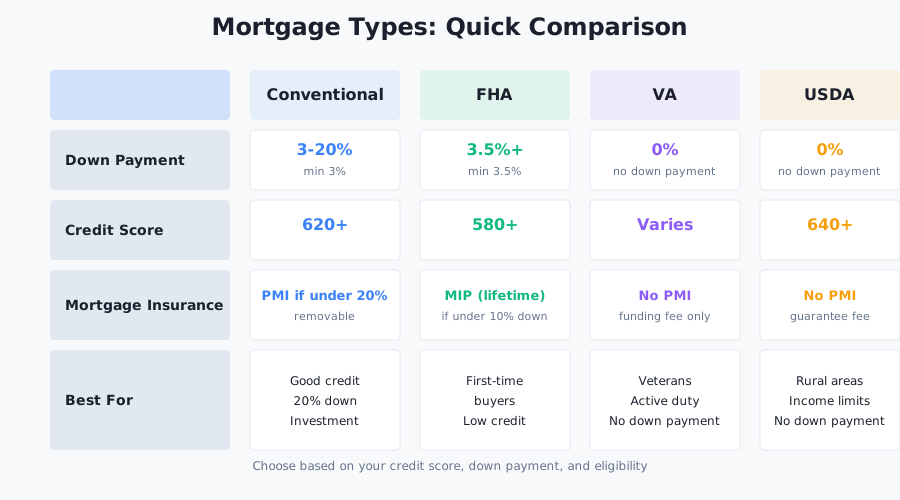
| Loan Type | Down Payment | Credit Score | PMI/MIP | Best For |
|---|---|---|---|---|
| Conventional | 3-20% | 620+ | PMI if < 20% | Good credit, 20% down |
| FHA | 3.5-10% | 500-580+ | MIP (life of loan if < 10% down) | First-time buyers, lower credit |
| VA | 0% | Varies | No PMI | Veterans, active military |
| USDA | 0% | 640+ | No PMI | Rural properties, low-moderate income |
Conventional Loans
Overview
Conventional loans are not backed by the government. They're offered by private lenders and typically sold to Fannie Mae or Freddie Mac.
Requirements
- Credit score: 620+ (better rates at 740+)
- Down payment: 3% minimum (PMI required if < 20%)
- Debt-to-income ratio: Typically 43% maximum (some programs allow up to 50%)
- Private Mortgage Insurance: Required if down payment < 20%
Pros
✅ No upfront mortgage insurance premium
✅ PMI can be removed at 20% equity
✅ Lower rates for borrowers with excellent credit
✅ Flexible terms (15, 20, 30 years)
✅ Can be used for primary residence, second home, or investment property
Cons
❌ Higher credit score requirements
❌ PMI adds to monthly payment
❌ Stricter underwriting standards
❌ Higher down payment needed to avoid PMI
Best For
- Borrowers with credit scores 740+
- Buyers with 20% down payment
- Those wanting to avoid mortgage insurance long-term
- Investment property purchases
Example: $400,000 home, 20% down ($80,000), 6.5% rate, 30 years = $2,023/month (no PMI)
For more on conventional loans, see our Mortgage Calculator Guide.
FHA Loans
Overview
FHA loans are backed by the Federal Housing Administration, part of HUD. They're designed to help first-time buyers and those with lower credit scores.
Requirements
- Credit score: 580+ for 3.5% down, 500-579 for 10% down
- Down payment: 3.5% minimum (with 580+ credit score)
- Debt-to-income ratio: 43% typically (can go up to 50% with compensating factors)
- Mortgage Insurance Premium (MIP): Required
MIP Details
According to FHA guidelines:
- Upfront MIP: 1.75% of loan amount (added to loan balance)
- Annual MIP: 0.55% (paid monthly)
- Duration: Life of loan if down payment < 10%, 11 years if down payment ≥ 10%
Example: $400,000 home, 3.5% down ($14,000), 6.5% rate
- Upfront MIP: $6,790 (added to loan)
- Monthly MIP: $177
- Total MIP over 30 years: $70,000+
Pros
✅ Lower credit score requirements
✅ Lower down payment (3.5%)
✅ Can use gift funds for down payment
✅ More flexible debt-to-income ratios
✅ Assumable loans (buyer can take over your loan)
Cons
❌ Mortgage insurance for life of loan (if < 10% down)
❌ Upfront MIP adds to loan balance
❌ Loan limits vary by area
❌ Property must meet FHA standards
❌ Can only be used for primary residence
Best For
- First-time homebuyers
- Buyers with credit scores 580-680
- Those with limited down payment funds
- Buyers who can't qualify for conventional loans
Example: $400,000 home, 3.5% down ($14,000), 6.5% rate, 30 years = $2,617/month (includes MIP)
Learn more about FHA MIP costs.
VA Loans
Overview
VA loans are guaranteed by the Department of Veterans Affairs for eligible veterans, active-duty service members, and some surviving spouses.
Requirements
- Eligibility: Veteran, active-duty, National Guard, Reserves, or surviving spouse
- Down payment: 0% required
- Credit score: Varies by lender (typically 620+)
- Debt-to-income ratio: Varies by lender
- Funding fee: 0.5% - 3.3% (can be rolled into loan)
Funding Fee
The VA funding fee helps fund the program:
| Down Payment | First-Time Use | Subsequent Use |
|---|---|---|
| 0% | 2.15% | 3.3% |
| 5-9.99% | 1.5% | 1.5% |
| 10%+ | 1.25% | 1.25% |
Disabled veterans are exempt from the funding fee.
Pros
✅ No down payment required
✅ No PMI
✅ Competitive interest rates
✅ No prepayment penalty
✅ Can be used multiple times
✅ Assumable loans
✅ More flexible credit requirements
Cons
❌ Funding fee (unless disabled)
❌ Limited to primary residence
❌ Property must meet VA standards
❌ Loan limits (though many areas have no limit)
Best For
- Eligible veterans and active-duty military
- Buyers with no down payment
- Those wanting to avoid PMI
- Buyers who qualify for funding fee exemption
Example: $400,000 home, 0% down, 6.0% rate, 30 years = $2,451/month (no PMI, funding fee rolled into loan)
USDA Loans
Overview
USDA loans are backed by the U.S. Department of Agriculture for properties in eligible rural and suburban areas.
Requirements
- Location: Property must be in eligible rural/suburban area
- Down payment: 0% required
- Credit score: 640+ typically
- Income limits: Varies by area and household size
- Debt-to-income ratio: 41% typically (can go up to 46%)
Guarantee Fee
- Upfront fee: 1% of loan amount (can be rolled into loan)
- Annual fee: 0.35% (paid monthly)
Pros
✅ No down payment required
✅ No PMI
✅ Lower interest rates
✅ Lower guarantee fees than FHA MIP
✅ Can finance closing costs
Cons
❌ Geographic restrictions (rural/suburban only)
❌ Income limits
❌ Property must meet USDA standards
❌ Limited to primary residence
❌ Longer processing times
Best For
- Buyers in rural or suburban areas
- Low to moderate income households
- Those with no down payment
- Buyers who meet income requirements
Example: $300,000 home, 0% down, 6.0% rate, 30 years = $1,799/month (no PMI)
Side-by-Side Comparison
$400,000 Home Example
| Loan Type | Down Payment | Loan Amount | Rate | Monthly Payment* | Total Cost |
|---|---|---|---|---|---|
| Conventional (20%) | $80,000 | $320,000 | 6.5% | $2,023 | $728,280 |
| Conventional (10%) | $40,000 | $360,000 | 6.5% | $2,276 + $150 PMI | $873,000 |
| FHA (3.5%) | $14,000 | $392,755** | 6.5% | $2,482 + $180 MIP | $985,000 |
| VA (0%) | $0 | $408,600*** | 6.0% | $2,451 | $883,000 |
*Principal and interest only
**Includes upfront MIP
***Includes funding fee
Use our Mortgage Calculator to calculate your specific scenario.
Which Loan Type Should You Choose?
Choose Conventional If:
- Credit score 740+
- 20% down payment available
- Want to avoid mortgage insurance
- Buying investment property
Choose FHA If:
- Credit score 580-680
- Limited down payment (3.5%)
- First-time homebuyer
- Can't qualify for conventional
Choose VA If:
- Eligible veteran or active-duty
- No down payment available
- Want to avoid PMI
- Competitive rates important
Choose USDA If:
- Property in eligible rural area
- Low to moderate income
- No down payment available
- Meet income requirements
Converting Between Loan Types
FHA to Conventional Refinance
You can refinance from FHA to conventional once you have:
- 20% equity
- Credit score 620+
- Stable income
This removes MIP and can lower your payment.
Learn more about refinancing options.
Removing PMI from Conventional
PMI is automatically removed at 22% equity, or you can request removal at 20% equity.
Frequently Asked Questions
Can I switch from FHA to conventional?
Yes, you can switch from FHA to conventional through refinancing. To qualify, you typically need at least 20% home equity, a credit score of 620 or higher, and stable income documentation. This switch eliminates FHA's lifetime mortgage insurance premium (MIP), potentially saving you $150-$300 per month. Most homeowners break even on refinancing costs within 2-3 years.
Which loan has the lowest interest rate?
VA loans typically offer the lowest mortgage interest rates because they're government-guaranteed and have no PMI requirement. As of 2026, VA loan rates average 0.25-0.5% lower than conventional loans. However, your actual rate depends on credit score, down payment, and lender. Borrowers with 760+ credit scores often get the best conventional rates, sometimes matching VA rates. FHA rates are slightly higher because lenders factor in the additional MIP costs. Always compare quotes from 3-5 lenders to find your best rate.
Can I use FHA loan for investment property?
No, FHA loans are only for primary residences. Use conventional loans for investment properties.
Do VA loans have income limits?
No, VA loans don't have income limits. USDA loans do have income limits.
Can I get a conventional loan with 3% down?
Yes, some conventional programs allow 3% down for first-time buyers. PMI is required until you reach 20% equity.
Which loan type is best for first-time buyers?
FHA loans are often the best choice for first-time homebuyers because they offer the lowest barrier to entry: just 3.5% down payment with a 580+ credit score. FHA also has more flexible debt-to-income ratios (up to 50% with compensating factors) and allows gift funds for your entire down payment. However, if you have a credit score of 700+ and can put 5% down, conventional loans may save you money long-term since PMI can be removed at 20% equity, while FHA's MIP lasts the life of the loan.
For first-time buyers, see our Complete First-Time Homebuyer Guide.
Related Articles
- First-Time Homebuyer Guide — Complete step-by-step guide for first-time buyers, including which loan type to choose
- Down Payment Guide — Understand down payment requirements for each loan type and assistance programs
- What's Really In Your Mortgage Payment? — Learn about PMI, MIP, funding fees, and all payment components for each loan type
- Mortgage Calculator: Complete Guide — Learn how to calculate payments for different loan types and compare options
- Mortgage Refinance Guide — Learn when and how to refinance between loan types (e.g., FHA to conventional)
Related Calculators
- Mortgage Calculator — Compare payments for different loan types
- FHA Loan Calculator — Calculate FHA loan payments with MIP
- VA Loan Calculator — Calculate VA loan payments
- Mortgage Refinance Calculator — See if refinancing makes sense
This guide provides general information for educational purposes. Loan requirements and rates vary by lender and are subject to change. Consult with a mortgage professional for advice specific to your situation.
This article is provided for informational and educational purposes only. Content should not be considered professional financial, medical, legal, or other advice. Always consult a qualified professional before making important decisions. UseCalcPro is not responsible for any actions taken based on the information in this article.
Try These Calculators
Figure out your monthly mortgage payment with principal, interest, taxes, and insurance included. See total cost and amortization schedule side by side.
Estimate 2026 mortgage monthly P&I payment by loan type (Conv/FHA/VA/Jumbo), term, and credit tier. Conv 30-yr averages 6.34%, FHA 6.07%, jumbo 6.62–6.87%.
Calculate FHA loan payments including MIP (mortgage insurance premium). Estimate monthly payments, down payment, and total costs for FHA mortgages. Compare.
Calculate VA loan payments with no down payment and no PMI. Estimate monthly payments, funding fee, and total costs for veterans and military. Compare options.
Calculate your DTI ratio to assess mortgage qualification. See front-end and back-end ratios, compare to lender limits, and get tips to improve your DTI.