EV vs Gas Car Cost Calculator: Electric vs Gasoline Comparison
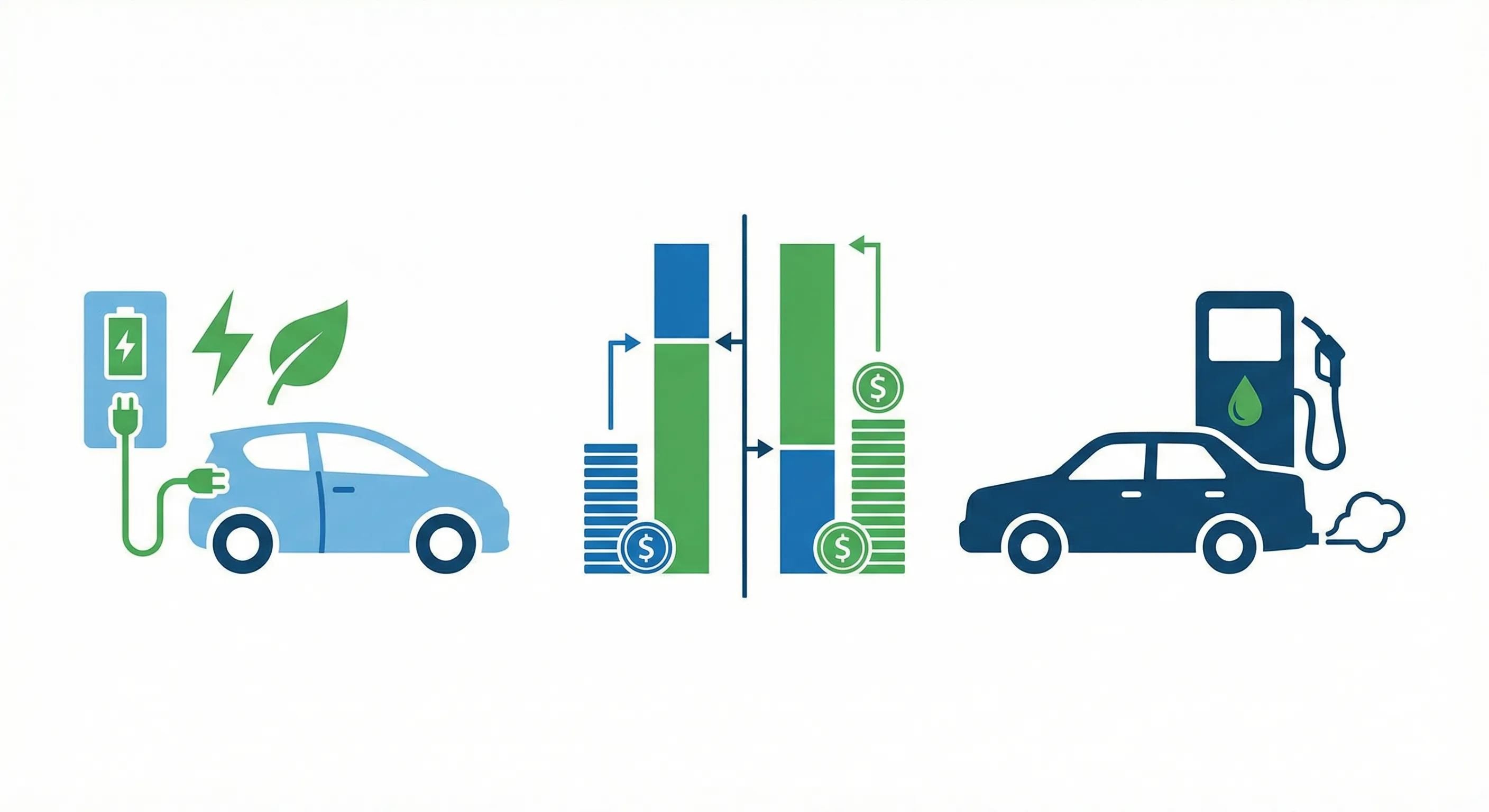
Electric vehicles cost 3-4 cents per mile for fuel compared to 12-15 cents per mile for gas cars. Driving 12,000 miles annually, an EV saves $1,000-$1,400 in fuel costs per year. But EVs typically cost more upfront, so total ownership costs depend on how long you keep the car.
In a three-month side-by-side comparison, a 2019 Toyota Camry owner tracked every dollar spent on fuel against a carpooling Tesla Model 3 owner's electricity costs. The Camry cost $1,520 in gas over 12,400 miles that year, while the Model 3 owner spent just $410 charging at home. That $1,100 difference shows the math is real — but only if you have home charging.
Use our EV vs Gas Calculator to compare total costs for specific vehicles based on your driving habits.
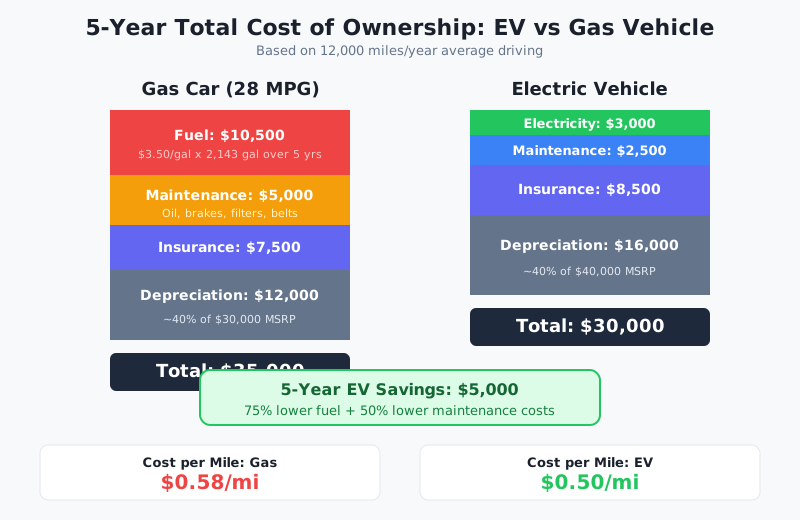
EV vs Gas: The Cost Breakdown
Fuel/Energy Costs
| Vehicle Type | Efficiency | Cost per Mile |
|---|---|---|
| Gas car (28 MPG) | 28 miles/gallon | $0.125 @ $3.50/gal |
| Hybrid (50 MPG) | 50 miles/gallon | $0.07 @ $3.50/gal |
| Electric (3.5 mi/kWh) | 3.5 miles/kWh | $0.04 @ $0.14/kWh |
| Plug-in Hybrid (EV mode) | 3.3 miles/kWh | $0.04 @ $0.14/kWh |
Annual Fuel Cost Comparison
Based on 12,000 miles/year:
| Vehicle | Annual Fuel Cost |
|---|---|
| Gas car (25 MPG) | $1,680 |
| Gas car (30 MPG) | $1,400 |
| Gas car (35 MPG) | $1,200 |
| Hybrid (45 MPG) | $933 |
| Hybrid (55 MPG) | $764 |
| Electric vehicle | $480 |
Annual EV savings vs. 28 MPG gas car: ~$1,020
Tip
Home charging is cheapest. At $0.14/kWh, home charging costs about 70% less than gas. Public fast charging ($0.30-0.50/kWh) is still cheaper than gas but erodes the savings.
Calculating Your Fuel Savings
The Formula
Annual Savings = (Gas Cost per Mile - Electric Cost per Mile) × Annual Miles
Step-by-Step Calculation
Your gas car:
Gas cost per mile = Gas price ÷ Your MPG
Example: $3.50 ÷ 28 MPG = $0.125/mile
Electric vehicle:
Electric cost per mile = Electricity rate ÷ Miles per kWh
Example: $0.14 ÷ 3.5 mi/kWh = $0.04/mile
Annual savings:
($0.125 - $0.04) × 12,000 miles = $1,020/year
Savings by Driving Distance
At current average prices ($3.50/gal, $0.14/kWh):
| Annual Miles | EV Fuel Cost | Gas (28 MPG) | Annual Savings |
|---|---|---|---|
| 8,000 | $320 | $1,000 | $680 |
| 10,000 | $400 | $1,250 | $850 |
| 12,000 | $480 | $1,500 | $1,020 |
| 15,000 | $600 | $1,875 | $1,275 |
| 20,000 | $800 | $2,500 | $1,700 |
| 25,000 | $1,000 | $3,125 | $2,125 |
Total Cost of Ownership Comparison
Fuel is just one factor. Here's the complete picture:
Sample 5-Year Comparison
Comparing similar vehicles:
- Gas car: $35,000 MSRP, 30 MPG
- EV: $45,000 MSRP, 3.5 mi/kWh
| Cost Category | Gas Car | Electric Car |
|---|---|---|
| Purchase price | $35,000 | $45,000 |
| Federal tax credit | $0 | -$7,500 |
| Adjusted price | $35,000 | $37,500 |
| Fuel (5 years) | $7,000 | $2,400 |
| Maintenance (5 years) | $4,500 | $2,000 |
| Insurance (5 years) | $7,500 | $8,500 |
| Registration (5 years) | $500 | $750 |
| 5-Year Total | $54,500 | $51,150 |
EV saves $3,350 over 5 years in this example.
Important
Tax credits change the math dramatically. The federal $7,500 EV tax credit (when eligible) can make EVs cost-competitive even with higher MSRPs. Check current eligibility at fueleconomy.gov.
Maintenance Cost Differences
| Component | Gas Car | Electric Car |
|---|---|---|
| Oil changes | $30-70 every 5k miles | None |
| Transmission service | $100-300 every 50k | None (single gear) |
| Brake pads | Every 40-60k miles | Every 100k+ miles (regen braking) |
| Spark plugs | Every 60-100k miles | None |
| Air filter | Every 15-30k miles | Every 15-30k miles |
| Coolant | Every 50k miles | Every 150k miles |
| Timing belt | $500-1000 once | None |
| Engine repairs | Potential | None |
| Battery replacement | N/A | $5-15k (rare, after 150k+ miles) |
Average maintenance:
- Gas car: $700-$1,200/year
- EV: $300-$500/year
When factoring in fuel costs, your actual MPG matters more than EPA estimates — learn how to track your real gas mileage for an accurate comparison.
EV Purchase Cost Analysis
Current EV Pricing (2026)
| Category | Price Range | Examples |
|---|---|---|
| Budget EV | $28,000-$35,000 | Chevy Equinox EV, Nissan Leaf |
| Mid-range EV | $40,000-$55,000 | Tesla Model 3, Ford Mustang Mach-E |
| Luxury EV | $60,000-$90,000 | BMW iX, Mercedes EQS |
| Premium EV | $100,000+ | Porsche Taycan, Lucid Air |
After Tax Credits
Federal EV tax credit: Up to $7,500 for qualifying vehicles State incentives: $0-$7,500 additional (varies)
| Sticker Price | Federal Credit | Effective Price |
|---|---|---|
| $45,000 | -$7,500 | $37,500 |
| $52,000 | -$7,500 | $44,500 |
| $65,000 | -$7,500 | $57,500 |
Lease vs. Buy for EVs
Leasing advantages:
- Lower payments if tax credit is applied by lessor
- Avoid battery degradation concerns
- Get newest technology every 3 years
Buying advantages:
- Keep the tax credit yourself
- Long-term savings from ownership (understand the full picture in our car payment guide)
- EVs have lower depreciation than gas cars now
Break-Even Analysis
How long until EV savings cover the higher purchase price?
Break-Even Formula
Years to Break Even = Price Difference ÷ Annual Savings
Example Calculations
| Scenario | Price Diff | Annual Savings | Break-Even |
|---|---|---|---|
| EV $8k more, 12k mi/year | $8,000 | $1,500 | 5.3 years |
| EV $5k more (w/credit), 12k mi/year | $5,000 | $1,500 | 3.3 years |
| EV $3k more (w/credit), 15k mi/year | $3,000 | $1,900 | 1.6 years |
| EV $10k more, 10k mi/year | $10,000 | $1,100 | 9.1 years |
High-mileage drivers benefit most from EVs.
Tip
Consider resale value. EVs are holding value better than expected. A 3-year-old EV may retain 60-70% of value vs. 50-60% for a gas car.
Charging Costs Explained
Home Charging
| Rate | Cost per kWh | Cost per 300-mile charge |
|---|---|---|
| Average US rate | $0.14/kWh | $12 |
| Low (off-peak) | $0.08/kWh | $7 |
| High (CA, HI) | $0.25/kWh | $21 |
| Time-of-use (night) | $0.05-0.10/kWh | $4-8 |
Public Charging
| Network | Cost per kWh | Cost per 300-mile charge |
|---|---|---|
| ChargePoint | $0.30-0.45/kWh | $25-40 |
| Electrify America | $0.35-0.48/kWh | $30-40 |
| Tesla Supercharger | $0.25-0.40/kWh | $20-35 |
| Free (workplace, retail) | $0 | $0 |
Home Charging Setup Costs
| Level | Equipment | Installation | Total |
|---|---|---|---|
| Level 1 (120V) | Included | $0 | $0 |
| Level 2 (240V) | $300-700 | $300-1,500 | $600-2,200 |
Level 1: 3-5 miles per hour of charging (overnight sufficient for <40 mi/day) Level 2: 25-30 miles per hour of charging (full charge in 8-10 hours)
EV Considerations Beyond Cost
Advantages of EVs
| Advantage | Explanation |
|---|---|
| Lower fuel costs | 50-70% less than gas |
| Less maintenance | No oil changes, less brake wear |
| Smoother driving | Instant torque, quiet operation |
| Environmental impact | Zero direct emissions |
| Home refueling | Convenient overnight charging |
| HOV lane access | In many states |
| Performance | Quick acceleration |
Challenges of EVs
| Challenge | Mitigation |
|---|---|
| Higher upfront cost | Tax credits, lower operating costs |
| Range anxiety | Plan routes, 300+ mile range common now |
| Charging infrastructure | Improving rapidly, Tesla network |
| Apartment/condo charging | Workplace charging, DC fast charging |
| Cold weather range loss | 10-25% reduction, precondition while plugged in |
| Battery degradation | Most retain 80%+ after 150k miles |
Who Should Consider an EV?
Great candidates:
- Home garage with electrical access
- Daily commute under 100 miles
- Second vehicle for long trips available
- High-mileage drivers (maximize savings)
- Environmentally motivated buyers
May want to wait:
- Frequent long-distance travel (see our road trip cost guide to compare driving costs)
- No home charging access
- Limited local charging infrastructure
- Very tight budget (used gas may be cheaper)
Hybrid as a Middle Ground
Plug-in hybrids (PHEVs) offer both worlds:
| Metric | Gas | PHEV | Full EV |
|---|---|---|---|
| Purchase price | Lowest | Middle | Highest |
| Fuel cost | Highest | Low (mostly electric) | Lowest |
| Range anxiety | None | None | Some |
| Charging needed | No | Beneficial | Yes |
| Maintenance | High | Medium | Low |
PHEVs work well for:
- Those who can't charge daily
- Frequent long-distance drivers
- Transition to full EV later
How to Use Our EV vs Gas Calculator
Our EV vs Gas Calculator provides personalized comparisons:
- Enter your current car's MPG — or select a comparison gas car
- Select an EV model — or enter efficiency (mi/kWh)
- Input your annual mileage — how much you drive
- Enter local prices — gas and electricity rates
- See results — annual savings, break-even point, 5-year comparison
The calculator also shows:
- Monthly fuel cost comparison
- Environmental impact (CO2 savings)
- Total cost of ownership breakdown
Frequently Asked Questions
Are electric cars actually cheaper to own?
Over 5-10 years, EVs are often cheaper due to fuel and maintenance savings. The higher purchase price is offset by lower operating costs, especially for high-mileage drivers. Tax credits can make EVs cost-competitive immediately.
How much do you save on gas with an electric car?
The average driver saves $1,000-$1,400 per year on fuel costs. Savings are higher for those who drive more miles or live in areas with high gas prices and low electricity rates.
How long do EV batteries last?
Most EV batteries retain 80%+ capacity after 150,000+ miles. Manufacturers typically warrant batteries for 8-10 years or 100,000 miles. Battery replacement costs $5,000-$15,000 but is rarely needed.
Is it cheaper to charge an EV at home or at a public station?
Home charging is significantly cheaper — typically $0.04-0.06 per mile vs. $0.10-0.15 per mile at public fast chargers. Home charging during off-peak hours is the most economical option.
Do EVs require less maintenance?
Yes, EVs have fewer moving parts: no oil changes, no transmission service, no spark plugs, and less brake wear due to regenerative braking. Expect 50-70% lower maintenance costs over the vehicle's life.
What is the break-even point for an EV vs gas car?
Typically 3-6 years depending on price difference, tax credits, and driving habits. High-mileage drivers break even faster. With a $7,500 tax credit, many EVs break even in 2-4 years.
Related Calculators
- Gas Mileage Calculator — Calculate your current vehicle's fuel economy
- Car Payment Calculator — Compare financing for EV vs gas
- Road Trip Cost Calculator — Plan trip costs for either vehicle type
Conclusion
Electric vehicles offer significant fuel and maintenance savings, but higher upfront costs mean the math depends on your situation. High-mileage drivers, those with home charging, and buyers who qualify for tax credits often find EVs cheaper over 5+ years. Use the complete picture — purchase price, fuel, maintenance, insurance, and incentives — to make the right choice.
Use our EV vs Gas Calculator to compare specific vehicles based on your driving habits and local prices. The right choice depends on how you drive, where you charge, and how long you plan to keep the car.
Cost comparisons are estimates based on current average prices. Actual costs vary by location, driving habits, specific vehicles, and changing energy prices. Tax credits and incentives vary by vehicle and buyer eligibility.
This article is provided for informational and educational purposes only. Content should not be considered professional financial, medical, legal, or other advice. Always consult a qualified professional before making important decisions. UseCalcPro is not responsible for any actions taken based on the information in this article.
Try These Calculators
Compare the total cost of owning an EV versus a gas car over 5 years. Factor in fuel savings, lower maintenance, and tax credits to find your break-even.
Find out what it really costs to charge an EV at home versus public charging stations. Compare annual charging costs to gas and see your projected savings.
Compare hybrid vs gas car costs in 2026: purchase price, yearly fuel cost, and break-even year. See if a hybrid’s MPG savings beat its higher sticker price.
Estimate your auto insurance premium based on age, driving record, vehicle type, location, and coverage level. See monthly and annual cost breakdowns.
Calculate car shipping costs by distance, vehicle type, and transport method. Compare open vs enclosed rates and get transit time estimates instantly.