Paycheck Calculator: How to Calculate Your Net Pay After Taxes
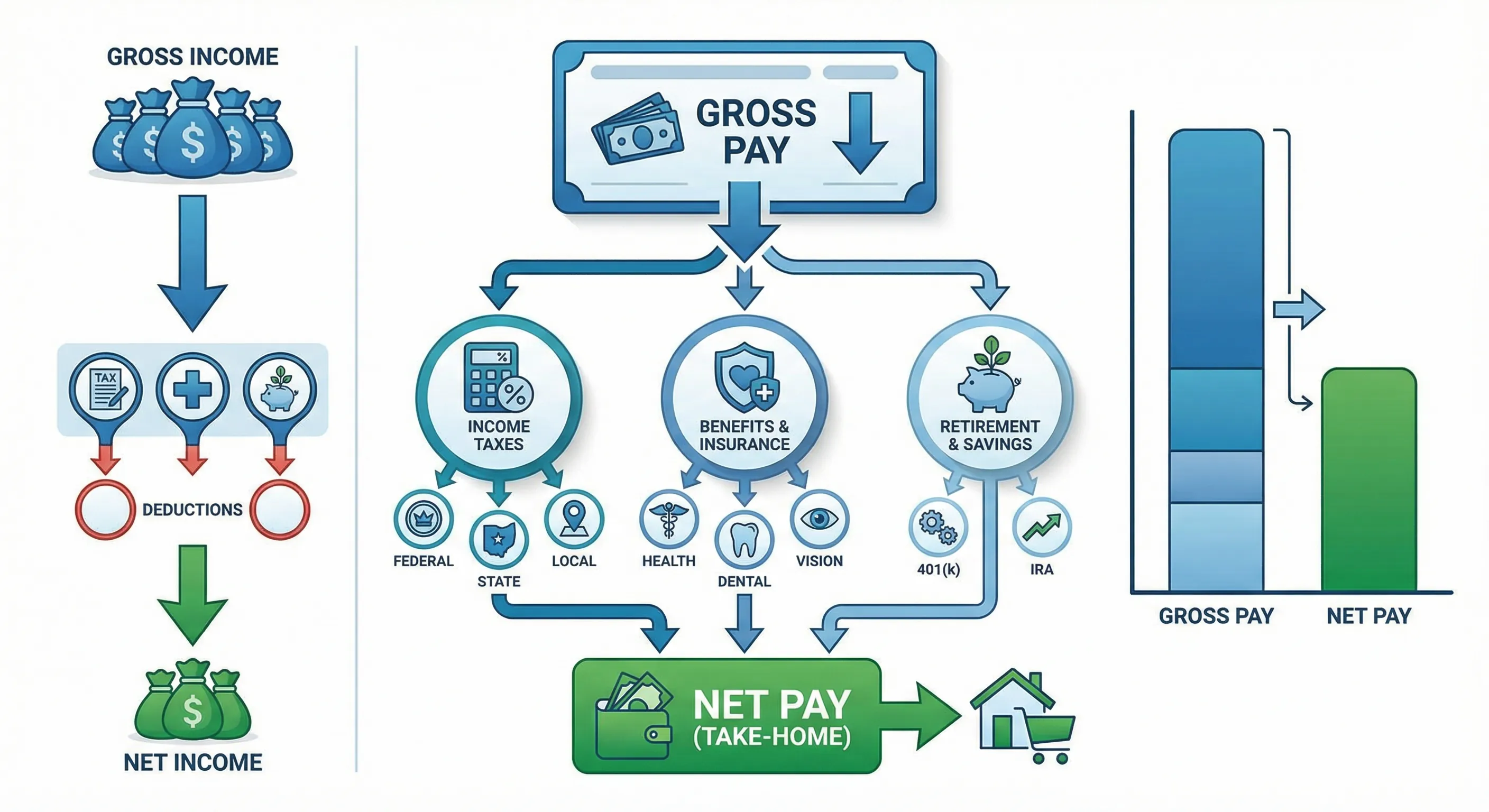
Your take-home pay is your gross income minus federal taxes, state taxes, Social Security, Medicare, and any deductions. For a $60,000 salary in a state with no income tax, you can expect roughly $47,000 in annual take-home pay, or about $1,808 per biweekly paycheck.
A first $55,000 salaried position often brings a surprise: a biweekly pay stub showing $1,642 instead of the $2,115 that a simple gross-pay split would suggest. That $473 gap typically breaks down to about $264 to federal taxes, $131 to FICA, and $78 to state income tax. Understanding every line on a paycheck matters before making financial commitments.
Use our Paycheck Calculator to get an accurate estimate of your net pay based on your specific situation.
Understanding Your Paycheck
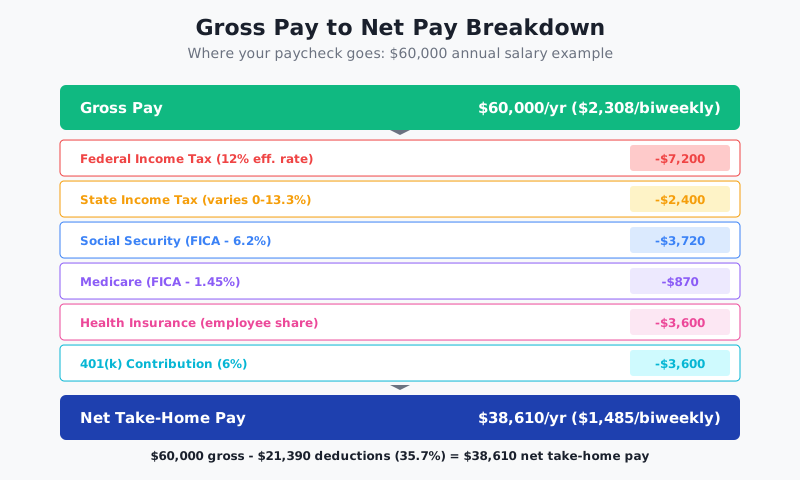
Every paycheck has multiple deductions that reduce your gross pay to net pay (take-home). Here's what comes out of your check:
Mandatory Deductions
| Deduction | Rate | What It Funds |
|---|---|---|
| Federal Income Tax | 10-37% (marginal) | Federal government operations |
| Social Security (FICA) | 6.2% | Retirement, disability benefits |
| Medicare (FICA) | 1.45% | Healthcare for seniors |
| Additional Medicare | 0.9% (over $200k) | High earner supplement |
| State Income Tax | 0-13.3% | State government operations |
| Local Income Tax | Varies | City/county services |
Optional Deductions
| Deduction | Typical Range | Notes |
|---|---|---|
| 401(k) Contribution | 0-$23,000/year | Pre-tax, reduces taxable income |
| Health Insurance | $100-$600/month | Often pre-tax |
| HSA Contribution | Up to $4,150/year | Pre-tax, for medical expenses |
| FSA Contribution | Up to $3,200/year | Pre-tax, use it or lose it |
| Life Insurance | $10-$50/month | Employer-sponsored |
| Disability Insurance | 0.5-2% of salary | Short/long term |
Tip
Pre-tax deductions reduce your taxable income. A $500/month 401(k) contribution doesn't reduce your take-home by $500 — it reduces it by less because you save on taxes.
How to Calculate Your Take-Home Pay
Step 1: Start with Gross Pay
Your gross pay is your salary divided by pay periods:
| Annual Salary | Weekly | Biweekly | Semi-Monthly | Monthly |
|---|---|---|---|---|
| $40,000 | $769.23 | $1,538.46 | $1,666.67 | $3,333.33 |
| $50,000 | $961.54 | $1,923.08 | $2,083.33 | $4,166.67 |
| $60,000 | $1,153.85 | $2,307.69 | $2,500.00 | $5,000.00 |
| $75,000 | $1,442.31 | $2,884.62 | $3,125.00 | $6,250.00 |
| $100,000 | $1,923.08 | $3,846.15 | $4,166.67 | $8,333.33 |
Pay periods per year:
- Weekly: 52
- Biweekly: 26
- Semi-monthly: 24
- Monthly: 12
Step 2: Calculate Federal Income Tax Withholding
Federal taxes are based on taxable income after deductions and your W-4 selections.
2026 Federal Tax Brackets (Single Filer):
| Taxable Income | Tax Rate |
|---|---|
| $0 - $11,925 | 10% |
| $11,926 - $48,475 | 12% |
| $48,476 - $103,350 | 22% |
| $103,351 - $197,300 | 24% |
| $197,301 - $250,525 | 32% |
| $250,526 - $626,350 | 35% |
| $626,351+ | 37% |
2026 Federal Tax Brackets (Married Filing Jointly):
| Taxable Income | Tax Rate |
|---|---|
| $0 - $23,850 | 10% |
| $23,851 - $96,950 | 12% |
| $96,951 - $206,700 | 22% |
| $206,701 - $394,600 | 24% |
| $394,601 - $501,050 | 32% |
| $501,051 - $751,600 | 35% |
| $751,601+ | 37% |
Important
Tax brackets are marginal. If you earn $60,000 as a single filer, you don't pay 22% on everything. You pay 10% on the first $11,925, 12% on the next $36,550, and 22% only on income above $48,475.
Step 3: Calculate FICA Taxes
Social Security:
- Rate: 6.2% of gross pay
- Wage base limit: $168,600 (2026)
- Maximum tax: $10,453.20/year
Medicare:
- Rate: 1.45% of all wages
- Additional Medicare: 0.9% on wages over $200,000
Example ($60,000 salary):
Social Security: $60,000 × 6.2% = $3,720
Medicare: $60,000 × 1.45% = $870
Total FICA: $4,590/year or $176.54/biweekly
Step 4: Calculate State Income Tax
State taxes vary dramatically. Here's a comparison:
No State Income Tax:
- Alaska, Florida, Nevada, New Hampshire*, South Dakota, Tennessee*, Texas, Washington, Wyoming
(*NH and TN only tax investment income)
Flat Tax States (Examples):
| State | Flat Rate |
|---|---|
| Colorado | 4.40% |
| Illinois | 4.95% |
| Indiana | 3.05% |
| Michigan | 4.25% |
| Utah | 4.65% |
Progressive Tax States (Examples):
| State | Rate Range | Top Rate Threshold |
|---|---|---|
| California | 1% - 13.3% | $1,000,000+ |
| New York | 4% - 10.9% | $25,000,000+ |
| New Jersey | 1.4% - 10.75% | $5,000,000+ |
| Oregon | 4.75% - 9.9% | $125,000+ |
Step 5: Subtract Pre-Tax Deductions
Pre-tax deductions reduce your taxable income:
Example calculation:
Gross biweekly pay: $2,307.69
- 401(k) contribution: $200.00
= Taxable wages: $2,107.69
Then calculate taxes on the reduced amount.
Paycheck Breakdown Example
Let's walk through a complete example:
Profile:
- Salary: $65,000/year
- Location: Texas (no state income tax)
- Filing status: Single
- Pay frequency: Biweekly (26 paychecks)
- 401(k): 6% contribution
- Health insurance: $150/paycheck (pre-tax)
Gross Pay:
$65,000 ÷ 26 = $2,500.00 per paycheck
Pre-Tax Deductions:
401(k) (6%): $150.00
Health insurance: $150.00
Total pre-tax: $300.00
Taxable wages: $2,200.00
Federal Tax (estimated for taxable income):
Approx. $264.00 per paycheck
FICA Taxes:
Social Security (6.2%): $155.00
Medicare (1.45%): $36.25
Total FICA: $191.25
Net Pay Calculation:
Gross pay: $2,500.00
- 401(k): $150.00
- Health insurance: $150.00
- Federal tax: $264.00
- FICA: $191.25
= Net pay: $1,744.75
Annual Summary:
Gross salary: $65,000.00
Take-home: $45,363.50 (69.8% of gross)
Factors That Affect Your Take-Home Pay
W-4 Selections
Your W-4 form tells your employer how much federal tax to withhold:
| Filing Status | Standard Deduction (2026) |
|---|---|
| Single | $15,000 |
| Married Filing Jointly | $30,000 |
| Head of Household | $22,500 |
Adjustments that increase take-home pay:
- Additional dependents claimed
- Other income claims (if filing jointly)
- Deductions claimed
Adjustments that decrease take-home pay:
- Extra withholding requested
- Multiple jobs worksheet
Warning
Owing taxes at year-end hurts. If you reduce withholding too much, you may owe taxes plus potential penalties in April. Use the IRS Tax Withholding Estimator to dial in your W-4.
Pre-Tax vs. Post-Tax Contributions
| Contribution Type | Impact on Taxable Income | Impact on Take-Home |
|---|---|---|
| Traditional 401(k) | Reduces | Smaller reduction |
| Health Insurance | Reduces | Smaller reduction |
| HSA | Reduces | Smaller reduction |
| Roth 401(k) | No reduction | Full reduction |
| After-tax benefits | No reduction | Full reduction |
Local Taxes
Some cities and counties add their own income taxes:
| Location | Local Tax Rate |
|---|---|
| New York City | 3.078% - 3.876% |
| Philadelphia | 3.79% |
| Detroit | 2.4% |
| Cleveland | 2.5% |
| Kansas City, MO | 1.0% |
Hourly vs. Salary Paycheck Differences
Salary Employees
- Same gross pay each period
- Predictable budgeting
- Overtime rarely applies (for exempt employees)
Hourly Employees
- Gross pay varies with hours worked
- Overtime pay (1.5x) after 40 hours/week
- May see fluctuations in take-home
Hourly to Salary Conversion:
Annual Salary = Hourly Rate × Hours Per Week × 52
$20/hour × 40 hours × 52 = $41,600/year
For hourly calculations, see our Hourly to Salary Calculator.
How to Increase Your Take-Home Pay
Legal Ways to Reduce Taxes
-
Maximize pre-tax contributions
- 401(k): Up to $23,000/year
- HSA: Up to $4,150 (individual) or $8,300 (family)
-
Review your W-4
- Ensure accurate filing status
- Claim all eligible dependents
- Adjust if you consistently get large refunds
-
Consider Roth strategically
- Roth reduces take-home now but grows tax-free
- Best for those expecting higher taxes in retirement
Negotiate Better Benefits
- Higher employer 401(k) match
- Better health insurance (lower premiums)
- HSA-eligible health plan
- Commuter benefits (pre-tax transit)
Tip
Getting a big tax refund? Adjust your W-4. A $2,400 refund means you overpaid by $200/month. That's YOUR money that could be in your paycheck instead of an interest-free loan to the government.
How to Use Our Paycheck Calculator
Our Paycheck Calculator handles all the complexity:
- Enter gross salary or hourly rate — annual salary or hourly wage
- Select pay frequency — weekly, biweekly, semi-monthly, monthly
- Choose your state — automatic state tax calculation
- Add filing status — single, married, head of household
- Input deductions — 401(k), health insurance, other pre-tax items
- Get results — detailed breakdown of every deduction
The calculator provides both per-paycheck and annual summaries.
Common Paycheck Mistakes
Mistake 1: Ignoring Pre-Tax Benefits
Problem: Not contributing to pre-tax accounts means paying more taxes than necessary.
Solution: At minimum, contribute enough to get your full employer 401(k) match. It's free money AND tax savings.
Mistake 2: Wrong W-4 Settings
Problem: Claiming too few allowances overwitholds; too many underwitholds.
Solution: Use the IRS withholding calculator after any life change (marriage, child, new job).
Mistake 3: Not Reviewing Pay Stubs
Problem: Errors in deductions, tax rates, or contributions go unnoticed.
Solution: Review every pay stub for accuracy. Compare to previous stubs when things change.
Frequently Asked Questions
How do I calculate my take-home pay?
Start with gross pay, subtract pre-tax deductions (401k, health insurance), calculate federal and state income taxes on the reduced amount, subtract FICA taxes (7.65%), then subtract any post-tax deductions. Our Paycheck Calculator automates this process.
Why is my take-home pay so low?
Common reasons include: high federal/state tax brackets, significant FICA contributions (7.65%), pre-tax deductions for retirement and insurance, and local income taxes. Review your pay stub to see exactly where money goes.
How much will I take home on a $50,000 salary?
In a no-state-tax state, a single filer with standard deductions will take home approximately $40,500-$42,000 annually. In high-tax states like California or New York, expect $36,000-$39,000 after state taxes.
Should I adjust my W-4 if I get a big refund?
Yes, if you consistently receive large refunds (over $500), you're overwithholding. Use the IRS Tax Withholding Estimator to adjust your W-4 and get more money in each paycheck.
How do 401(k) contributions affect my paycheck?
Pre-tax 401(k) contributions reduce your taxable income, so a $500 contribution doesn't reduce your take-home by $500. If you're in the 22% bracket, that $500 contribution only reduces your paycheck by about $390 ($500 × 78%).
What's the difference between gross pay and net pay?
Gross pay is your total earnings before deductions. Net pay (take-home pay) is what you actually receive after federal taxes, state taxes, FICA, and all other deductions are subtracted.
Related Calculators
- Budget Calculator — Plan your spending with the 50/30/20 rule (see our 50/30/20 budget guide for a deep dive)
- Hourly to Salary Calculator — Convert hourly wages to annual salary
- Savings Goal Calculator — Plan savings from your paycheck (our savings goal guide shows how to set targets)
Conclusion
Understanding your paycheck helps you plan better and potentially keep more of your money. Federal taxes, FICA, state taxes, and various deductions all take a bite, but strategic choices about pre-tax contributions and W-4 settings can optimize your take-home pay.
Use our Paycheck Calculator to see exactly how your gross pay becomes net pay. Armed with that knowledge, you can make informed decisions about retirement contributions, insurance elections, and tax withholding.
Tax calculations are estimates based on current tax rates and standard deductions. Individual situations vary based on filing status, deductions, credits, and local taxes. Consult a tax professional for personalized advice.
This article is provided for informational and educational purposes only. Content should not be considered professional financial, medical, legal, or other advice. Always consult a qualified professional before making important decisions. UseCalcPro is not responsible for any actions taken based on the information in this article.
Try These Calculators
Enter your salary, state, filing status, and 401(k) contributions to see net pay after federal, state, Social Security, and Medicare taxes are withheld.
Enter your salary, filing status, and state to see your take-home pay after federal tax, state tax, Social Security, and Medicare deductions per paycheck.
Enter your income and deductions to see your federal and state tax breakdown. Shows marginal vs effective rate and after-tax income for 2026 brackets.
Enter your home value and state to estimate annual and monthly property taxes. Compares effective rates across all 50 states with assessment adjustments.
Enter your 1099 income and business expenses to estimate quarterly tax payments, self-employment tax, and take-home pay with federal and state breakdowns.