Garden Watering Calculator: How Much Water Does Your Garden Really Need?
Most vegetable gardens need 1 to 1.5 inches of water per week, which equals 0.623 gallons per square foot per inch of depth. A 200-square-foot garden at 1 inch per week requires roughly 125 gallons weekly, but the actual amount depends on your soil type, irrigation method efficiency, local rainfall, and evapotranspiration rate.
Consider a representative case: tracking water usage across three garden plots totaling 480 square feet over two full growing seasons in Zone 6b. Switching from overhead sprinklers to drip irrigation cut the water bill from $38/month to $14/month during peak summer, a 63% reduction. The $55 drip kit paid for itself in six weeks. More importantly, tomato plants stopped developing the fungal leaf spots that plagued every sprinkler-watered season before. The soil doesn't lie -- measuring moisture at 4-inch depth with a $12 probe shows exactly how much water a delivery method wastes.
Use our Irrigation Calculator to determine exactly how many gallons your garden needs each week based on square footage, soil type, and local conditions.
The Garden Watering Formula
The core calculation converts inches of water into gallons for your specific garden area:
Gallons per week = Garden area (sq ft) x Inches needed x 0.623
The 0.623 factor converts square-foot-inches to gallons (1 cubic foot = 7.48 gallons, and 1 inch = 1/12 foot, so 7.48/12 = 0.623).
But this formula gives you the amount of water your plants need at root level. The amount you actually apply depends on your delivery system's efficiency.
Adjusted Formula with Irrigation Efficiency
Gallons to apply = Gallons needed / Irrigation efficiency
For a 200 sq ft garden needing 1 inch per week:
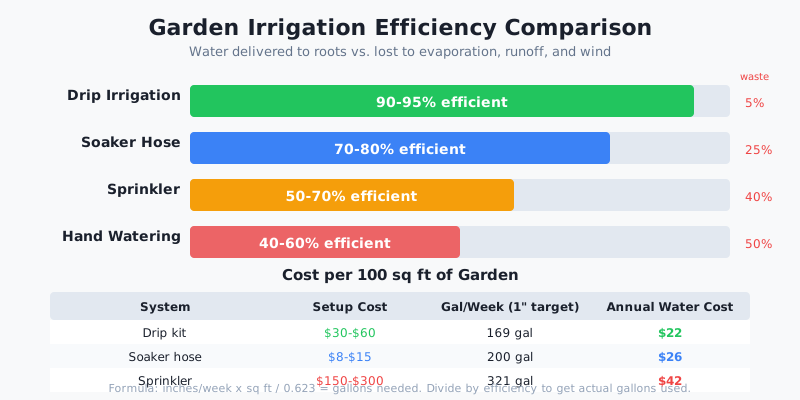
- Drip irrigation (90% efficiency): 125 / 0.90 = 139 gallons applied
- Soaker hose (75% efficiency): 125 / 0.75 = 167 gallons applied
- Sprinkler (60% efficiency): 125 / 0.60 = 208 gallons applied
That sprinkler system wastes 83 gallons per week compared to drip. Over a 20-week growing season, that is 1,660 gallons lost to evaporation and overspray. Every square foot counts -- and so does every gallon.
Water Needs by Crop Type
Not every plant drinks equally. Shallow-rooted lettuce and deep-rooted tomatoes have fundamentally different water demands. Here is a reference table based on USDA and university extension data:
| Crop | Water (inches/week) | Gallons per sq ft/week | Root Depth | Critical Watering Period |
|---|---|---|---|---|
| Tomatoes | 1.0 - 1.5 | 0.62 - 0.93 | 24 - 36 in | Flowering through fruit set |
| Peppers | 1.0 - 1.5 | 0.62 - 0.93 | 18 - 24 in | Flowering through harvest |
| Lettuce / greens | 1.0 | 0.62 | 6 - 12 in | Continuous (bolts in drought) |
| Cucumbers | 1.0 - 1.5 | 0.62 - 0.93 | 12 - 18 in | Flowering through harvest |
| Beans | 0.75 - 1.0 | 0.47 - 0.62 | 18 - 24 in | Flowering and pod fill |
| Squash / zucchini | 1.0 - 1.5 | 0.62 - 0.93 | 24 - 36 in | Fruit development |
| Carrots / root crops | 0.75 - 1.0 | 0.47 - 0.62 | 12 - 18 in | Root sizing (last 4 weeks) |
| Herbs (basil, cilantro) | 0.5 - 1.0 | 0.31 - 0.62 | 6 - 12 in | Continuous, light |
| Corn | 1.5 - 2.0 | 0.93 - 1.25 | 24 - 36 in | Tasseling through ear fill |
| Garlic / onions | 0.75 - 1.0 | 0.47 - 0.62 | 6 - 12 in | Bulb sizing (stop 2 weeks before harvest) |
Tip
Deep-rooted crops (tomatoes, squash, corn) benefit from less frequent but deeper watering. Shallow-rooted crops (lettuce, herbs) need more frequent, lighter applications. Use our Seed Spacing Calculator to plan proper plant density, which directly affects water competition.
Drip Irrigation vs Soaker Hose vs Sprinkler
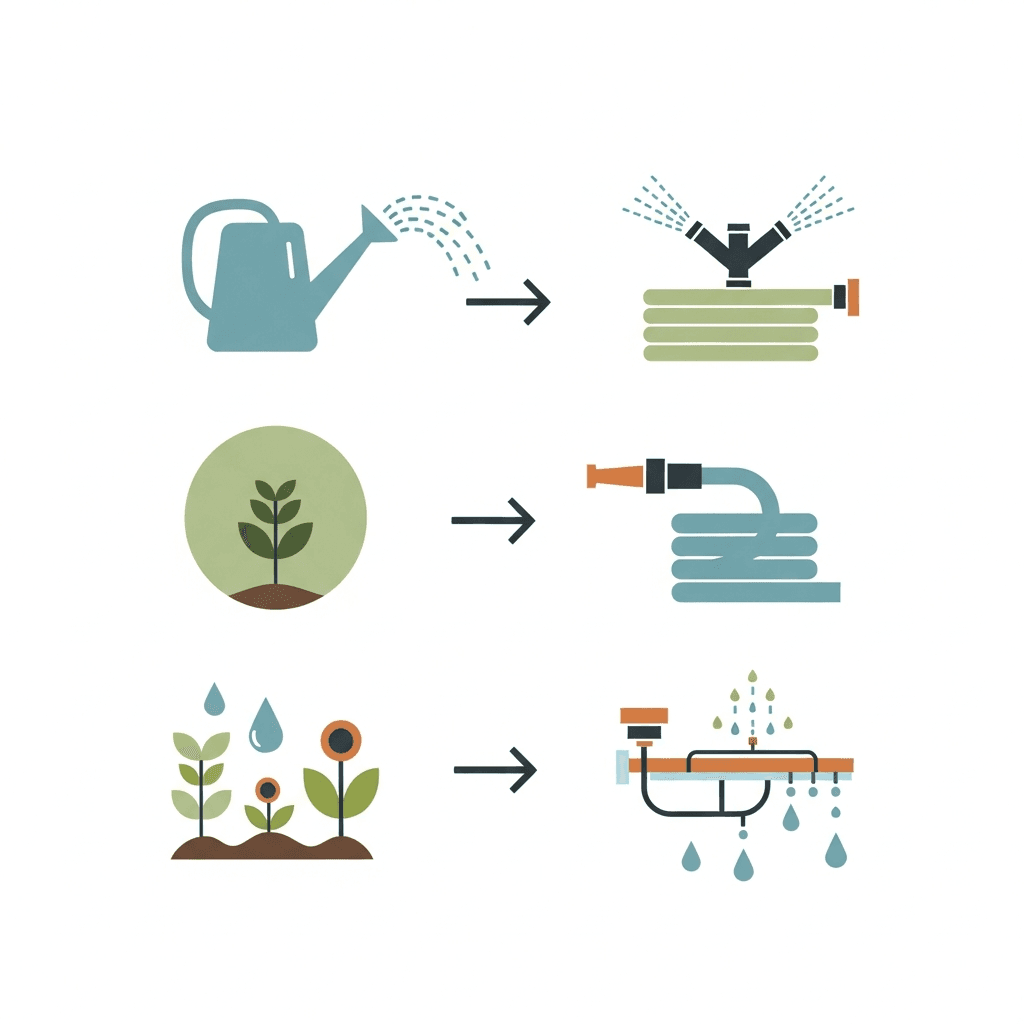
Choosing the right delivery system is the single biggest decision affecting water efficiency, disease pressure, and cost. Here is a direct comparison:
| Factor | Drip Irrigation | Soaker Hose | Sprinkler |
|---|---|---|---|
| Water efficiency | 90 - 95% | 70 - 80% | 50 - 70% |
| Setup cost (200 sq ft) | $30 - $60 | $15 - $30 | $150 - $300 |
| Lifespan | 5 - 10 years | 2 - 4 years | 10 - 20 years |
| Leaf wetting | None | Minimal | Heavy |
| Disease risk | Very low | Low | High (fungal) |
| Weed encouragement | Low (targeted) | Moderate (line) | High (broadcast) |
| Slope performance | Excellent with pressure compensation | Poor (uneven) | Fair |
| Maintenance | Annual flush, replace emitters | Replace when clogged | Seasonal winterization |
| Best for | Row crops, raised beds | Dense plantings, small beds | Lawns, large open areas |
| Water pressure needed | 15 - 30 PSI | 10 - 25 PSI | 30 - 50 PSI |
Why Drip Wins for Vegetable Gardens
According to Texas A&M AgriLife Extension, drip irrigation reduces water use by 30-50% compared to overhead sprinklers while increasing tomato yields by 10-20%. The reason is simple: water goes directly to the root zone instead of evaporating from leaf surfaces or landing between rows where only weeds benefit.
The cost math favors drip too. A basic drip kit for a 200 sq ft garden costs $30-60 and lasts 5+ years. A comparable sprinkler setup costs $150-300. Even if municipal water is only $0.005 per gallon, the 1,660 gallons saved annually adds up to $8.30/year -- meaning the drip kit's lower purchase price plus water savings make it the clear winner.
Case Study: When Overwatering Destroys a Garden
A gardener in central Texas watered her in-ground vegetable garden daily with sprinklers -- 1 inch per day on clay soil that drains at 0.2 inches per hour. The soil was perpetually saturated. Within three weeks, tomato plants developed root rot (Phytophthora), peppers wilted despite wet soil (oxygen-starved roots), and basil turned yellow from waterlogged conditions.
A percolation test revealed her soil held water for 16+ hours after each application. She was applying 7 inches per week when her plants needed 1 to 1.5 inches. That is 4-7 times the optimal amount.
The fix involved three changes:
- Switched to drip irrigation at 0.5 inches, applied twice per week (1 inch total)
- Added 4 inches of compost tilled into the top 8 inches, improving drainage from 0.2 to 0.8 inches per hour
- Raised beds 6 inches above grade to prevent water pooling
All new plantings survived the rest of the season. The lesson: more water is not better water. Calculate before you plant -- and calculate before you irrigate.
How to Set Up Drip Irrigation
Setting up drip irrigation is straightforward if you plan the layout before buying materials. Here is a step-by-step guide:
Step 1: Measure your garden beds and sketch a layout. Record the length and width of each bed. Note the distance from your outdoor spigot to the garden. A 4x8 raised bed is 32 sq ft; a 4x12 bed is 48 sq ft. Use the Raised Bed Calculator to confirm your bed dimensions if you are building new ones.
Step 2: Calculate your water needs. Multiply total square footage by 0.623 gallons per inch, then divide by your target efficiency (0.90 for drip). A 100 sq ft garden needing 1 inch/week requires 69.2 gallons applied per week.
Step 3: Choose drip components. You need a backflow preventer, pressure regulator (25 PSI), filter, main line (1/2-inch poly tubing), and emitter line or individual drip emitters. For vegetable gardens, 1/2-inch tubing with inline emitters spaced 12 inches apart at 0.5 GPH works for most crops.
Step 4: Run the main supply line from the spigot. Lay 1/2-inch poly tubing along the edge of your garden area. Secure with ground stakes every 3 feet. Cut with a tubing cutter or sharp knife.
Step 5: Run emitter lines through each bed. Space emitter lines 12 inches apart for dense plantings (lettuce, carrots) or 18-24 inches apart for larger crops (tomatoes, squash). Use barbed tee connectors to split from the main line.
Step 6: Install an end cap on each line and flush the system. Before capping, run water through the system for 2 minutes to flush sediment. Then install figure-8 end caps or compression end caps.
Step 7: Set a timer and test. A battery-operated hose timer ($25-40) automates watering. Set it to run in early morning (5-7 AM) when evaporation is lowest. Run for the duration that delivers your target gallons, then check soil moisture at 4-inch depth the next day.
Important
Always install a backflow preventer between the spigot and the drip system. This is required by code in most municipalities and prevents garden water from contaminating your household supply.
Adjusting for Rainfall
Nature does part of the work. Every inch of rainfall on your garden delivers 0.623 gallons per square foot -- exactly the same as irrigation. The adjustment is simple:
Irrigation needed = Crop requirement - Effective rainfall
"Effective rainfall" is not the same as total rainfall. Light drizzles under 0.10 inches mostly evaporate before reaching roots. Heavy downpours over 1 inch per hour cause runoff on most soils before full absorption. A general rule from the USDA Natural Resources Conservation Service: effective rainfall is about 75% of measured rainfall for storms under 1 inch, and 50-60% for heavier storms.
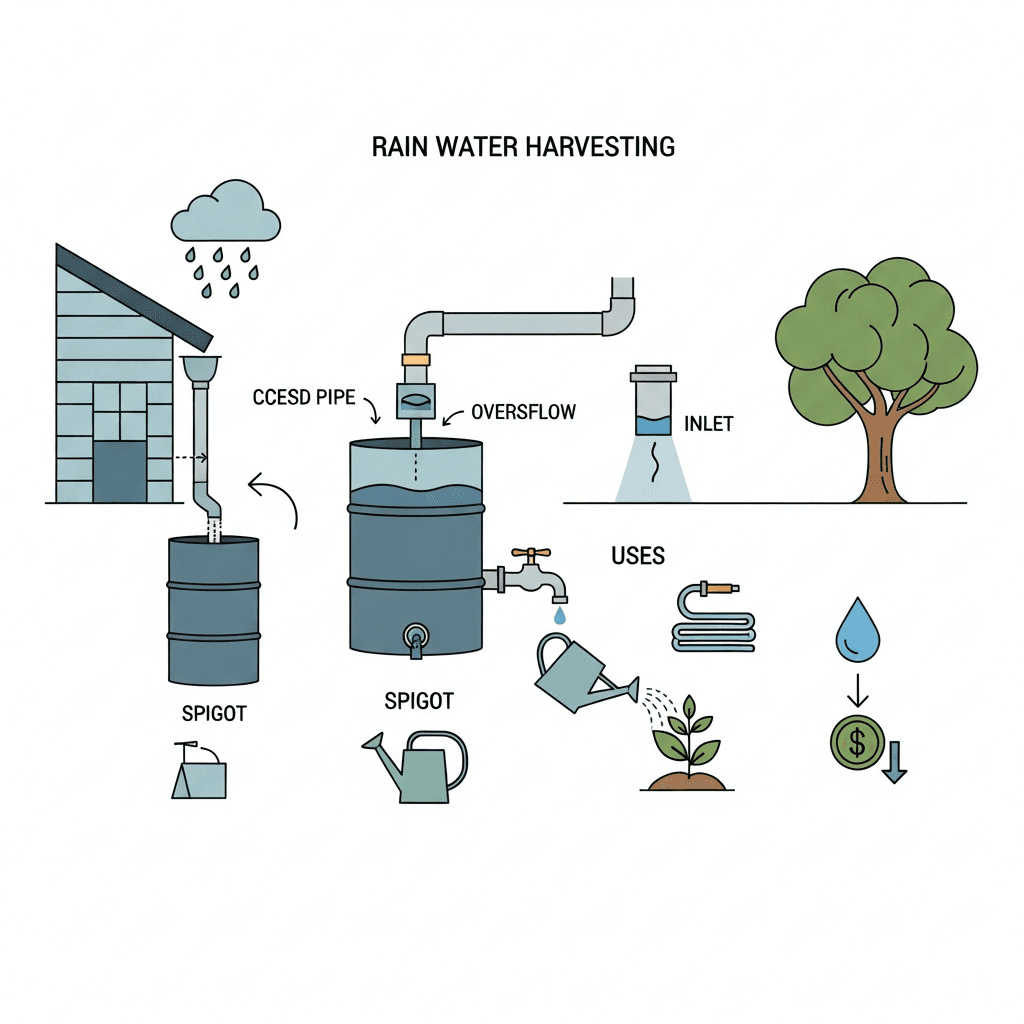
If you collect rainwater in barrels, you can track your actual capture. Our Rain Barrel Calculator shows how much water your roof sheds per storm -- and how that offsets your irrigation needs. For a complete guide on setting up a rainwater collection system, read our Rain Barrel Water Harvesting Guide.
Seasonal Watering Adjustments
Water needs change dramatically across the growing season. These adjustments apply to USDA Zones 5-8:
| Season | Adjustment | Reason |
|---|---|---|
| Early spring (March-April) | 50-75% of peak | Cool temps, low evapotranspiration, spring rain |
| Late spring (May) | 75-100% | Warming soil, active growth begins |
| Summer (June-August) | 100-125% | Peak heat, highest evapotranspiration |
| Late summer (September) | 75-100% | Shorter days, cooling nights |
| Fall (October) | 50-75% | Reduced growth, lower temps |
Use the Frost Date Calculator to determine your local growing season boundaries and plan watering start/end dates accordingly.
Water Conservation Strategies
Beyond choosing an efficient delivery system, several techniques reduce total water usage:
Mulching
A 3-4 inch layer of organic mulch (straw, wood chips, shredded leaves) reduces evaporation by 25-50% according to Oregon State University Extension. On a 200 sq ft garden losing 20 gallons/week to surface evaporation, mulch saves 5-10 gallons weekly -- 100-200 gallons per season.
Soil Improvement
Compost-amended soil holds water better than raw clay or sand. Adding 2-3 inches of finished compost per year increases water-holding capacity by 20% in sandy soils and improves drainage by 25% in clay soils. See our Composting Beginners Guide for how to produce enough compost for your garden beds.
Time of Day
Water between 5 AM and 9 AM. The University of Georgia Extension reports that morning watering reduces evaporation losses by 20-30% compared to midday application. Evening watering saves water too but leaves foliage wet overnight, increasing fungal disease risk.
Grouping by Water Need
Plant crops with similar water requirements together. Put heavy drinkers (tomatoes, cucumbers, squash) on one drip zone and light drinkers (herbs, garlic, root vegetables) on another. This prevents overwatering some crops to meet the demands of others.
Tip
A $12 soil moisture meter eliminates guesswork. Insert it at 4-inch depth near the root zone. Water when the reading drops to "dry" for that crop's tolerance level. This single tool can cut overwatering by 30% or more.
What to Do This Week
Check your irrigation system before the growing season ramps up. Run water through all lines and look for clogged emitters, cracked tubing, and leaking connections. Replace damaged components now while hardware stores have full stock. If you do not have drip irrigation yet, measure your garden beds this weekend and enter the dimensions into our Irrigation Calculator to see exactly how many gallons you need and what components to buy.
Frequently Asked Questions
How many gallons of water does a garden need per week?
A garden needs approximately 0.623 gallons per square foot per inch of water depth. For the standard recommendation of 1 inch per week, a 100 sq ft garden needs about 62 gallons, a 200 sq ft garden needs 125 gallons, and a 400 sq ft garden needs 249 gallons. Actual needs vary by crop type, soil, and climate.
Is drip irrigation worth it for a small garden?
Yes. Even for a single 4x8 raised bed (32 sq ft), a $30 drip kit reduces water waste by 30-50% compared to hand-watering or sprinklers, prevents fungal diseases from wet foliage, and delivers water precisely to root zones. The kit pays for itself in reduced water usage within one to two seasons.
How long should I run drip irrigation?
Run time depends on your emitter flow rate and target gallons. For 0.5 GPH emitters spaced 12 inches apart on 12-inch rows, a 4x8 bed with 32 emitters delivers 16 gallons per hour. If you need 20 gallons per week, run for about 75 minutes per session, twice weekly. Use our Irrigation Calculator for exact run times.
How do I know if I am overwatering my garden?
Signs of overwatering include: yellow lower leaves, wilting despite moist soil (oxygen-starved roots), fungal growth on soil surface, mushy stems at the base, and standing water more than 30 minutes after irrigation. Test by inserting a finger 2-3 inches into the soil -- if it feels wet and sticky, skip the next watering.
Should I water every day in summer?
No. Deep watering 2-3 times per week is better than daily shallow watering. Daily light watering encourages shallow root growth, making plants more drought-vulnerable. Apply enough water each session to moisten the top 6-8 inches of soil, then let the top inch dry before the next application. Deep-rooted crops like tomatoes prefer even less frequent, deeper soaks.
How do I account for rainfall in my watering schedule?
Subtract effective rainfall from your weekly target. If your garden needs 1 inch per week and you received 0.6 inches of rain, only irrigate the remaining 0.4 inches. Use a $5 rain gauge placed in the garden to measure actual precipitation. Remember that only about 75% of measured rainfall is "effective" -- the rest evaporates or runs off before roots absorb it.
Related Calculators
- Irrigation Calculator -- Calculate exact water needs for your garden size and crop types
- Rain Barrel Calculator -- Determine how much rainwater you can harvest from your roof
- Raised Bed Calculator -- Size and plan raised beds for optimal drainage and watering
- Compost Calculator -- Calculate compost volume to improve soil water retention
- Frost Date Calculator -- Find your growing season to plan irrigation start and end dates
Related Articles
- Rain Barrel Water Harvesting Guide -- How to capture and store rainwater for garden irrigation
- Raised Bed Garden Complete Guide -- Build beds with proper drainage for healthier plants
- Composting Beginners Guide -- Improve soil water-holding capacity with homemade compost
- Vegetable Garden Spacing and Yield Guide -- Plant density affects water competition between crops
This guide provides general irrigation estimates based on USDA and university extension research. Actual water needs vary by microclimate, soil composition, cultivar, and local weather patterns. Always verify soil moisture before watering and adjust schedules based on observed plant health.
This article is provided for informational and educational purposes only. Content should not be considered professional financial, medical, legal, or other advice. Always consult a qualified professional before making important decisions. UseCalcPro is not responsible for any actions taken based on the information in this article.
Try These Calculators
Calculate weekly water needs for lawns, vegetables, shrubs, and trees by soil type, sun exposure, and climate. Get gallons, runtime, and drip emitter counts.
Estimate weekly and monthly garden water needs by plant zone, climate, and season. Get gallons per area and cost projections for lawn and garden watering.
Plan your garden layout with correct plant and row spacing. Enter bed dimensions and crop type to get exact plant counts, row counts, and seed quantities.
Estimate monthly rainwater collection from your roof by area, material, and local rainfall. Get barrel count, garden watering duration, and annual savings.