How to Build a Raised Bed Garden: Complete Soil & Materials Calculator Guide
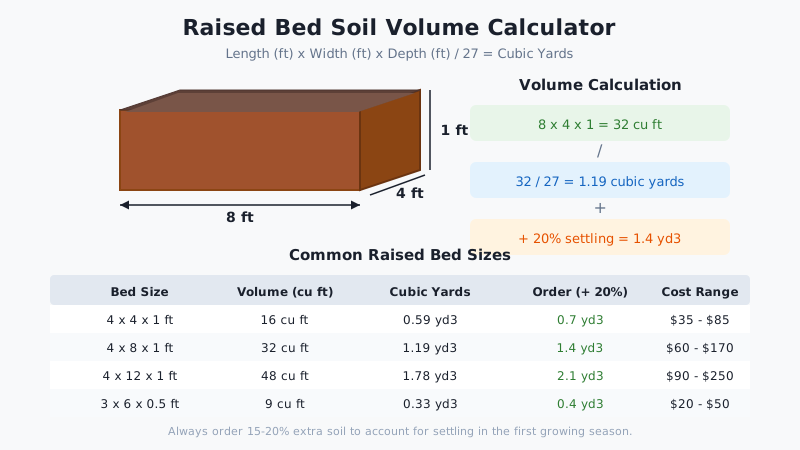
A standard 4x8-foot raised bed 12 inches deep requires 32 cubic feet (1.19 cubic yards) of soil mix, but you should order 1.4 cubic yards to account for 15-20% settling in the first growing season. The formula is simple: Length (ft) x Width (ft) x Depth (ft) = Volume in cubic feet, then divide by 27 for cubic yards. Material costs range from $20-40 for pine to $80-150 for cedar to $100-400 for steel, before you spend a single dollar on soil.
A common first-year mistake shows why the overage matters: a gardener builds a 4x8x12-inch raised bed and orders exactly 1.0 cubic yard of a 50/30/20 topsoil-compost-perlite mix. The calculated volume is 32 cu ft, which equals 1.19 cubic yards, but the order gets rounded down after a supplier says "one yard is plenty." After filling, the bed is 3 inches short of the top. Rain and watering compress the mix further over the first month, leaving a 5-inch gap. Topping off then means buying bags of potting mix -- six bags at $12 each is $72, versus roughly $15 for the equivalent bulk soil. The soil doesn't lie. Always add 15-20% overage for settling. Order 1.4 cubic yards for a 4x8x12-inch bed, not 1.0.
Use our Raised Bed Calculator to get precise soil volume, lumber quantities, and cost estimates for any bed size before you buy materials.
How Much Soil Do I Need for a Raised Bed?
32 cubic feet is the magic number for a 4x8-foot bed at 12 inches deep. But most gardeners get this wrong because they forget that soil compacts, and cubic feet are not cubic yards.
The Soil Volume Formula
The calculation is straightforward:
Volume (cu ft) = Length (ft) x Width (ft) x Depth (ft)
Volume (cu yd) = Volume (cu ft) / 27
Order Volume = Volume (cu yd) x 1.15 to 1.20  (settling overage)
For a 4x8 bed at 12 inches (1 foot) deep:
- 4 x 8 x 1 = 32 cu ft
- 32 / 27 = 1.19 cu yd
- 1.19 x 1.18 = 1.40 cu yd (with 18% overage)
Soil Volume by Common Bed Sizes
| Bed Size | Depth (in) | Volume (cu ft) | Volume (cu yd) | With 18% Overage (cu yd) | Approx. Bags (2 cu ft) |
|---|---|---|---|---|---|
| 4x4 | 6 | 8 | 0.30 | 0.35 | 5 |
| 4x4 | 12 | 16 | 0.59 | 0.70 | 9 |
| 4x8 | 6 | 16 | 0.59 | 0.70 | 9 |
| 4x8 | 12 | 32 | 1.19 | 1.40 | 18 |
| 4x8 | 18 | 48 | 1.78 | 2.10 | 27 |
| 4x12 | 12 | 48 | 1.78 | 2.10 | 27 |
| 3x6 | 10 | 15 | 0.56 | 0.66 | 9 |
Tip
Bulk soil costs $30-60 per cubic yard delivered. Bagged soil costs $5-12 per bag (1-2 cu ft), which works out to $67-162 per cubic yard. If your project needs more than half a cubic yard, bulk delivery saves 40-70%. Use the Raised Bed Calculator to compare bulk vs. bagged costs for your exact dimensions.
Why Soil Settling Matters
Fresh soil mix settles 15-20% in the first year due to three factors:
- Gravity compaction -- loose fill compresses under its own weight
- Water compaction -- irrigation and rain push particles closer together
- Organic matter decomposition -- compost breaks down and shrinks in volume
A bed filled level in March will be 2-4 inches below the rim by August. Every square foot counts when your root zone is shrinking. Plan ahead or pay the bagged-soil premium mid-season.
Raised Bed Material Comparison: Cedar vs Pine vs Steel
Choosing your frame material affects durability, soil health, and total project cost. Here is a side-by-side comparison for a standard 4x8-foot, 12-inch-deep bed.
| Feature | Western Red Cedar | Pressure-Treated Pine | Untreated Pine/Fir | Corrugated Steel | Composite Lumber |
|---|---|---|---|---|---|
| Material cost (4x8x12") | $80 - $150 | $30 - $60 | $20 - $40 | $100 - $400 | $120 - $250 |
| Lifespan | 10 - 15 years | 8 - 12 years | 2 - 5 years | 20 - 30 years | 15 - 25 years |
| Rot resistance | Excellent (natural oils) | Good (chemical treatment) | Poor | Excellent (galvanized) | Excellent |
| Food safety | Safe | Safe (post-2003 ACQ/MCA) | Safe | Safe | Safe |
| Appearance | Warm natural grain | Green tint, fades to gray | Light wood, weathers fast | Industrial/modern | Uniform, many colors |
| DIY difficulty | Easy (standard tools) | Easy (standard tools) | Easy (standard tools) | Moderate (metal cutting) | Easy (standard tools) |
| Best for | Long-term food gardens | Budget builds, 5+ year use | 1-2 season temporary beds | Permanent installations | Low-maintenance gardens |
Cedar: The Gold Standard
Western red cedar contains natural oils (thujaplicins) that resist rot and insect damage without chemical treatment. At $80-150 for a 4x8 bed, it costs 2-3 times more than pine but lasts 2-3 times longer. The cost per year of service is roughly equal -- but cedar doesn't leach chemicals into the soil.
According to the USDA Forest Products Laboratory, western red cedar heartwood is rated "durable to very durable" for decay resistance and can last 15+ years in ground contact when properly maintained.
Pressure-Treated Pine
Modern pressure-treated lumber uses micronized copper azole (MCA) or alkaline copper quaternary (ACQ), which replaced the arsenic-containing CCA treatment banned for residential use in 2003. The EPA confirms that current ACQ/MCA treatments are approved for use around food gardens.
Corrugated Steel
Galvanized corrugated steel beds have surged in popularity for their modern look and 20-30 year lifespan. The metal heats up faster in spring, giving warm-season crops a slight head start. However, steel conducts heat aggressively in hot climates (USDA Zones 8-10) and can cook roots in midsummer without adequate mulch.
Warning
Steel beds in Zones 8-10 need 3-4 inches of mulch to prevent soil temperatures from exceeding 95F at root depth. Without mulch, soil against the south-facing wall can hit 130F on a July afternoon -- lethal for most vegetable roots.
Raised Bed Soil Mixes: Which Recipe Is Best?
The soil mix is the most important investment you make. A 4x8 bed filled with poor soil will underperform a 2x4 bed filled with the right blend. Nature runs on ratios -- learn them.
Three Proven Soil Mix Recipes
| Mix | Ratio | Components | Cost per cu yd | Best For | pH Range |
|---|---|---|---|---|---|
| Mel's Mix | 33/33/33 | Compost, peat moss, vermiculite | $80 - $120 | Square foot gardening, containers | 6.0 - 6.8 |
| Premium Blend | 50/30/20 | Topsoil, compost, perlite/pumice | $45 - $75 | Deep-root vegetables, long-term beds | 6.2 - 7.0 |
| Budget Basic | 60/30/10 | Topsoil, compost, coarse sand | $30 - $50 | Large beds, first-season gardens | 6.5 - 7.2 |
Mel's Mix (Square Foot Gardening Method)
Developed by Mel Bartholomew for the Square Foot Gardening Foundation, this mix is equal parts compost, peat moss (or coconut coir), and coarse vermiculite. It drains excellently, holds moisture well, and supports dense planting. The downside: vermiculite is expensive ($25-40 per 4 cu ft bag), which pushes the total cost higher than soil-based mixes.
Premium Blend (Recommended)
The 50/30/20 topsoil-compost-perlite blend is a strong all-around choice for a food garden of any size, from a single raised bed up to large plots of 2,800 sq ft or more. The topsoil provides structure and mineral content, compost adds biology and nutrients, and perlite ensures drainage. This mix works for everything from lettuce to tomatoes and improves year over year as you add compost annually.
For a 4x8 bed needing 1.4 cu yd:
- 0.70 cu yd screened topsoil: $21 - $35
- 0.42 cu yd finished compost: $13 - $25
- 0.28 cu yd perlite: $20 - $45
- Total: $54 - $105 (plus delivery)
Use our Compost Calculator to determine how much compost you need based on your bed dimensions and soil recipe.
Budget Basic
The 60/30/10 mix uses topsoil, compost, and coarse builder's sand. It costs the least but drains the slowest and compacts the most over time. Suitable for first-season gardens when budget is tight. Plan to amend with compost and perlite in year two.
Important
Never use fine play sand in raised bed mixes. Play sand packs too tightly and creates waterlogged conditions. Use coarse builder's sand or horticultural-grade sand with particle sizes between 0.5 and 2.0 mm. The distinction matters for root health and drainage.
Step-by-Step: How to Build a Raised Bed Garden
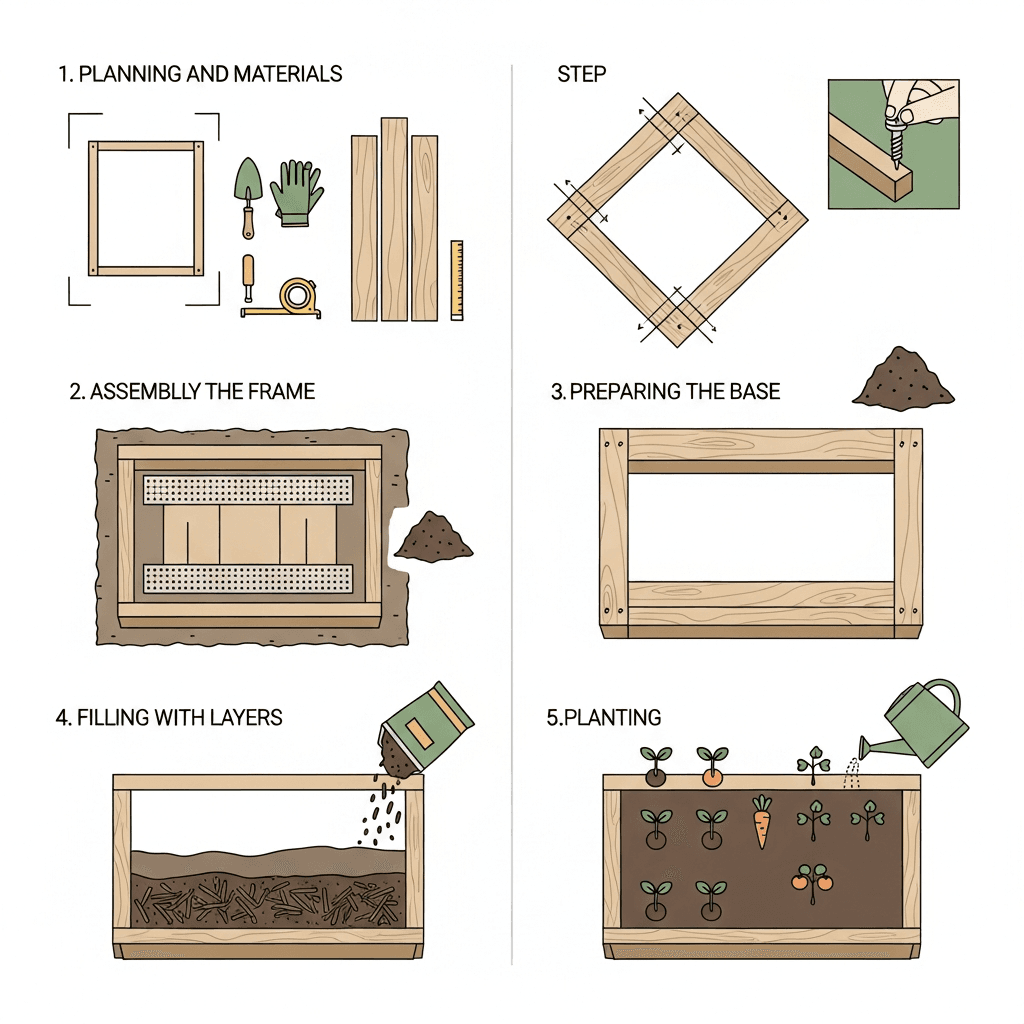
Here is the complete build process for a standard 4x8-foot cedar raised bed, 12 inches deep. Total build time: 1-2 hours. Calculate before you plant.
Materials Needed
- 4 cedar boards, 2x12, 8 feet long (long sides)
- 4 cedar boards, 2x12, 4 feet long (short sides, cut from two 8-footers)
- 4 cedar or treated 4x4 posts, 12 inches long (interior corner braces)
- 3-inch exterior wood screws (stainless or coated), 32 count
- Landscape fabric or hardware cloth (optional, for gopher protection)
- 1.4 cubic yards of soil mix
Step 1: Choose and prepare your site. Select a location with 6-8 hours of direct sunlight for vegetables, or 3-4 hours for leafy greens and herbs. Level the ground using a rake and a 4-foot level. Remove sod or lay cardboard over grass to smother it. According to Texas A&M AgriLife Extension, raised beds should be oriented north-to-south to maximize sun exposure on both sides.
Step 2: Cut your lumber to size. You need six 8-foot cedar 2x12 boards total. Use four boards at full length for the long sides (two per side, stacked). Cut two boards in half at 4 feet for the short sides. Sand any rough edges to prevent splinters.
Step 3: Assemble the corner braces. Cut four 4x4 cedar posts to 12-inch lengths. These serve as interior corner brackets. Pre-drill screw holes to prevent cedar from splitting.
Step 4: Build the first layer. Set two 8-foot boards and two 4-foot boards on edge in a rectangle. Place a 4x4 corner brace at each inside corner. Drive three 3-inch exterior screws through each board into the corner brace. Check for square by measuring diagonals -- they should be equal within 1/4 inch.
Step 5: Stack the second layer (if using two courses). For a 12-inch-deep bed with standard 2x12 lumber (actual height 11.25 inches), one course is sufficient. If using 2x6 boards, stack two courses and stagger the joints for strength. Secure with additional screws into the corner posts.
Step 6: Position the bed and level it. Move the assembled frame to your prepared site. Use a spirit level across the top in both directions. Shim the low side with gravel or soil until level. A bed that is out of level will have pooling water on one end.
Step 7: Install bottom protection (optional). Line the bottom with hardware cloth (1/2-inch mesh) to prevent burrowing pests like gophers and voles. Staple the cloth to the inside bottom of the frame. Skip this step if burrowing pests are not present in your area.
Step 8: Fill with soil mix. Add soil in 4-inch lifts, watering each layer lightly to settle air pockets. Overfill by 2-3 inches above the rim -- it will settle to rim height within two weeks. Use our Raised Bed Calculator to confirm the exact volume needed.
Step 9: Let the bed rest for 1-2 weeks. Water the filled bed deeply two or three times and let it settle before planting. This initial settling happens quickly and prevents seeds or transplants from sinking below optimal depth.
Step 10: Plan your planting layout. Use the Garden Bed Planner and Seed Spacing Calculator to maximize yield per square foot. Intensive spacing in raised beds can produce 2-5 times more yield per square foot than traditional row gardening, according to the Oregon State University Extension Service.
Tip
What to do this week: If you are in USDA Zones 6-7, the ground is still frozen. Use this time to order lumber and schedule bulk soil delivery for 2-4 weeks before your last frost date. In Zones 8-10, you can build and plant cool-season crops (lettuce, peas, spinach) right now.
Raised Bed Cost Breakdown
Understanding the full cost prevents sticker shock at the garden center. Here is what a single 4x8-foot cedar bed costs in 2026.
| Expense | Budget Option | Mid-Range | Premium |
|---|---|---|---|
| Frame lumber | Pine: $25 | Cedar: $100 | Steel kit: $250 |
| Corner hardware | Screws: $8 | Screws + brackets: $15 | Included in kit |
| Soil mix (1.4 cu yd) | Budget Basic: $50 | Premium Blend: $80 | Mel's Mix: $140 |
| Delivery | Pickup: $0 | Local delivery: $30 | Delivery: $50 |
| Bottom protection | None: $0 | Hardware cloth: $15 | Hardware cloth: $15 |
| Total | $83 | $240 | $455 |
The mid-range cedar-and-premium-soil option ($240) provides the best value for gardeners planning to grow food for 5+ years. Over a 10-year lifespan, that works out to $24 per year for a bed that produces $200-600 worth of vegetables annually.
Tip
Compare bulk vs. bagged soil cost carefully. One cubic yard of bulk topsoil-compost blend costs $30-60 delivered. The same volume in 2 cu ft bags from a garden center costs $67-162 (13.5 bags at $5-12 each). Use the Raised Bed Calculator to see the exact cost difference for your project.
Common Raised Bed Mistakes (and How to Avoid Them)
Across years of building, filling, and replanting raised beds, these are the five most expensive mistakes gardeners make.
Mistake 1: Underfilling by Rounding Down
As the case study above shows, rounding 1.19 cu yd down to 1.0 costs more in bagged top-ups than ordering the correct amount would have. Always round up and add 15-20% for settling. The math doesn't lie -- and neither does the soil.
Mistake 2: Skipping Drainage in Heavy Clay Soils
If your native soil is heavy clay, water pools under the raised bed after rain. The fix: dig out 2-3 inches of clay beneath the bed and replace with coarse gravel before placing the frame. This allows water to drain away from your root zone.
Mistake 3: Building Too Narrow
Beds narrower than 3 feet waste vertical space because you can only reach partway across from each side. The ideal width is 3-4 feet for adults (you should be able to reach the center from either side without stepping into the bed). Length is flexible: 4, 8, or 12 feet are standard lumber increments.
Mistake 4: Ignoring Soil pH
Most vegetables thrive in pH 6.0-7.0. Fresh compost-heavy mixes can start above 7.5 (alkaline), which locks out iron, manganese, and zinc. Test your soil pH before planting using a $10-15 test kit, and amend with sulfur (to lower pH) or lime (to raise pH) as needed. According to the USDA Natural Resources Conservation Service, pH is the single most important soil chemical property affecting nutrient availability.
Mistake 5: Not Planning for Irrigation
Hand watering a 4x8 bed takes 15-20 minutes per session, and you need to water 3-5 times per week in summer. A simple drip irrigation system costs $20-40 and saves 200+ hours per season. Use the Irrigation Calculator to size your system, and consider connecting it to a Rain Barrel to reduce water costs.
How Deep Should a Raised Bed Be?
Depth depends on what you are growing and whether you have usable native soil beneath the bed.
| Crop Type | Minimum Depth | Recommended Depth | Examples |
|---|---|---|---|
| Lettuce, herbs, radishes | 6 inches | 8 inches | Basil, cilantro, arugula |
| Beans, peppers, squash | 8 inches | 12 inches | Bush beans, bell peppers |
| Tomatoes, root vegetables | 12 inches | 18 inches | Tomatoes, carrots, potatoes |
| Trees, deep-root perennials | 18 inches | 24 inches | Blueberries, dwarf fruit trees |
If your native soil is decent (loamy, drains well), roots will grow into it below the bed. In that case, 6-8 inches of raised bed depth is sufficient for most crops. If you are building on concrete, compacted clay, or contaminated soil, you need the full depth in your raised bed alone -- 12-18 inches minimum for vegetables.
Seasonal Planning for Raised Beds
Timing matters as much as materials. Here is when to build, fill, and plant by USDA zone.
-
Zones 3-4 (last frost mid-May to early June): Build and fill beds in mid-April. Soil temperatures at 6-inch depth won't reach 50F (minimum for most seeds) until early May. Start cool-season seeds indoors 6-8 weeks before last frost using the Seed Starting Calculator. Check your local Frost Date Calculator for exact timing.
-
Zones 5-6 (last frost late April to mid-May): Build in late March. Direct sow peas, spinach, and lettuce 4-6 weeks before last frost. Start tomatoes and peppers indoors now.
-
Zones 7-8 (last frost late March to mid-April): Build in February or early March. You can direct sow cool-season crops immediately and transplant warm-season starts after last frost.
-
Zones 9-10 (frost rare or absent): Build anytime. Plant cool-season crops October through February and warm-season crops March through September. The challenge here is summer heat, not frost. Read our Garden Watering & Irrigation Guide for hot-climate water management.
Frequently Asked Questions
How many bags of soil do I need for a 4x8 raised bed?
For a 4x8 bed 12 inches deep, you need approximately 32 cubic feet of soil, which equals sixteen 2-cubic-foot bags. Add 3 extra bags (19 total) for settling overage. At $5-12 per bag, that costs $95-228. Compare this to bulk delivery at $45-75 per cubic yard by running your numbers through our Raised Bed Calculator.
Is pressure-treated wood safe for vegetable gardens?
Yes. Modern pressure-treated lumber uses micronized copper azole (MCA) or alkaline copper quaternary (ACQ), which the EPA considers safe for residential use including food gardens. The older CCA treatment (containing arsenic) was banned for residential use in 2003. If you are using reclaimed lumber, verify it is post-2003 production.
What is the best soil mix for raised beds?
The best general-purpose mix is 50% screened topsoil, 30% finished compost, and 20% perlite or coarse vermiculite. This blend provides mineral content, biological activity, and drainage. For intensive square-foot gardening, Mel's Mix (equal parts compost, peat moss, and vermiculite) is the industry standard. Use the Compost Calculator to determine how much compost your specific bed dimensions require.
How often should I add soil to my raised bed?
Top-dress with 1-2 inches of compost each spring before planting. This replaces the volume lost to decomposition and settling (typically 10-15% per year) and replenishes nutrients consumed by the previous season's crops. After 3-5 years, you may need to add a full 2-3 inch layer of blended soil mix if the bed has settled significantly.
Do raised beds need drainage holes?
No. Raised beds with open bottoms drain naturally into the ground below. If your bed sits on concrete or an impermeable surface, drill 1/2-inch drainage holes every 12 inches along the bottom edge of the frame. Water pooling at the root zone causes root rot in most vegetables within 48-72 hours.
How much does it cost to build a raised bed garden?
A single 4x8x12-inch raised bed costs $83-455 depending on materials and soil quality. A budget pine frame with basic soil runs about $83. A mid-range cedar frame with premium soil costs approximately $240. A steel kit with Mel's Mix reaches $455. Over a 10-year lifespan, the annual cost of a mid-range bed is $24 -- and it produces $200-600 in vegetables per year. Learn more in our Vegetable Garden Spacing & Yield Guide.
Related Calculators
- Raised Bed Calculator -- Calculate exact soil volume, lumber quantities, and costs for any bed size
- Compost Calculator -- Determine compost ratios and quantities for soil amendments
- Seed Spacing Calculator -- Plan intensive planting layouts for maximum yield per square foot
- Garden Bed Planner -- Visual layout tool for arranging crops in your raised bed
- Irrigation Calculator -- Size drip irrigation systems and calculate water needs
- Frost Date Calculator -- Find your last frost date and plan seasonal planting
Related Articles
- Composting for Beginners: C:N Ratios, Methods & Calculator Guide -- Learn how to make your own compost for raised bed soil amendments
- When to Start Seeds Indoors: Frost Date Calculator & Planting Schedule -- Time your seed starting for the perfect transplant window
- Garden Watering & Irrigation Guide -- Keep your raised beds properly watered through the growing season
- Rain Barrel & Water Harvesting Guide -- Reduce water costs with rainwater collection for garden irrigation
- Vegetable Garden Spacing & Yield Guide -- Maximize produce from every square foot of raised bed space
This article provides general gardening guidance for educational purposes. Soil conditions, climate, and local building codes vary by region. Consult your local cooperative extension service for region-specific recommendations.
This article is provided for informational and educational purposes only. Content should not be considered professional financial, medical, legal, or other advice. Always consult a qualified professional before making important decisions. UseCalcPro is not responsible for any actions taken based on the information in this article.
Try These Calculators
Calculate how much soil your raised bed needs in cubic feet and cubic yards. Get mix ratios for topsoil, compost, and amendments by bed size and depth.
Find the right container size for tomatoes, peppers, herbs, and vegetables. Calculate total potting soil in gallons and bags for your container garden.
Plan your raised bed garden layout with our free planner. Calculate how many plants fit, get companion planting tips, and optimize spacing for maximum yield.
Calculate cubic yards of topsoil needed for lawn prep, garden beds, and leveling. Get bag counts, weight in tons, and cost estimates for bulk vs bagged soil.