Rain Barrel Calculator: How Many Barrels Do You Need for Rainwater Harvesting?
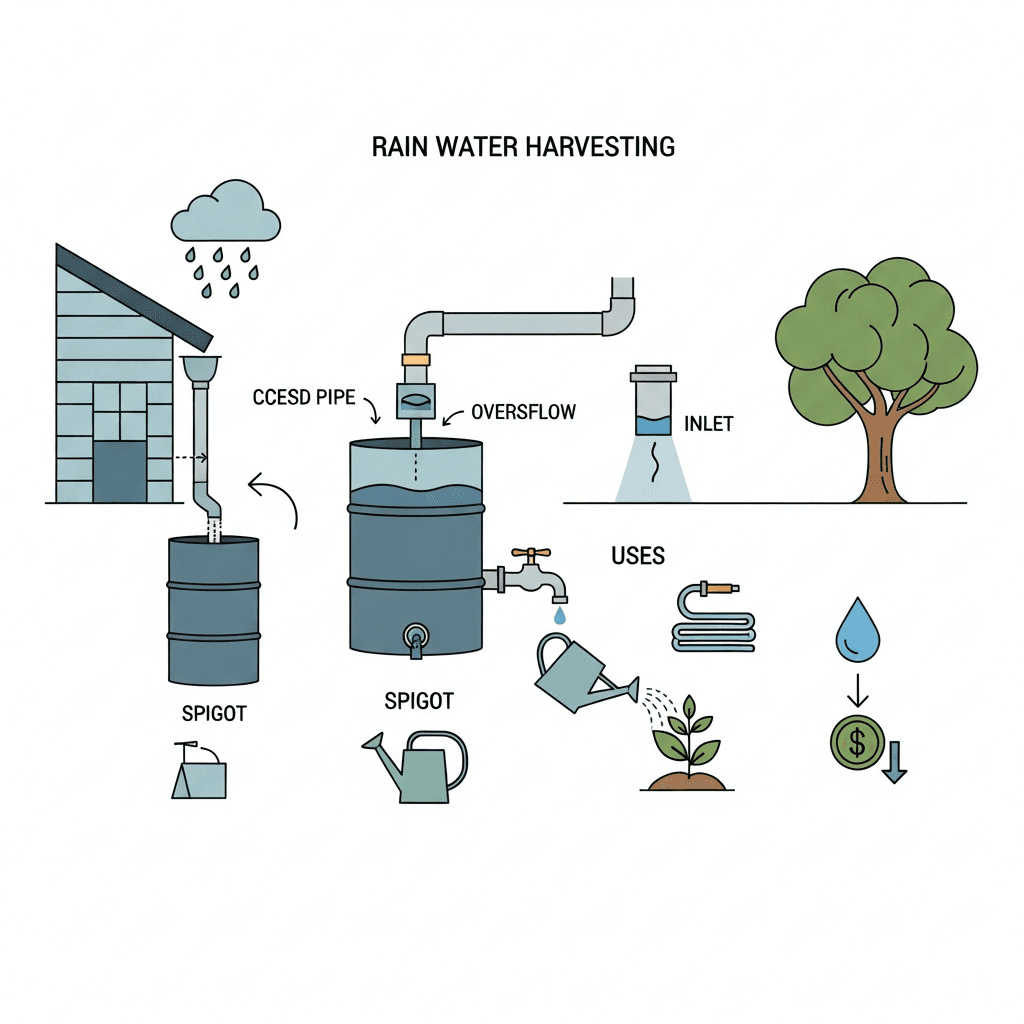
A 1,000-square-foot roof section sheds approximately 623 gallons of water per 1 inch of rainfall, calculated as roof area (sq ft) x rainfall (inches) x 0.623. A single 50-gallon rain barrel captures only 8% of that water. Most homeowners need 2-4 barrels connected in series, with overflow directed to a rain garden or dry well.
Consider a representative case: a 3-barrel system (165 gallons total) installed under a 900-square-foot roof section in a Zone 6b climate. Total cost ran $185 for three recycled food-grade barrels, $42 in fittings, and $28 for a first-flush diverter -- $255 total versus $420 for comparable prefabricated units. Over 22 rain events in one season, the system captured roughly 2,800 gallons that would have otherwise eroded the foundation bed. At a local water rate of $0.008 per gallon, that is $22.40 in saved water -- but the real savings come from avoiding foundation grading repairs, which can run $350 or more. Nature runs on ratios -- learn them, and rainwater becomes a resource instead of a problem.
Use our Rain Barrel Calculator to determine exactly how much water your roof produces per storm and how many barrels you need.

The Roof Catchment Formula
Every square foot of roof is a collection surface. The standard catchment formula is:
Gallons collected = Roof area (sq ft) x Rainfall (inches) x 0.623
The 0.623 conversion factor comes from the relationship between cubic feet and gallons: 1 cubic foot = 7.48 gallons, and 1 inch = 1/12 foot, so 7.48 / 12 = 0.623 gallons per square-foot-inch.
However, not all rain that hits your roof reaches the barrel. A collection efficiency factor accounts for losses from splashing, gutter overflow, and the first-flush diverter:
Effective gallons = Roof area x Rainfall x 0.623 x Collection efficiency
- Smooth metal roof: 95% efficiency
- Asphalt shingles: 85-90% efficiency
- Clay or concrete tile: 80-85% efficiency
- Flat/green roof: 50-70% efficiency
For a 1,200 sq ft asphalt-shingle roof in a 0.75-inch rainstorm: 1,200 x 0.75 x 0.623 x 0.85 = 476 gallons of collectible water.
That is nearly 10 full 50-gallon barrels from a single moderate storm. Every square foot counts when you are sizing a collection system.
How Many Rain Barrels Do You Need?
The answer depends on your roof size, local rainfall patterns, and how much water you plan to use between storms. Here is a practical sizing approach:
Step 1: Calculate your roof's yield per typical storm. Look up your area's average storm size. The EPA reports that most of the continental US averages 0.5-1.0 inches per rain event. For a 1,000 sq ft roof section with 0.75-inch average storm and 85% efficiency: 1,000 x 0.75 x 0.623 x 0.85 = 397 gallons per storm.
Step 2: Determine your target capture percentage. You do not need to capture 100% of every storm. That requires massive storage. A practical target is 25-40% of a typical storm, which covers most garden irrigation needs between rain events.
Step 3: Divide target gallons by barrel size. For 40% capture of 397 gallons: 159 gallons / 55-gallon barrels = 2.9 barrels, round up to 3 barrels.
Step 4: Plan overflow routing. The remaining 60% of storm water needs somewhere to go. Direct overflow to a rain garden, dry well, or at least 10 feet from your foundation. Never let overflow pool against the house.
Step 5: Position barrels on a stable, level platform. A full 55-gallon barrel weighs 459 lbs. Place it on compacted gravel or concrete blocks rated for the weight. Elevate 12-24 inches for gravity-fed hose pressure.
Warning
A single overflowing barrel next to a foundation can cause more damage than no barrel at all. Always install an overflow fitting and direct it away from the house. See the case study below for a real-world example.
Case Study: When One Barrel Is Not Enough
A homeowner installed a single 50-gallon rain barrel under a 1,200 sq ft roof section. In the first moderate rainstorm (0.75 inches), her roof shed approximately 560 gallons. The barrel filled in under 5 minutes and overflowed for the remaining 510 gallons, eroding the foundation bed and creating a muddy channel through the lawn.
She calculated that she needed 560 / 50 = 11 barrels to catch the full storm -- impractical for a residential lot.
The real solution: 3 barrels (150 gallons total) connected in series with an overflow hose directed to a rain garden 10 feet from the foundation. This system captures 27% of a typical storm and eliminates erosion entirely. The rain garden -- a shallow depression planted with native sedges and black-eyed Susans -- absorbs the overflow and filters it into the groundwater table.
Calculate before you plant -- and calculate before you install. Our Rain Barrel Calculator shows you exactly how much water your roof produces so you can size your system realistically.
Rain Barrel Costs: Prefab vs DIY
| Barrel Type | Capacity | Cost | Lifespan | Pros | Cons |
|---|---|---|---|---|---|
| Prefab decorative (resin) | 50 gal | $95 - $140 | 10-15 years | Attractive, ready to use, built-in spigot | Expensive per gallon, limited sizes |
| Prefab heavy-duty (HDPE) | 55 gal | $80 - $120 | 15-20 years | Durable, UV-resistant | Plain appearance |
| Recycled food-grade drum | 55 gal | $25 - $50 | 10+ years | Cheapest, strong | Requires DIY fittings, plain look |
| IBC tote (pallet tank) | 275 gal | $50 - $100 | 10-15 years | Massive capacity per unit | Very large footprint, needs screening |
| Collapsible bladder | 50-100 gal | $40 - $80 | 5-8 years | Folds flat in winter, portable | Less durable, UV-sensitive |
For a 3-barrel system using recycled food-grade drums:
- 3 drums at $35 each: $105
- Spigots, overflow fittings, linking hoses: $40-55
- First-flush diverter: $25-35
- Platform materials (cinder blocks): $20-30
- Total: $190 - $225 vs $285-$420 for three prefab units
Tip
Food-grade drums (previously used for olive oil, juice concentrate, or food-grade chemicals) are available at most farm supply stores or through Craigslist/Facebook Marketplace. Avoid drums that held non-food chemicals. If you build raised beds for your garden, use our Raised Bed Calculator to plan beds that make the most of your collected rainwater.
Is Rainwater Harvesting Legal in Your State?
Rainwater harvesting legality varies significantly across the United States. Most states allow it, but some have restrictions on volume or method. Always check your specific county and municipality for local ordinances.
| State | Status | Key Restriction |
|---|---|---|
| Colorado | Legal with limits | Max 110 gallons (two 55-gal barrels), residential only |
| Utah | Legal with limits | Max 2,500 gallons, must register with state |
| Texas | Legal, encouraged | No limits, some counties offer tax incentives |
| Oregon | Legal | Must be from rooftop, no stream/river collection |
| California | Legal, encouraged | No limits since 2012, some rebate programs |
| Florida | Legal | No restrictions, some HOAs may regulate appearance |
| Arizona | Legal, incentivized | Tax credits up to $1,000 for harvesting systems |
| Washington | Legal | Rooftop collection, no permit needed |
| Ohio | Legal | No state restrictions |
| Georgia | Legal | No state restrictions, some counties limit use |
| Illinois | Legal | Encouraged since 2017 Rain Barrel Act |
| Nevada | Legal with limits | Noncommercial use only, max 20,000 gallons |
Important
Colorado's 110-gallon limit means you can only legally use two standard 55-gallon barrels. Utah requires online registration through the Division of Water Rights. Check your state's specific requirements before installing a large system.
First-Flush Diverter: Protecting Your Water Quality
The first 10-15 gallons of runoff from any rainstorm carry the heaviest concentration of contaminants -- bird droppings, dust, pollen, roofing chemicals, and atmospheric pollutants. A first-flush diverter routes this initial dirty water away from your barrels.
A simple chamber-type diverter ($25-35) consists of a sealed PVC pipe that fills first, then a float ball seals it and redirects clean water to the barrel. After the storm, a slow-drain valve empties the diverter chamber over 24-48 hours, resetting it for the next rain event.
Sizing rule: use 1 gallon of diverter capacity per 100 sq ft of roof area. A 1,000 sq ft roof needs a 10-gallon first-flush diverter.
Mosquito Prevention
Standing water breeds mosquitoes. Every barrel opening must be sealed or screened. Non-negotiable measures:
- Fine mesh screen (1/16 inch or smaller) over every opening, inlet, and overflow
- Sealed lid with no gaps larger than a pencil tip
- Mosquito dunks (Bti tablets) -- one quarter-dunk per 50-gallon barrel, lasts 30 days, safe for plants
- Use water regularly -- stagnant water is the problem; water that cycles every 7-10 days rarely breeds mosquitoes
- Check overflow outlets -- standing puddles near the overflow point are breeding grounds
The EPA recommends inspecting rain barrels weekly during mosquito season and replacing screens that develop tears.
Integrating Rain Barrels with Garden Irrigation
Collected rainwater is ideal for garden use. It is slightly acidic (pH 5.6-6.2), which most vegetables prefer, and it is free of chlorine and fluoride found in municipal water. Here is how to connect barrels to your irrigation system:
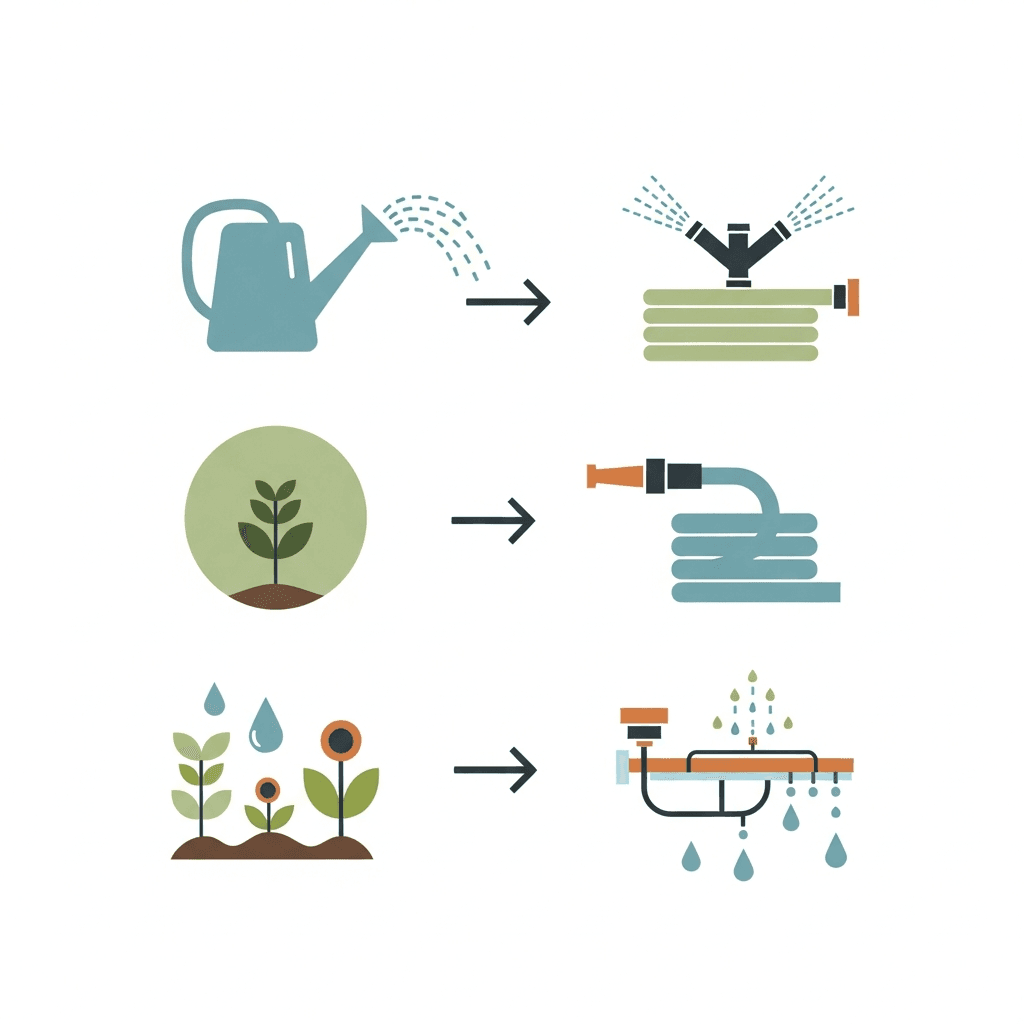
Gravity-fed drip irrigation: Elevate barrels 24-36 inches above the garden bed on a sturdy platform. A standard garden hose connected to the barrel spigot provides about 1-2 PSI per foot of elevation. At 2 feet of elevation, expect 2-4 PSI -- enough for low-pressure drip emitters but not sprinklers. Our Irrigation Calculator helps calculate run times for gravity-fed systems. For detailed drip irrigation setup instructions, see our Garden Watering and Irrigation Guide.
Pump-assisted systems: A small utility pump ($40-80) boosts pressure to 20-40 PSI, enough for any drip or soaker system. Use a barrel-mounted float switch to prevent the pump from running dry.
Hand watering: A simple spigot at barrel bottom with a garden hose works for small gardens. Expect 2-4 gallons per minute flow rate from a full barrel elevated 2 feet.
How Much Garden Can Rain Barrels Water?
A 165-gallon system (3 barrels) delivers enough water for:
- 265 sq ft of garden at 1 inch per week (165 / 0.623 = 265 sq ft)
- A 4x8 raised bed for over 5 weeks without rain
- Five 20-gallon container plants for 8+ waterings
For serious gardeners with larger plots, consider supplementing barrel water with an efficient drip system connected to a hose bib. Our Pool Volume Calculator uses similar volume math if you are sizing a water feature.
What to Do This Week
Inspect your gutters and downspouts before spring storms arrive. Clear any debris, check that all joints are sealed, and identify the downspout closest to your garden beds -- that is where your first barrel goes. If you already have barrels, flush them with a garden hose to remove sediment from winter, check all screens for tears, and replace mosquito dunks. Enter your roof dimensions into the Rain Barrel Calculator to see how much water your next storm will produce.
Frequently Asked Questions
How much water can I collect from my roof?
A 1,000-square-foot roof collects approximately 623 gallons per 1 inch of rainfall, assuming perfect collection. With realistic efficiency (85% for asphalt shingles), expect about 530 gallons per inch. Over a year, a roof in an area receiving 40 inches of annual rainfall can theoretically yield over 21,000 gallons.
How many rain barrels do I need for a vegetable garden?
For a typical 200 sq ft vegetable garden needing 1 inch of water per week (125 gallons), 3 barrels (165 gallons) provide enough storage for one full week of irrigation. In areas with weekly rainfall, 2 barrels (110 gallons) may suffice since storms replenish your supply regularly.
Can I drink rainwater from a rain barrel?
No, not without extensive treatment. Rooftop rainwater contains contaminants from bird droppings, asphalt shingle chemicals, atmospheric pollutants, and bacteria. It is excellent for garden irrigation, car washing, and toilet flushing but requires filtration, UV treatment, and testing before any potable use. The CDC advises against drinking untreated rainwater.
Do rain barrels really save money?
A typical 165-gallon rain barrel system saves 3,000-5,000 gallons of municipal water per growing season. At average US water rates ($0.006-$0.012 per gallon), that saves $18-$60 per year. A DIY system costing $200 pays for itself in 3-5 years. The bigger savings come from preventing foundation erosion damage, which can cost $500-$3,000 to repair.
What is the best material for rain barrels?
Food-grade HDPE (high-density polyethylene) is the best material for rain barrels. It is UV-resistant, BPA-free, and rated for food contact. Look for barrels stamped with recycling code #2 (HDPE). Avoid barrels that previously held non-food chemicals, and never use galvanized metal barrels for garden irrigation, as zinc can leach into the water.
How do I winterize rain barrels?
In freezing climates (USDA Zones 6 and below), disconnect and drain barrels before the first hard freeze. A full 55-gallon barrel can crack when water expands into ice. Store barrels upside-down in a garage or shed. Reconnect after your last frost date -- use our Frost Date Calculator to find the right timing for your area.
Related Calculators
- Rain Barrel Calculator -- Calculate roof catchment volume and number of barrels needed
- Irrigation Calculator -- Determine how long rain barrel water will last for your garden
- Pool Volume Calculator -- Calculate water volume for any container or water feature
- Raised Bed Calculator -- Plan beds that maximize rainwater irrigation efficiency
- Frost Date Calculator -- Know when to reconnect barrels after winter
Related Articles
- Garden Watering and Irrigation Guide -- Set up drip irrigation to use your collected rainwater efficiently
- Raised Bed Garden Complete Guide -- Build raised beds with proper drainage near your barrel system
- Seed Starting and Frost Date Guide -- Time your planting around spring rains for maximum barrel fill
- Composting Beginners Guide -- Compost-amended soil absorbs rainwater more efficiently
This guide provides general information on residential rainwater harvesting. Regulations vary by state, county, and municipality. Always verify local codes before installing a collection system. Water quality from rooftop collection is not suitable for drinking without treatment. Consult your local extension office for region-specific recommendations.
This article is provided for informational and educational purposes only. Content should not be considered professional financial, medical, legal, or other advice. Always consult a qualified professional before making important decisions. UseCalcPro is not responsible for any actions taken based on the information in this article.
Try These Calculators
Estimate monthly rainwater collection from your roof by area, material, and local rainfall. Get barrel count, garden watering duration, and annual savings.
Estimate annual rainwater collection from your roof area, calculate water bill savings, and find the ideal tank size based on your usage and local rainfall.
Plan sprinkler head placement for full lawn coverage. Calculate heads needed, GPM flow rate, zone count, and weekly water usage by sprinkler type and area.
Plan your garden layout with correct plant and row spacing. Enter bed dimensions and crop type to get exact plant counts, row counts, and seed quantities.