RV Size Insurance Rates: 2026 Premiums by Length, Class & Weight
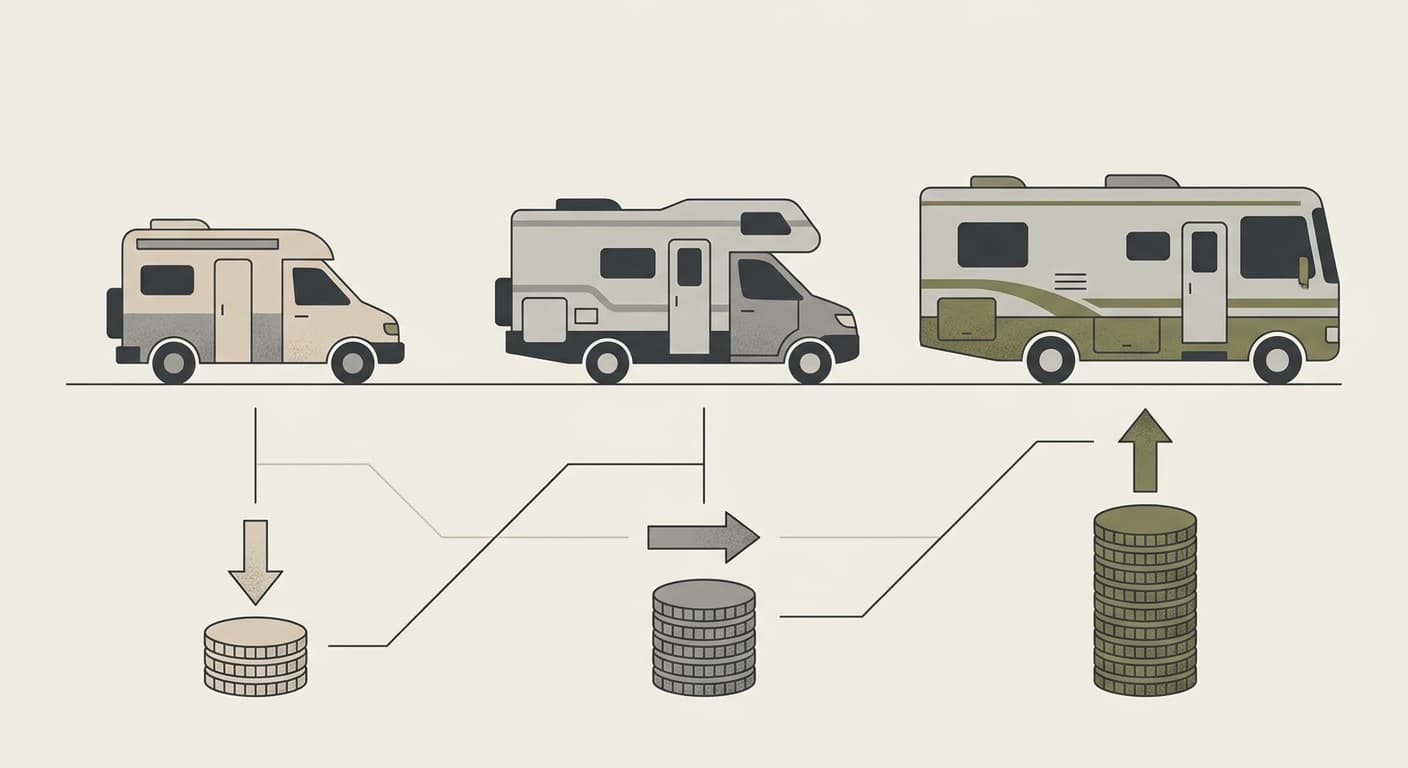
RV size insurance rates in 2026 climb from about $300/yr for a 20-foot travel trailer to $4,000/yr for a 40-foot Class A diesel pusher — roughly a 13x spread driven by length, weight, value, and class. Size is not a standalone rating field on most policies, but it correlates tightly with the four factors that are. Estimate your number by size and class with our free RV Insurance Quote Calculator before you call a carrier.
The first question when pricing an RV is almost always "does a bigger RV cost more to insure?" The short answer is yes, but not because a foot of length has a price tag. A 40-foot coach typically weighs 30,000+ pounds, carries a $250,000+ value, and needs higher liability limits — and those three things, not the tape measure, set the rate. Two 32-foot units can quote $900 apart purely on weight and value, while a 24-foot and a 28-foot trailer can quote within $40 of each other. Length is a proxy. The real levers sit underneath it.
This guide is the size-and-length companion to our general RV insurance cost breakdown and the carrier-specific Good Sam quote guide. Here we focus on one question: how does the physical size of your RV — its length, weight, and class footprint — map to a 2026 annual premium?
Does RV Size Affect Insurance Rates?
RV size affects insurance indirectly: insurers do not price by length, but length correlates with vehicle value, gross weight, repair cost, and required liability limits — the factors that actually drive the premium. According to Inszone Insurance, larger RVs require higher liability coverage because a heavier, longer rig causes more damage in an at-fault accident, so insurers build bigger liability limits into the policy.
A Class A motorhome can weigh 30,000 pounds and stretch 45 feet, per Inszone. A 20-foot Class B camper van weighs under 9,000 pounds. The accident a 45-foot, 30,000-pound coach can cause is in a different universe from a fender-bender in a van — and the premium reflects that risk, not the literal foot count.
Three size-linked factors do the work:
- Weight — heavier RVs cause more damage and cost more to tow, repair, and total out.
- Value — longer RVs almost always cost more, and value is the single biggest lever within any class.
- Liability exposure — a bigger rig needs higher minimum liability limits, which raises the floor of the premium.
Tip
If two RVs are the same length but one is 5,000 pounds heavier (a diesel chassis vs a gas chassis, or a triple-slide vs a single-slide), the heavier one usually insures higher even at the same value. Weight is the quiet lever buyers forget to ask about.
RV Insurance Rates by Length: The 2026 Size Bands
Length is the fastest way to size up your likely premium because it sorts RVs into recognizable tiers. The table below maps typical length ranges to the matching class and a 2026 standard-comprehensive annual rate band. These bands mirror the published 2024-2026 rate data from Progressive, HomeGuide, and the figures behind our RV Insurance Quote Calculator.
| Length | Typical RV Type | 2026 Standard Rate (per yr) | Liability-Only Floor |
|---|---|---|---|
| 16–22 ft | Small travel trailer / teardrop | $300–$450 | $125–$200 |
| 18–24 ft | Class B camper van (Sprinter, Transit) | $600–$1,200 | $250–$500 |
| 24–32 ft | Class C motorhome (cab-over) | $600–$1,000 | $300–$500 |
| 25–35 ft | Mid-size travel trailer / small 5th wheel | $450–$900 | $200–$400 |
| 30–42 ft | Large 5th wheel (triple-slide) | $1,000–$2,500 | $400–$600 |
| 30–36 ft | Class A gas coach | $1,000–$1,500 | $400–$700 |
| 36–45 ft | Class A diesel pusher | $2,500–$4,000 | $600–$900 |
Notice the bands overlap by length. A 30-foot rig could be a Class A gas coach at $1,200/yr or a large 5th wheel at $1,500/yr — same length, different class, different price. That is exactly why length alone never sets your rate. The class tells you whether the RV is motorized (it has an engine to insure) and roughly how much it is worth.
Important
A motorized RV of a given length almost always insures higher than a towable of the same length, because the motorized unit adds engine, transmission, and chassis-liability exposure the trailer does not have. A 30-foot Class C motorhome ($600–$1,000/yr) and a 30-foot travel trailer ($450–$700/yr) are not the same insurance product.
Worked Example 1: 22-Foot Travel Trailer vs 22-Foot Class B Van
Take two RVs the same 22-foot length. A $20,000 used travel trailer, seasonal use, experienced driver, liability-only, lands at about $150–$200/yr because there is no engine to insure and the value is low. A $90,000 Class B Sprinter conversion at the same 22 feet, standard comprehensive, runs $700–$1,000/yr — roughly 4–5x more. Same length, but the van adds a drivetrain, four times the value, and motorized-liability exposure. Length is identical; the premium is not.
Worked Example 2: Scaling Up a Class A by Length
A 32-foot gas Class A valued at $130,000, seasonal, standard comprehensive, quotes near $1,200/yr. Stretch to a 40-foot diesel pusher valued at $280,000 and the same coverage runs $3,000–$3,500/yr. The 8 extra feet did not cost $1,800. The jump came from a $150,000 higher value (the dominant lever), a 10,000-pound heavier diesel chassis, and a larger liability footprint. Re-run both rigs side by side in the RV Insurance Quote Calculator and the value field moves the needle far more than length.
RV Weight, Value, and Class: What Size Really Prices
Length is the headline, but weight, value, and class are the engine. Here is how each scales with size and what it does to your rate.
| Size Factor | Small RV | Large RV | Effect on Premium |
|---|---|---|---|
| Gross weight | Van ~8,000 lb | Diesel Class A ~30,000 lb | Heavier = more damage, higher tow/repair cost |
| Typical value | Trailer ~$20,000 | Diesel pusher ~$280,000 | Value is the biggest single lever (2–4x within a class) |
| Liability need | $100k baseline | $300k–$500k recommended | Larger rig raises the liability floor |
| Repair cost | Single bay, fast | Specialized RV bay, slow | Bigger units cost more per claim |
| Class footprint | Towable, no engine | Motorized, full chassis | Motorized adds drivetrain exposure |
Value is the lever that dwarfs length. Within a single class, value alone swings the premium 2–4x from the bottom to the top of the band — a $25,000 used Class C and a $150,000 new Class C are both "Class C," but they sit at opposite ends of the $600–$1,000/yr range and then some. Weight is the secondary size lever: a diesel pusher's chassis can weigh twice a gas coach's, and heavier rigs cost more to tow, lift, and total.
Warning
A bigger RV also nudges you toward higher liability limits — and you should accept that nudge. On a 40-foot coach, a single at-fault multi-car accident can exceed a $100k liability limit easily. Upgrading from $100k to $300k–$500k typically adds only $100–$250/yr and is the highest-value upgrade on a large rig. Do not buy the biggest RV you can afford and the smallest liability limit you can find.
Worked Example 3: Same Length, Different Weight
Two 36-foot Class A coaches. The first is a gas-chassis coach valued at $140,000 weighing about 22,000 pounds — standard comprehensive lands near $1,400/yr. The second is a diesel pusher valued at $300,000 weighing about 33,000 pounds — the same coverage runs $3,200–$3,800/yr. Identical 36-foot length. The diesel's higher value ($160,000 more) and 11,000 extra pounds more than double the premium. Length held constant; weight and value did all the work.
How Full-Time Use Stacks on Top of Size
Size sets the base; use type multiplies it. Full-time RVers — those living in the RV more than six months a year as a primary residence — pay 20–40% more than seasonal users, because the carrier structures the policy like homeowner insurance with personal liability, contents, and emergency living expense added, per the RV Insurance Quote Calculator rate model. That uplift is multiplicative, so it hits big rigs hardest in absolute dollars.
A 40-foot diesel pusher at a $3,500/yr seasonal base pays roughly $4,200–$4,900/yr full-time — the same 20–40% percentage, but $700–$1,400 in real money. A 24-foot travel trailer at a $400/yr base pays about $480–$560/yr full-time — the identical percentage costs only $80–$160. Bigger rigs amplify every multiplier, which is why the full-timer decision matters far more on a large coach than on a small trailer.
| RV Size | Seasonal Base | Full-Time (+20–40%) | Extra Dollars |
|---|---|---|---|
| 24-ft travel trailer | $400/yr | $480–$560/yr | $80–$160 |
| 28-ft Class C | $800/yr | $960–$1,120/yr | $160–$320 |
| 34-ft Class A gas | $1,300/yr | $1,560–$1,820/yr | $260–$520 |
| 40-ft Class A diesel | $3,500/yr | $4,200–$4,900/yr | $700–$1,400 |
Tip
Never misrepresent seasonal vs full-time use to dodge the uplift. If a claim reveals you were living in the RV full-time on a recreational policy, the claim can be denied and the policy voided retroactively. On a 40-foot six-figure coach, that is the most expensive corner you could possibly cut.
How to Estimate Your RV Insurance Rate by Size
Pricing your own rig by size takes five inputs and two minutes. Run them through the RV Insurance Quote Calculator to get a benchmark before any carrier quotes you.
- Identify your class and length. Towable (travel trailer, 5th wheel) or motorized (Class A/B/C)? Length sorts you into the right band above.
- Pin your value. Purchase price or current market value. This is the dominant lever — be accurate.
- Note your gross weight. Heavier-for-length rigs (diesel, triple-slide) price above the band midpoint.
- Set use type. Seasonal or full-time. Full-time adds the 20–40% uplift, which is biggest in dollars on large rigs.
- Pick coverage and liability. Liability-only trims to roughly 35% of standard; bigger rigs should carry $300k–$500k liability.
Then quote at least three carriers on identical coverage. A 20–35% spread between carriers on the same deductible and limits is routine — and that spread is worth more on a big-rig premium than a small one. If you are financing, total the loan payment with the RV Loan Calculator and project resale with the RV Depreciation Calculator so you see the full carrying cost, not just the premium. And before you buy a large towable, confirm your tow vehicle can handle the weight with the RV Towing Calculator — an over-tow scenario can void a claim regardless of how well you insured it.
Important
Quote insurance on your top two or three RV choices BEFORE buying. The premium gap between a 32-foot gas Class A and a 40-foot diesel coach can exceed $2,000/yr — comparable to several years of loan interest. Two hours of size-by-size quote comparison often out-earns two days of price haggling on the RV itself.
Frequently Asked Questions
Does RV size affect insurance rates?
Yes, but indirectly — insurers do not price by length, they price by the value, gross weight, repair cost, and liability exposure that grow with size. A 20-foot trailer runs about $300/yr while a 40-foot Class A diesel pusher runs up to $4,000/yr, a roughly 13x spread, because the larger rig carries far more value, weight, and liability risk. Estimate yours with the RV Insurance Quote Calculator.
How much does it cost to insure a 40-foot Class A motorhome?
A 40-foot Class A diesel pusher costs about $2,500–$4,000/yr for standard comprehensive coverage in 2026, with a luxury coach reaching $4,000+. Casey Insurance and Progressive note that diesel pushers cost more than gas Class A coaches due to their higher value, weight, and complex systems. A gas Class A of similar length runs $1,000–$1,500/yr.
Is a bigger RV always more expensive to insure?
Almost always, but length alone is not the reason — a heavier, higher-value, motorized RV of the same length will insure higher than a lighter towable. A 30-foot Class C motorhome ($600–$1,000/yr) insures above a 30-foot travel trailer ($450–$700/yr) because the motorhome adds engine, transmission, and chassis-liability exposure the trailer lacks.
How much does RV insurance cost by length in 2026?
By length, 2026 standard rates run $300–$450/yr for a 16–22 ft travel trailer, $600–$1,000/yr for a 24–32 ft Class C, $1,000–$2,500/yr for a 30–42 ft 5th wheel, and $2,500–$4,000/yr for a 36–45 ft Class A diesel. Length bands overlap across classes, so confirm your class first; the full per-class breakdown is in our RV insurance cost guide.
Does RV weight change my insurance premium?
Yes — at the same length and value, a heavier RV usually insures higher because it causes more damage and costs more to tow, repair, and total out. A 36-foot diesel pusher weighing ~33,000 pounds insures far above a 36-foot gas coach weighing ~22,000 pounds, even before the value difference is counted. Weight is the size lever buyers most often overlook.
Why does a Class B van the same length as a small trailer cost more to insure?
A Class B camper van insures higher than a same-length travel trailer because the van is motorized — it adds engine, transmission, and driving-liability exposure, plus its conversion value is typically 3–5x the trailer's. A 22-foot Sprinter conversion runs $700–$1,000/yr while a 22-foot used travel trailer can be $150–$200/yr liability-only. Use type and conversion quality also affect Class B pricing.
How can I lower the insurance rate on a large RV?
On a big rig, the highest-value moves are raising your deductible $500 to $1,000 (cuts 10–20%), bundling with auto or home (10–25%), enclosed storage (10–25%), and quoting three carriers on identical coverage (20–35% spread). Do not cut liability limits to save money on a large coach — keep $300k–$500k, because a 40-foot rig's at-fault accident easily exceeds a $100k limit.
Related Articles
- How Much Does RV Insurance Cost in 2026? — The full cross-carrier cost breakdown by RV class, the companion to this size-and-length guide
- Class C Motorhome Insurance Cost: 2026 Averages — A deep dive on the mid-size 24–32 ft motorized tier
- Good Sam RV Insurance Quote 2026 — Carrier-specific guide for the broker that packages full-timer coverage well
Related Calculators
- RV Insurance Quote Calculator — Estimate your premium by class, value, use, and coverage before you call a carrier
- RV Loan Calculator — Monthly payment so you can total true ownership cost on a larger rig
- RV Depreciation Calculator — Project resale value to decide when agreed-value coverage stops paying
- RV Towing Calculator — Match tow vehicle to trailer weight before insuring a large towable
- Auto Insurance Quote Calculator — Price the tow-vehicle policy you can bundle for a multi-policy discount
Methodology
Premium ranges reflect published 2024-2026 rate data from Progressive (travel trailer 2024 average $594/yr; motorhome $1,052/yr; liability-only from $125/yr), HomeGuide's 2026 RV insurance cost guide, Casey Insurance's Class A guide, and Inszone Insurance's analysis of how RV size affects coverage needs. Size, weight, and value relationships mirror the rate model behind our RV Insurance Quote Calculator. Length bands overlap across classes by design; always confirm your class and obtain written quotes from at least three carriers on identical coverage before purchasing.
This article provides general information for educational purposes. RV insurance pricing and coverage vary by carrier, state regulation, weight, value, and individual underwriting. Always obtain written quotes on identical coverage and consult a licensed insurance agent before purchasing.
This article is provided for informational and educational purposes only. Content should not be considered professional financial, medical, legal, or other advice. Always consult a qualified professional before making important decisions. UseCalcPro is not responsible for any actions taken based on the information in this article.
Try These Calculators
Estimate 2026 RV insurance annual premium by RV class, value, and full-time vs seasonal use. Class A $1K-$4K, Class C $600-$1K, trailers $300-$600 yearly.
Calculate RV fuel economy adjusted for terrain, wind, and cargo load. See gallons needed, total fuel cost, and cost-per-mile for any RV type and trip distance.
Calculate garage door size, weight, spring rating, and opener HP requirements. Get headroom clearance and cost estimates for steel, wood, or aluminum.
Estimate 2026 motorcycle insurance monthly premium by bike type, rider age, ZIP, and coverage tier. Sport bikes run 2-3x cruiser rates; lay-up cuts 15-35%.
Estimate 2026 cataract surgery costs by lens type. Monofocal IOL runs $1,500–$3,500/eye; multifocal up to $6,500. Compare lens options and insurance coverage.