Scaling Cocktail Recipes for Large Groups Without Losing Quality (2026)
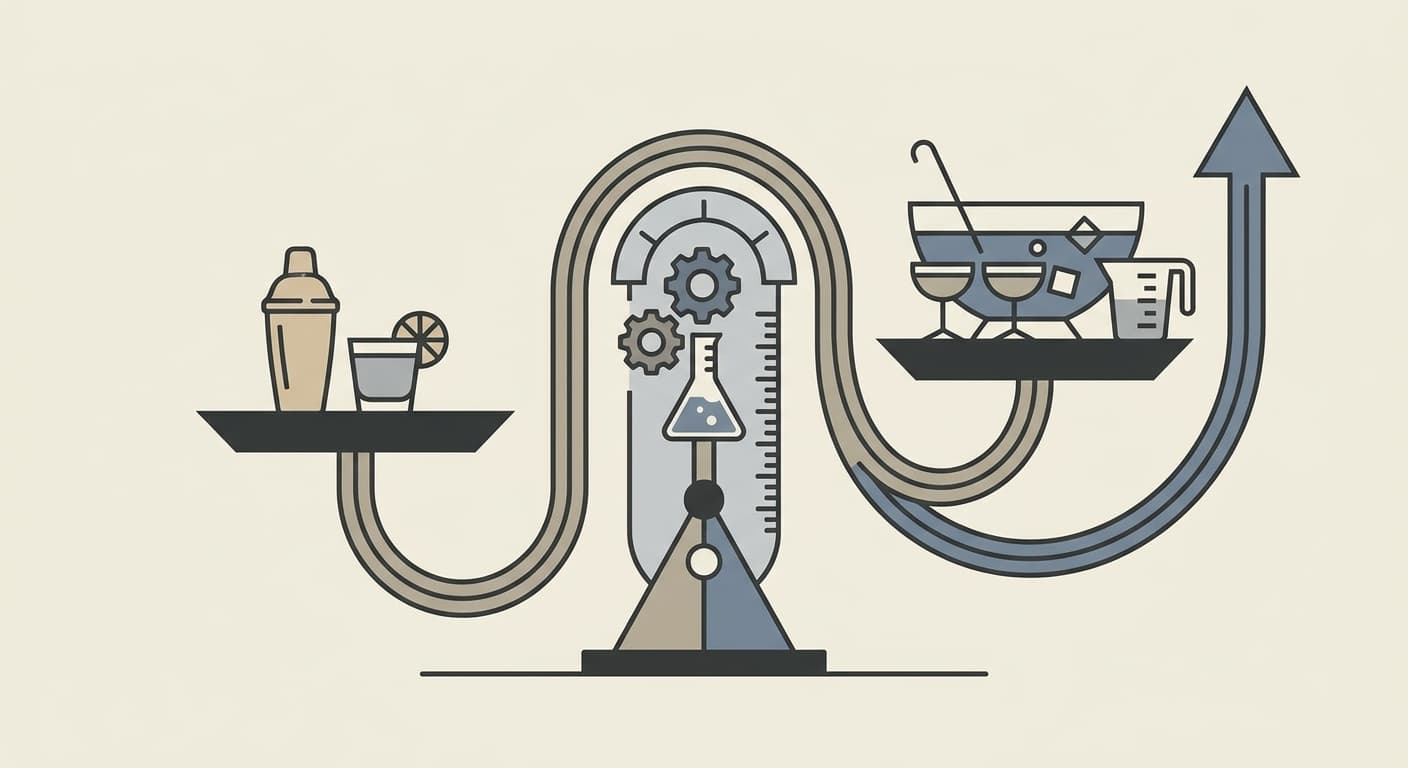
To scale a cocktail recipe for a large group without losing quality, multiply every spirit, liqueur, and syrup by your serving count, then add 20-25% water to replace the dilution you lose by not shaking each drink over ice. That single adjustment — pre-dilution — is what separates a balanced batch from a harsh, over-strong pitcher. Run your recipe through our Cocktail Batch Calculator to get exact ounces, cups, and bottles in one click.
Batching margaritas for a 24-person birthday party illustrates the trap: scaling the recipe perfectly — 48 oz tequila, 18 oz triple sec, 24 oz lime — can still produce a drink that tastes like a punch in the face. Multiplying the ingredients flawlessly forgets the one thing a shaker does for free: it melts ice into the drink. A single shaken margarita ends up roughly 25% water by the time it hits the glass, while a straight-multiplied pitcher has zero. Adding back about 18 oz of water to that 90 oz batch brings the drinks back to the recipe's intended balance.
That is the core lesson of scaling cocktails: the ingredient math is the easy part, and it scales linearly. Quality lives in the things that do not scale linearly — dilution, citrus freshness, carbonation, and temperature. This guide walks through each one with exact ratios, worked examples for 12, 24, and 50 guests, and the timing rules that keep a large batch tasting like a freshly made drink.
Why Scaling Cocktail Recipes Breaks Quality (and the Fix)
A cocktail recipe written for one drink assumes a process: you add ice, you shake or stir, the ice chills and dilutes, you strain. When you scale that recipe for 50 people and pour it from a pitcher, you keep the ingredients but lose the process. Four things degrade, and each has a fix.
| What Breaks at Scale | Why | The Fix |
|---|---|---|
| Drink is too strong / harsh | No ice-melt dilution from shaking | Add 20-25% water to the batch (pre-dilution) |
| Citrus tastes flat or bitter | Fresh juice oxidizes after 6-8 hours | Batch citrus drinks same-day, add juice last |
| Fizzy drinks go flat | Carbonation escapes during storage | Add soda, tonic, or sparkling wine at serving time only |
| Drink warms up fast in a pitcher | Large volume, small ice surface area | Pre-chill batch to 34-38°F; use large-format ice |
The ingredient scaling itself is pure multiplication. According to the National Institute on Alcohol Abuse and Alcoholism, a standard drink contains 0.6 fl oz of pure alcohol — the amount in 1.5 oz of 80-proof spirit. Most cocktail recipes use 2 oz of base spirit per serving, which is why a 750ml bottle (25.4 oz) yields about 12 standard 2 oz cocktail pours. Scaling spirits and syrups is safe to do by simple multiplication. The judgment calls are everything else.
Tip
Scale the recipe first, then treat dilution, citrus, and carbonation as separate steps layered on top. Mixing those decisions into the ingredient math is exactly how a perfectly multiplied recipe ends up tasting wrong.
The Scaling Math: From One Drink to a Crowd
Spirits, liqueurs, and syrups scale linearly. If one Margarita calls for 2 oz tequila, 0.75 oz triple sec, 1 oz lime juice, and 0.5 oz simple syrup, you multiply each ingredient by the number of servings. The Cocktail Batch Calculator does this instantly and converts the spirit totals into 750ml bottles so you know exactly what to buy.
Worked Example: Margarita for 24
Here is the full calculation for 24 margaritas — the batch size used in the dilution example above.
- Tequila: 2 oz × 24 = 48 oz → 48 ÷ 25.4 = 1.9 → 2 bottles.
- Triple sec: 0.75 oz × 24 = 18 oz → 18 ÷ 25.4 = 0.7 → 1 bottle.
- Lime juice: 1 oz × 24 = 24 oz → at ~1 oz juice per lime, that is 24 limes (buy ~28 to allow for garnish wedges).
- Simple syrup: 0.5 oz × 24 = 12 oz.
- Pre-batch subtotal: 48 + 18 + 24 + 12 = 102 oz.
- Pre-dilution (shaken, 25% of spirit volume): spirits = tequila 48 + triple sec 18 = 66 oz of spirit; 66 × 0.25 = 16.5 oz water.
- Final batch volume: 102 + 16.5 = 118.5 oz (about 14.8 cups, or 3.5 liters).
That serves 24 drinks at roughly 4.9 oz each before ice. Without the 16.5 oz of water, each pour would be about 14% under-diluted — the water makes up 16.5 of the 118.5 oz final volume — exactly the harshness an undiluted batch produces.
How Many Drinks to Scale For
Before you multiply anything, decide how many drinks the group will actually consume. The widely used party-planning rule is 2 drinks per guest in the first hour, then 1 drink per guest per additional hour, per beverage planners like Reventals' party drink calculator. A 3-hour event therefore averages 4 drinks per guest.
| Guests | 2-Hour Event | 3-Hour Event | 4-Hour Event |
|---|---|---|---|
| 12 | 36 drinks | 48 drinks | 60 drinks |
| 24 | 72 drinks | 96 drinks | 120 drinks |
| 50 | 150 drinks | 200 drinks | 250 drinks |
| 100 | 300 drinks | 400 drinks | 500 drinks |
To keep that table honest: the formula is guests × (2 + 1 × (hours − 1)). For 50 guests over 3 hours that is 50 × (2 + 1 + 1) = 50 × 4 = 200 drinks. Always size for the conservative number and buy a 10% buffer rather than over-scaling the whole recipe.
Warning
Do not scale the recipe to the maximum possible consumption. Scaling for 4 drinks per guest when your group averages 2.5 means you batch 60% too much — and a citrus batch you cannot save for tomorrow becomes 40 oz of waste poured down the drain.
Pre-Dilution: The Single Most Important Quality Step
Pre-dilution adds water to a batch to replace the ice-melt a shaker or stirring glass would normally contribute — about 20% by spirit volume for stirred drinks and 25% for shaken drinks. Skip it and every drink tastes stronger and harsher than the recipe intends. This is the number-one reason scaled cocktails "lose quality."
When you shake a cocktail with ice, roughly 20-30% of the finished drink's volume is water from melted ice, according to bartending references like Cocktails & Bars' dilution guide. Shaking is more vigorous than stirring, breaks ice into smaller high-surface-area pieces, and therefore dilutes more. That is why the two techniques get different water additions.
Dilution by Cocktail Type
| Cocktail Type | Technique | Water to Add | Example (per 24 oz spirit) |
|---|---|---|---|
| Negroni, Manhattan, Old Fashioned | Stirred | 20% of spirit volume | 4.8 oz |
| Margarita, Daiquiri, Whiskey Sour | Shaken | 25% of spirit volume | 6.0 oz |
| French 75, Mimosa (sparkling) | Light shake + bubbles | 0-10% (bubbles dilute) | 0-2.4 oz |
| Anything served over ice | Self-diluting | 0% (ice melts in glass) | 0 oz |
The formula is simple: Water = Total Spirit Oz × dilution factor. For a stirred batch with 40 oz of combined spirit, add 40 × 0.20 = 8 oz of water. The Cocktail Batch Calculator applies the right factor automatically when you toggle pre-dilution on.
Important
Pre-dilution only applies when the drink will NOT spend much time on ice. If you are serving over a big cube in a rocks glass, skip it — the ice in the glass will dilute naturally, and pre-diluted-plus-ice equals a watery drink. Match the water to the service method, not the recipe.
Use the Right Water
Use filtered water or melted clear ice, not tap water. Tap-water chlorine and minerals can dull the delicate botanicals in gin or the agave character in good tequila. The water is now a real ingredient in your drink — treat it like one.
Timing: What to Batch Ahead and What to Add Last
The biggest difference between a pro-quality large batch and a sad pitcher is when each ingredient goes in. Some components are stable for days; others die within hours.
The Prep Timeline
- Spirit-only batches (Negroni, Manhattan, Boulevardier): Mix 2-3 days ahead and refrigerate. Spirits, vermouth, and bitters are shelf-stable when combined, so these actually improve with a day of marrying in the fridge.
- Citrus cocktails (Margarita, Daiquiri, Whiskey Sour): Batch the spirit base ahead, but add fresh lime or lemon juice the same day, within 6-8 hours of serving. Fresh citrus oxidizes and turns bitter fast.
- Simple syrup: Make it 2-4 weeks ahead. Equal parts sugar and water by volume keeps in a sealed container in the fridge for a month.
- Carbonated mixers (tonic, soda, sparkling wine): Add at the moment of serving, never before. A batch of gin and tonics made the night before is flat by party time.
Worked Example: Negroni Batch for 12 (Made 2 Days Ahead)
The Negroni is the ideal make-ahead cocktail — equal parts, no citrus, all shelf-stable.
- Gin: 1 oz × 12 = 12 oz.
- Campari: 1 oz × 12 = 12 oz.
- Sweet vermouth: 1 oz × 12 = 12 oz.
- Pre-batch subtotal: 12 + 12 + 12 = 36 oz of spirit.
- Pre-dilution (stirred, 20%): 36 × 0.20 = 7.2 oz water.
- Final batch: 36 + 7.2 = 43.2 oz (about 5.4 cups), serving twelve 3.6 oz pours.
- Bottles to buy: 12 oz each of gin, Campari, and vermouth — one 750ml bottle of each covers it with margin.
Mix it, bottle it, refrigerate, and pour straight over a large ice cube two days later. No shaker, no measuring, no bottleneck behind the bar.
Tip
For spirit-only batches, store the pre-diluted mix in the freezer, not just the fridge. Alcohol will not freeze at typical freezer temperatures, so you get an ice-cold drink that needs zero serving ice — and therefore zero extra dilution.
Keeping a Large Batch Cold Without Watering It Down
Temperature is the quiet quality-killer. A pitcher of cocktail warms up far faster than a single glass because it has a small ice-to-liquid surface ratio. Warm cocktails taste sweeter and boozier, and the fix of "add more ice" just dilutes the batch you carefully balanced.
The answer is to chill the batch before it meets serving ice. Get the mix to 34-38°F in the fridge or freezer, then serve over large-format clear ice (2-inch cubes) which melts 30-40% slower than crushed or small cubes. Plan about 1 pound of serving ice per guest for a 3-hour event, plus 5-10 extra pounds for chilling bottles in a cooler.
| Guests | Drinks (3 hr) | Serving Ice | Chilling Ice | Total Ice |
|---|---|---|---|---|
| 12 | 48 | 12 lbs | 5 lbs | ~17 lbs |
| 24 | 96 | 24 lbs | 8 lbs | ~32 lbs |
| 50 | 200 | 50 lbs | 10 lbs | ~60 lbs |
Pre-chill your glasses in the freezer for 15-20 minutes before service. A cold glass means less ice melts on contact, which keeps the drink colder and closer to the dilution you dialed in. For more cold-drink ratio math, our Coffee to Water Calculator uses the same "the water is an ingredient" principle for brewing.
Scaling Ratios vs. Scaling Quantities: A Common Trap
There is a difference between scaling a recipe's quantities and preserving its ratios. When you scale correctly, every ratio stays identical — a 1:1:1 Negroni is still 1:1:1 whether you make one or one hundred. The trap is "rounding to convenience": buying a full bottle of triple sec for a batch that needs 18 oz, then dumping all 25.4 oz in "so it doesn't go to waste." That extra 7.4 oz shifts a balanced 2:0.75 tequila-to-triple-sec ratio toward cloying sweetness.
Scale the ratio, buy to the next bottle, but measure into the batch. Leftover liqueur keeps for months; a ruined batch does not. If you are converting between measurement systems (a recipe in ml, your jigger in oz), the Recipe Converter handles the unit math so your ratios survive the translation.
Warning
Never "eyeball" a scaled batch. A 0.25 oz over-pour on a single drink is forgivable; multiplied across 50 servings it is 12.5 oz of extra spirit — a full extra half-bottle that throws the whole batch out of balance. Measure the batch total, then divide into servings.
Non-Alcoholic and Lighter Options Scale Too
Always batch at least one non-alcoholic option, and plan for 20-30% of guests choosing it at any moment. The easiest move is a "virgin" version of your signature cocktail: the same recipe minus the spirits, plus extra juice or soda to fill the volume. A virgin margarita batch is lime juice, simple syrup, and a splash of orange juice scaled to the same serving count — no tequila, no pre-dilution needed since there is no spirit harshness to soften.
This also trims your spirit budget. If 25% of 50 guests go non-alcoholic, you are effectively batching alcoholic drinks for 37-38 people, not 50 — a real saving on the priciest line item. For planning food alongside the bar, the BBQ Party Calculator sizes meat, sides, and drinks together so nothing runs short.
Frequently Asked Questions
How do I scale cocktail recipes for large groups without losing quality?
Multiply each spirit, liqueur, and syrup by your serving count, then add 20-25% water to the batch to replace the ice-melt dilution you would normally get from shaking or stirring each drink. Batch citrus same-day, add carbonation only at serving time, and chill the mix to 34-38°F before pouring. Use the Cocktail Batch Calculator to get exact amounts.
How do I scale a cocktail recipe for large batches?
Spirits and syrups scale linearly, so multiply every ingredient by the number of drinks. A Margarita at 2 oz tequila, 0.75 oz triple sec, 1 oz lime, and 0.5 oz syrup becomes, for 24 servings, 48 oz tequila (2 bottles), 18 oz triple sec, 24 oz lime juice, and 12 oz syrup. Convert spirit ounces to bottles by dividing by 25.4 (the ounces in a 750ml bottle) and rounding up.
How much water do I add when batching cocktails?
Add 20% of the total spirit volume for stirred cocktails like a Negroni or Manhattan, and 25% for shaken cocktails like a Margarita or Daiquiri, because shaking dilutes more than stirring. For a 40 oz stirred batch that is 8 oz of water; for a 40 oz shaken batch it is 10 oz. Skip pre-dilution entirely if you serve the drink over ice, since the ice will dilute it in the glass.
How far in advance can I batch cocktails?
Spirit-only batches like Negronis and Manhattans keep 2-3 days refrigerated and even improve as the flavors marry. Citrus cocktails should be mixed the same day, within 6-8 hours, because fresh juice oxidizes and turns bitter. Simple syrup lasts 2-4 weeks sealed in the fridge, and carbonated mixers should always be added right before serving.
How many drinks should I scale for per guest?
Plan 2 drinks per guest in the first hour, then 1 drink per guest per additional hour. A 3-hour party for 24 guests needs about 96 drinks (24 × 4), and a 3-hour event for 50 guests needs about 200 drinks (50 × 4). Add a 10% buffer rather than over-scaling the whole recipe, and remember that 20-30% of guests may choose a non-alcoholic option.
How much ice do I need for batch cocktails at a party?
Plan about 1 pound of serving ice per guest for a 3-hour event, plus 5-10 extra pounds for chilling bottles in a cooler. A 24-guest party needs roughly 32 pounds total. Use large-format clear ice cubes, which melt 30-40% slower than crushed ice and dilute drinks less, and pre-chill the batch to 34-38°F so the ice does its job slowly.
Why do my scaled cocktails taste too strong?
The most common cause is skipping pre-dilution. A single shaken cocktail gains 25% of its volume in water from melted ice, but a batch poured from a pitcher has none, so it tastes harsher and stronger than the recipe intends. Add 20-25% water by spirit volume to fix it, or serve the batch over plenty of ice to dilute it in the glass.
Related Articles
- Recipe Scaling Guide — How to multiply any home recipe up to crowd volume, including why salt, leaveners, and seasoning do not always scale linearly.
- Cooking Measurement Guide — Convert ounces, cups, milliliters, and liters when translating a cocktail recipe into a shopping list.
- Wedding Planning by the Numbers — Planning benchmarks for guest counts, drinks, ice, and bar logistics at large events.
Related Calculators
- Cocktail Batch Calculator — Scale any cocktail recipe to a crowd with exact ounces, cups, bottles, and pre-dilution.
- Recipe Converter — Convert and scale recipe measurements up or down across units.
- BBQ Party Calculator — Size meat, sides, and drinks together for a backyard cookout.
- Coffee to Water Calculator — Dial in brew ratios using the same "water is an ingredient" math.
This article provides general information for educational purposes. Please drink responsibly and confirm quantities for your specific recipe and guest list before shopping.
This article is provided for informational and educational purposes only. Content should not be considered professional financial, medical, legal, or other advice. Always consult a qualified professional before making important decisions. UseCalcPro is not responsible for any actions taken based on the information in this article.
Try These Calculators
Free cocktail batch calculator. Scale any cocktail recipe for a crowd with exact ounces, cups, and bottles needed per ingredient plus pre-dilution for pitchers.
Free party drinks calculator. Find out exactly how many cases of beer, bottles of wine, and spirits to buy for your party with a complete shopping list.