Windshield Wiper Size Chart by Vehicle (2026): Driver & Passenger Blades
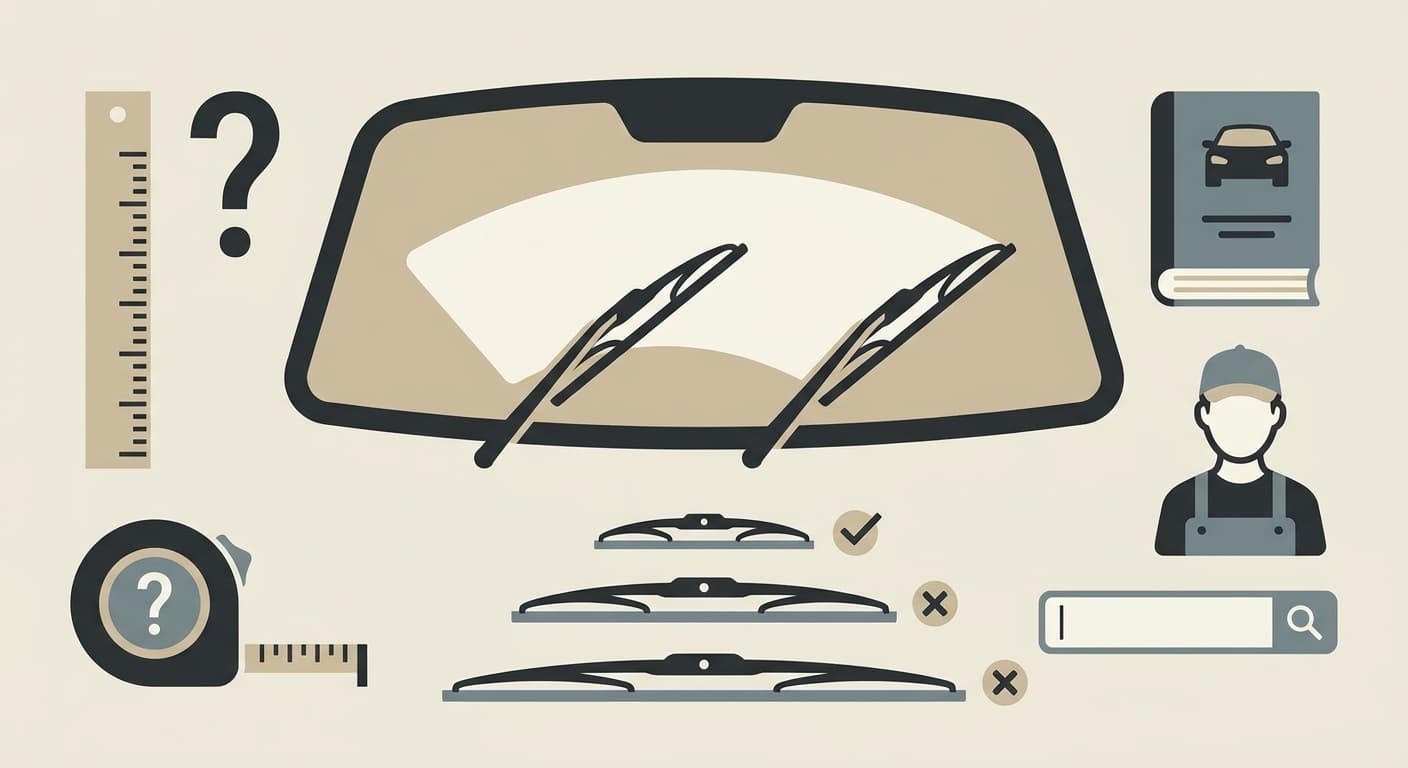
Most cars need a longer driver-side blade between 24 and 28 inches and a shorter passenger-side blade between 16 and 20 inches, because the two arms pivot from different points and clear different arcs of the windshield. Trucks more often run two equal blades around 22 inches, and many SUVs add a 12-14 inch rear wiper. Look up your exact sizes by make and model with the Windshield Wiper Size Calculator before you buy a mismatched pair.
A common mistake looks like this: buying 26-inch blades for both sides, only to have the passenger one slap the driver one halfway through the sweep. That happens because the two arms are almost never the same length. A typical mid-size sedan pairs a 26-inch driver blade with an 18-inch passenger blade — an 8-inch difference. Buy two 26s and the blades collide; buy two 18s and you leave a foot of glass unwiped. Getting the pair right costs the same money and takes the same five minutes, so there is no reason to guess.
This is the sizing answer page — how to find the correct blade lengths and types for your vehicle. For the dollar side of glass repair, see our companion note on the Windshield Replacement Cost Calculator. For the broader maintenance picture, our auto maintenance calculator data report shows where wipers fit in the service calendar.
Windshield Wiper Size Chart by Vehicle Type
Wiper sizes follow the body style more than the brand. A sedan, an SUV, and a pickup each have a characteristic pattern because the windshield rake and the wiper-arm geometry differ. The table below gives the typical ranges; your exact sizes still come from the Windshield Wiper Size Calculator or your owner's manual.
| Vehicle Type | Driver Side | Passenger Side | Rear Wiper |
|---|---|---|---|
| Sedans | 24 – 28" | 16 – 20" | Rarely |
| SUVs / Crossovers | 24 – 26" | 16 – 20" | 12 – 14" |
| Trucks (pickups) | 22" | 22" | Rarely |
| Hatchbacks / Wagons | 24 – 26" | 16 – 18" | 11 – 14" |
| Minivans | 26 – 28" | 18 – 22" | 12 – 16" |
Typical wiper sizes by body style, 2026. Driver-side blades run longer on most sedans and SUVs; many pickups use two equal blades.
According to Auto Glass Now, using the wrong size leads to inadequate coverage, streaking, or damage to the windshield, which is exactly why the driver and passenger arms are matched to specific lengths at the factory.
Why the two wipers are different lengths
The driver and passenger arms pivot from separate base points, so each one sweeps a different-sized arc across the glass. As YourMechanic explains, the lengths are chosen to maximize the total swept area without the two blades overlapping or colliding at the top of the stroke. On most vehicles the driver side is the longer blade because that arc is wider, but a minority of designs flip it. The only safe rule is to match each side to its own spec, never to install two of the same size unless the spec actually calls for a matched pair.
Specific make-and-model examples
| Vehicle | Driver | Passenger | Rear | Pair Type Common |
|---|---|---|---|---|
| Toyota Camry | 26" | 18" | None | Beam |
| Honda CR-V | 26" | 17" | 14" | Beam |
| Ford F-150 | 22" | 22" | None | Conventional or beam |
| Chevrolet Equinox | 24" | 18" | 12" | Beam |
| Toyota RAV4 | 26" | 16" | 12" | Beam |
Representative front and rear blade sizes for popular 2026-era models. Always confirm against your owner's manual or the size calculator, since sizes can shift between model-year redesigns.
The Camry and CR-V both use a 26-inch driver blade, but their passenger blades differ (18 vs 17 inches) and the CR-V adds a 14-inch rear wiper because it is a crossover with a near-vertical rear glass. The F-150 is the classic two-equal-blade pickup at 22 inches per side. These differences are the whole reason a generic "fits most cars" pack is a bad idea.
Tip
The fastest way to confirm your size with zero guesswork: read the numbers printed on your current blades. Most blades stamp the length right on the rubber or the plastic spine. If they are unreadable, the Windshield Wiper Size Calculator and your owner's manual are the two reliable backups.
How to Find Your Exact Wiper Size in Under 5 Minutes
You have three reliable ways to find the correct sizes, and a fourth that you should avoid. Use whichever is fastest with what you have on hand.
- Check the owner's manual. The maintenance section lists front and rear blade lengths. This is the definitive source because it matches the exact arm geometry of your trim.
- Read your current blades. Many blades print the size (e.g., "26IN" or "650mm") on the spine. A 650mm metric blade equals about 26 inches; a 450mm blade is about 18 inches. Divide millimeters by 25.4 to convert to inches.
- Use a size lookup tool. The Windshield Wiper Size Calculator takes your make and model and returns driver, passenger, and rear lengths plus a cost estimate. Auto parts retailers offer similar finders at the counter.
- Do not measure with a tape and round. A worn blade may already be the wrong size, and rounding a measured length to the nearest inch produces collisions. Measuring is the last resort, not the first.
Worked example: converting a metric blade size
Say your current driver blade reads "600mm" with no inch marking. Divide: 600 ÷ 25.4 = 23.6 inches, which rounds to the standard 24-inch blade. A passenger blade marked "450mm" works out to 450 ÷ 25.4 = 17.7 inches, sold as an 18-inch blade. Blades are manufactured in even-inch increments, so a metric size almost always maps to the nearest even inch.
Worked example: a sedan owner buying a fresh pair
A Camry owner needs a 26-inch driver and an 18-inch passenger blade. Buying beam blades at about $20 each puts the pair at 2 × $20 = $40. There is no rear wiper, so the job stops at two blades. If that owner mistakenly grabs a "26-inch twin pack," the 26-inch passenger blade is 8 inches too long, overlaps the driver blade, and either jams the linkage or chatters across the glass. The five-second size check prevents a returned product and a scratched windshield.
Warning
Going one inch longer on the driver side sometimes clears more glass, but only if the blade does not hit the A-pillar trim or the opposing wiper at full sweep. Going shorter always leaves an unwiped strip directly in your line of sight. When in doubt, match the factory spec exactly.
Blade Types: Beam vs Conventional vs Hybrid
Size tells you the length; type tells you the performance and the price. The three mainstream designs — conventional (frame), beam (frameless), and hybrid — differ in lifespan, cold-weather behavior, and cost per blade.
| Blade Type | Cost Per Blade | Typical Lifespan | Best For |
|---|---|---|---|
| Conventional (frame) | $8 – $15 | 6 – 9 months | Mild climates, budget jobs |
| Beam (frameless) | $15 – $25 | 9 – 12 months | Snow, ice, highway speeds |
| Hybrid | $20 – $35 | 9 – 12 months | All-around performance |
| Silicone beam (premium) | $25 – $40 | up to 2 – 3 years | Long-life, hot-sun climates |
Wiper blade cost and lifespan by type, 2026. Beam blades resist ice packing because they have no exposed frame joints.
According to Stoner Car Care, beam blades distribute pressure more evenly along the full length of the blade, which is why they resist streaking and last longer than conventional frame blades. The Windshield Advisor buying guide notes that a quality beam blade commonly reaches nine to twelve months or more, while conventional blades may need replacing every six months due to UV damage or joint failure.
Beam blades: the modern default
Beam blades have no external metal frame. The tension is built into a curved spring steel spine hidden inside the rubber, so there are no joints for ice to pack into and no frame to catch wind at highway speed. That design is why most new vehicles ship with beam blades from the factory. They cost more per blade — $15 to $25 — but the longer life and better snow performance usually justify the premium for daily drivers.
Conventional blades: the budget pick
Conventional blades use the classic metal frame with several pressure points. They are the cheapest at $8 to $15 each and work fine in mild, dry climates. The downsides are a shorter 6-to-9-month life and a tendency to ice up in winter because snow and slush pack into the frame joints. For a second car or a mild-weather commuter, they are perfectly adequate.
Hybrid and silicone: the long-life options
Hybrid blades wrap a conventional frame in an aerodynamic plastic shell, blending the bite of a frame with the clean wind profile of a beam. Silicone beam blades push lifespan furthest — premium silicone compounds can last two to three years versus the 9-to-12-month rubber norm — at $25 to $40 each. Over a three-year window, one silicone pair can be cheaper than three rubber pairs even at the higher sticker price.
Tip
A faint groan during light braking is a brake symptom, not a wiper one — but a rhythmic chatter or skip during the wipe is your blades telling you the rubber edge has hardened. Replace at the first chatter rather than waiting for full streaking.
How Often to Replace Windshield Wipers
Replace wiper blades every 6 to 12 months, or immediately at the first sign of streaking, skipping, squeaking, or torn rubber, whichever comes first. Climate is the biggest variable: UV exposure and extreme heat harden the rubber edge faster, so blades in hot, sunny regions may need replacing every 6 months even if the rest of the car is babied.
| Climate / Use | Replace Interval | Driving Reason |
|---|---|---|
| Hot, sunny (Southwest) | Every 6 months | UV bakes the rubber edge |
| Cold, snowy (Northeast) | Every 9 months | Ice scraping tears the edge |
| Mild, temperate | Every 12 months | Slow normal wear |
| Garage-kept, light use | Up to 12 months | Less UV and ice exposure |
Replacement interval by climate, 2026. Replace both front blades together so wipe quality stays even.
This is not just a comfort issue. According to U.S. Department of Transportation road-weather data from the Federal Highway Administration, about 75% of weather-related crashes happen on wet pavement and roughly 47% occur during rainfall — the exact conditions where worn blades fail. Clear glass is a safety system, not a luxury. The Windshield Replacement Cost Calculator is worth a look if a stone chip from a wet-road follow-too-close already cracked your glass.
Worked example: budgeting a year of wipers
A driver in Phoenix runs beam blades and replaces them every 6 months because of the UV load. That is two replacement cycles a year. Front blades only, at about $20 each: 2 blades × $20 × 2 cycles = $80 per year. A temperate-climate driver replacing the same blades once a year spends 2 × $20 = $40. The hot-climate driver pays double — not because the blades are worse, but because the sun degrades the rubber twice as fast.
Important
Replace both front blades at the same time even if only one is streaking. Mismatched blade age means one side wipes clean while the other smears, and the smear is usually right where you are looking. Buying as a pair also locks in the correct asymmetric sizes in one transaction.
Do You Need a Rear Wiper, and What Size?
Rear wipers appear on most SUVs, crossovers, hatchbacks, and wagons, and almost never on sedans or pickups. If your vehicle has a rear wiper arm, it takes a short blade — typically 11 to 16 inches — and it lasts longer than the fronts because it runs far less often. Replace a rear blade every 12 to 18 months.
A worn rear blade matters most in reverse: backing out of a driveway in the rain with a smeared rear window is a genuine visibility gap, and most backup cameras still benefit from a clear glass path. Rear blades cost about $8 to $15 each regardless of type, so there is little reason to stretch their life past the point they streak.
When you tally a full set for a crossover, count three blades: driver front, passenger front, and rear. A CR-V owner buying beam fronts (26" + 17") plus a 14" rear pays roughly $20 + $20 + $12 = $52 for the complete set. Routine maintenance like this pairs naturally with an Oil Change Calculator check — both are short-interval items easy to forget until visibility or the dashboard light reminds you.
Frequently Asked Questions
What size windshield wipers do I need?
Most cars need a 24-28 inch driver-side blade and a 16-20 inch passenger-side blade, while many pickups use two equal 22-inch blades and crossovers add a 12-14 inch rear wiper; confirm your exact sizes with the Windshield Wiper Size Calculator or your owner's manual.
Why are my two windshield wipers different lengths?
The driver and passenger arms pivot from separate points and sweep different-sized arcs, so the lengths are matched to clear the most glass without the blades overlapping; on most vehicles the driver side is longer, but a minority of designs reverse it.
Are beam wiper blades better than conventional ones?
Beam blades distribute pressure evenly with no exposed frame, so they resist ice packing, last 9-12 months versus 6-9 for conventional, and perform better at highway speed; the trade-off is cost, at $15-$25 each versus $8-$15 for conventional.
How often should I replace my windshield wipers?
Replace wipers every 6-12 months or at the first streak, skip, or squeak; hot, sunny climates degrade the rubber faster and may require replacement every 6 months, while mild climates can stretch to a full year.
Can I use a slightly different wiper size than recommended?
Going one inch longer on the driver side can work if the blade clears the A-pillar and the opposing wiper, but going shorter always leaves an unwiped strip in your sightline; matching the factory spec is the safest choice for full coverage.
Do all SUVs have a rear wiper, and what size is it?
Most SUVs, crossovers, hatchbacks, and wagons have a rear wiper, usually 11-16 inches, while sedans and pickups rarely do; rear blades cost $8-$15, last 12-18 months, and matter most for visibility when backing up in the rain.
How much should a full set of wiper blades cost?
A front pair runs about $16-$30 for conventional and $30-$50 for beam, and adding an $8-$15 rear blade pushes a three-blade crossover beam set to roughly $38-$65; AutoZone and similar stores often install them free at the counter.
Related Articles
- Auto Maintenance Calculator Data 2026 — Where wiper replacement fits in the full service calendar alongside oil, tires, and brakes.
- Brake Pad Mileage Chart 2026 — Another short-interval safety item, sized and timed by material and driving style.
- Gas Mileage Guide — The same routine-maintenance mindset that keeps wipers fresh also protects your fuel economy.
Related Calculators
- Windshield Wiper Size Calculator — Look up driver, passenger, and rear blade sizes by make and model with a cost estimate.
- Windshield Replacement Cost Calculator — Price a full glass replacement when a chip or crack goes past repair.
- Oil Change Calculator — Track your next oil change so short-interval items stay on schedule.
- Tire Size Calculator — Decode the numbers on your tires and find compatible replacements.
- Car Detailing Calculator — Estimate detailing costs, including the glass treatment that helps wipers grip.
This article provides general information for educational purposes. Consult your owner's manual or a qualified technician for the exact blade sizes and fitment for your specific vehicle.
This article is provided for informational and educational purposes only. Content should not be considered professional financial, medical, legal, or other advice. Always consult a qualified professional before making important decisions. UseCalcPro is not responsible for any actions taken based on the information in this article.
Try These Calculators
Find the correct wiper blade sizes for your car by make and model. Compare beam, hybrid, and conventional blades with cost estimates and replacement tips.
Serpentine belt length calculator for multi-pulley systems. Measure or calculate drive belt size from pulley diameters, center distances, and routing layout.
Car carpet replacement cost calculator for DIY and professional installs. Estimate materials, padding, and labor by vehicle type — sedan, truck, or SUV.
Find the right ceiling fan size for any room. Get blade span, CFM rating, downrod length, and mount type recommendations based on your room dimensions.
Calculate how much paracord you need for a bracelet by weave pattern and wrist size. Get cord length for cobra, king cobra, fishtail, and trilobite weaves.