How to Calculate Dust Collection: 2026 CFM and Duct Guide
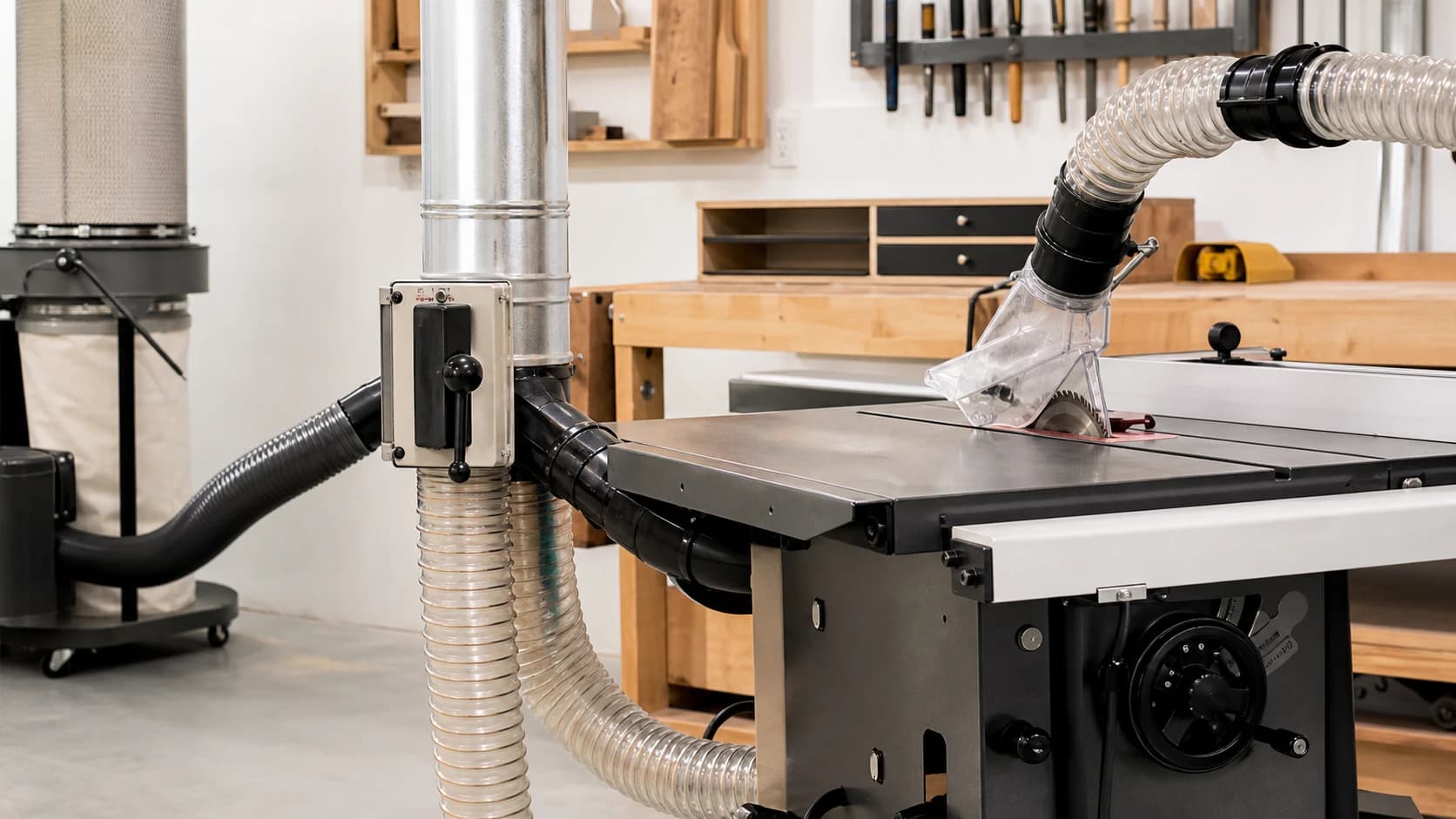
To calculate dust collection, add the CFM required by the largest tool running at one time, choose duct diameter that keeps air velocity near 3,500-4,500 FPM, then subtract static-pressure losses from duct length, elbows, hose, fittings, filter, and separator. Most small woodworking shops need 400-800 CFM at the tool, while cabinet saws, planers, and jointers often need 600-1,200 CFM with 4- to 6-inch ducting. Use the Dust Collection Calculator to size your collector and duct path.
The common small-shop mistake is buying by motor horsepower alone. A "2 HP" collector connected through 20 feet of flex hose, two tight elbows, a cyclone lid, and a clogged filter may deliver far less air than expected at the tool. The calculation has to happen at the machine port, not at the marketing label. If the planer needs 800 CFM and the duct path leaves only 450 CFM, chips will pile up no matter what the badge says.
This guide walks through the sizing math. For compressed-air tools, use the Air Compressor Calculator. For finishing after dust control, the Woodworking Finish Calculator covers stain, oil, and coating quantities.
The Dust Collection Formula
Dust collection sizing has three linked parts:
- Required CFM at the tool.
- Duct diameter and air velocity.
- Static pressure loss across the path.
The basic airflow relationship is:
CFM = Duct area × Air velocity
Round ducts use this practical version:
CFM = 0.00545 × Diameter² × FPM
A 4-inch duct at 4,000 FPM carries about 0.00545 × 16 × 4,000 = 349 CFM. A 6-inch duct at the same velocity carries about 0.00545 × 36 × 4,000 = 785 CFM. That is why a planer connected through a 4-inch line can struggle even if the collector is strong.
| Duct Diameter | CFM at 3,500 FPM | CFM at 4,000 FPM | CFM at 4,500 FPM |
|---|---|---|---|
| 4 in | 305 | 349 | 392 |
| 5 in | 477 | 545 | 613 |
| 6 in | 687 | 785 | 883 |
| 7 in | 935 | 1,068 | 1,202 |
Tool CFM Requirements
Tool ports and chip load set the target. Fine sanding dust and heavy planer chips are different problems. Planers and jointers need high airflow to move chips. Sanders need good capture close to the source, often with shop-vac style high static pressure.
| Tool | Typical CFM Target | Common Port |
|---|---|---|
| Miter saw | 350-600 | 2.5-4 in |
| Table saw cabinet | 400-800 | 4 in |
| Contractor saw | 350-600 | 2.5-4 in |
| 6 in jointer | 500-700 | 4 in |
| 8 in jointer | 700-1,000 | 5-6 in |
| 13 in planer | 600-900 | 4 in |
| 15-20 in planer | 900-1,200+ | 5-6 in |
| Router table | 350-600 | 2.5-4 in |
| Drum sander | 700-1,200 | 4-6 in |
Use the largest active tool, not the sum of every tool in the shop, unless you truly run multiple machines at the same time. A one-person shop with blast gates normally sizes for one machine plus a small safety margin.
Static Pressure: The Number That Steals CFM
Static pressure is resistance. Every foot of duct, elbow, reducer, flex hose, blast gate, filter, and separator slows airflow. Collectors are rated on a fan curve: more static pressure means less delivered CFM.
Common loss drivers:
| Part | Why It Hurts |
|---|---|
| Flex hose | Ribbed interior creates turbulence |
| Tight 90-degree elbows | Sudden direction change |
| Long duct runs | Friction adds up |
| Undersized duct | Velocity and resistance spike |
| Cyclone / separator | Adds pressure drop |
| Dirty filter | Reduces airflow sharply |
If you can change only one thing, reduce flex hose. Ten feet of flex can behave like several times that length of smooth pipe. Use short flex drops only where the machine must move.
Worked Example: Table Saw and Planer
Suppose a shop has a cabinet saw needing 600 CFM and a lunchbox planer needing 750 CFM. Only one runs at a time, so size for the planer.
The main run is 22 feet of 6-inch duct with three elbows, one blast gate, a cyclone separator, and 4 feet of flex at the tool. The target is 750 CFM at the planer.
The 6-inch duct can carry about 785 CFM at 4,000 FPM, so diameter is appropriate. The question is whether the collector can still deliver that after losses. If the fan curve says the collector delivers 900 CFM at 6 inches of static pressure but only 620 CFM at 9 inches, the duct layout matters. Tight elbows and flex may push the system into the weak part of the curve.
The fix is not always a bigger motor. Often it is:
- Replace flex with smooth duct.
- Use long-radius elbows.
- Keep the main at 6 inches.
- Avoid reducing to 4 inches until the machine.
- Clean or upgrade the filter.
- Seal obvious leaks.
Duct Diameter Selection
Choose duct size to carry the CFM you need without dropping velocity too low. Too small creates high resistance. Too large can let chips settle if airflow is weak.
| Target CFM | Suggested Main Duct | Notes |
|---|---|---|
| 300-450 | 4 in | Small tools, short runs |
| 450-650 | 5 in | Mid-size tools where supported |
| 650-900 | 6 in | Most serious hobby shops |
| 900-1,200 | 7-8 in | Large planers, drum sanders |
Do not assume a 4-inch port means the entire system should be 4 inches. Many machines ship with undersized ports for compatibility. If the collector and layout support 6-inch main duct, keep it large as long as possible and reduce near the tool.
Dust Collector vs Shop Vacuum
Dust collectors move high CFM at lower static pressure. Shop vacuums move lower CFM at higher static pressure. That makes them suited to different tools.
| System | Strength | Best For |
|---|---|---|
| Shop vacuum | High suction, low hose diameter | Sanders, track saws, small ports |
| Single-stage collector | High chip volume | Table saw, jointer, planer |
| Cyclone collector | Better separation, filter protection | Whole-shop ducting |
| Ambient air cleaner | Background fine dust | Supplemental only |
A shop vacuum can work better than a dust collector on a sander with a tiny port. It will not move enough air for a planer. A dust collector can move planer chips but may not capture fine dust well from a random-orbit sander unless the hood design is good.
How to Improve an Existing System
Before replacing the collector, audit the layout. Many systems lose performance through avoidable restrictions.
Quick wins:
- Empty the bag or bin before it overfills.
- Clean the filter.
- Shorten flex hose.
- Seal duct leaks.
- Open only one blast gate at a time.
- Use wyes instead of hard tees.
- Replace tight elbows with long-radius elbows.
- Keep the main duct larger than branch drops.
Run the layout through the Dust Collection Calculator, then compare tool support with Air Compressor Calculator, Woodworking Finish Calculator, and Board Foot Calculator. Related planning guides include High Resolution Photo File Size Estimates, 1080 1350 Ratio Guide, and How to Calculate Lighting Layout.
Collector Size vs Real Delivered Airflow
Dust collector marketing numbers are often measured at the inlet with little or no duct attached. A shop system has duct, elbows, machine ports, gates, filters, and a separator. That is why two collectors with similar advertised CFM can behave very differently in a real layout.
| Advertised Collector | Realistic Use Case | Watch-Out |
|---|---|---|
| 650 CFM portable | One small machine, short hose | Weak on planers |
| 1,200 CFM single-stage | One 4-6 in machine at a time | Filter condition matters |
| 1,500-2,000 CFM cyclone | Small whole-shop ducting | Needs good duct design |
| 3 HP+ cyclone | Larger shop, multiple branches | Electrical and space requirements |
If your duct design needs 800 CFM at the planer after losses, a collector advertised at 800 CFM is probably too small. You need headroom because static pressure reduces output. Read the fan curve when available and compare CFM at the expected static pressure, not the open-air number.
Blast Gates and One-Person Shops
Blast gates let a one-person shop use a smaller collector effectively. Instead of sizing for every branch open at once, you close inactive branches and concentrate airflow on the active tool. This is why a 1.5-2 HP collector can work in many hobby shops if the ducting is short and disciplined.
The rule is simple: one tool open at a time unless the collector is sized for multiple simultaneous branches. Leaving three gates open can cut capture at the active tool below the needed CFM. If chips collect in the duct after a planer pass, check for open gates before blaming the collector.
Place blast gates where they are easy to reach. A gate behind a machine will be left open. A gate at chest height on the main branch is more likely to be used every time.
Fine Dust vs Chips
Dust collection is not only about visible chips. Fine dust is the health problem. A system can clear chips from a planer and still leak fine dust through a poor filter or bad hood design. Capture at the source matters, and filtration matters after capture.
For fine dust control:
- Use a filter rated for fine particles, not only a loose cloth bag.
- Keep hoods close to the dust source.
- Avoid open machine bases where airflow bypasses the blade or cutterhead.
- Use an ambient air cleaner as a supplement, not a substitute.
- Wear a respirator during sanding and dusty cleanup.
Sanding is especially tricky because it produces fine particles through small ports. A high-static-pressure vacuum or extractor may outperform a large dust collector on handheld sanders. That is not a contradiction; it is the difference between suction through a small hose and air volume through a large duct.
Frequently Asked Questions
How do you calculate dust collection CFM?
Calculate dust collection CFM from the tool requirement and duct velocity. The airflow formula is CFM = duct area × air velocity. In practical round-duct terms, CFM = 0.00545 × diameter² × FPM. A 6-inch duct at 4,000 FPM carries about 785 CFM, enough for many planers and cabinet saws if static pressure is controlled.
What size dust collector do I need for a small shop?
Most small one-person woodworking shops need 400-800 CFM at the active tool. If you use a planer, jointer, cabinet saw, or drum sander, plan around 600-1,200 CFM depending on duct size and run length. Size the collector from delivered CFM at static pressure, not only motor horsepower.
Is 4-inch duct enough for dust collection?
Four-inch duct can carry about 350 CFM at 4,000 FPM, which is enough for some small tools but often weak for planers, jointers, and cabinet saws. A 6-inch duct carries about 785 CFM at the same velocity. Use 4-inch drops where necessary, but keep the main larger when the collector supports it.
What is static pressure in dust collection?
Static pressure is the resistance the fan must overcome from duct length, elbows, flex hose, blast gates, filters, separators, and machine ports. Higher static pressure lowers delivered CFM. A collector that looks strong at open inlet may perform poorly after a long flex-heavy duct run.
Is a shop vacuum better than a dust collector?
A shop vacuum is better for small ports and sanders because it has high suction through narrow hoses. A dust collector is better for chip-heavy tools because it moves more air volume through larger duct. Many shops use both: dust collector for machines and vacuum/extractor for handheld sanders.
How can I increase dust collector airflow?
Increase airflow by shortening flex hose, cleaning the filter, sealing leaks, opening only one blast gate, using smooth duct, replacing tight elbows, and keeping duct diameter large until near the tool. These changes often improve capture more than buying a larger collector.
This article is provided for informational and educational purposes only. Content should not be considered professional financial, medical, legal, or other advice. Always consult a qualified professional before making important decisions. UseCalcPro is not responsible for any actions taken based on the information in this article.
Try These Calculators
Size your workshop dust collection system with CFM requirements, duct diameter, and static pressure loss calculations based on your tools and duct run layout.
Subwoofer box calculator for sealed and ported enclosures. Calculate box volume, port length, and tuning frequency for 10, 12, and 15 inch subwoofers.
Size a turbocharger by engine displacement and target horsepower. Get required CFM airflow, boost PSI, pressure ratio, and turbo frame size recommendations.
Calculate the right RV inverter size based on your appliance loads, surge requirements, and battery capacity. Includes runtime estimates and draw amps.