Real Estate Appreciation Calculator Pros and Cons: An Honest 2026 Review
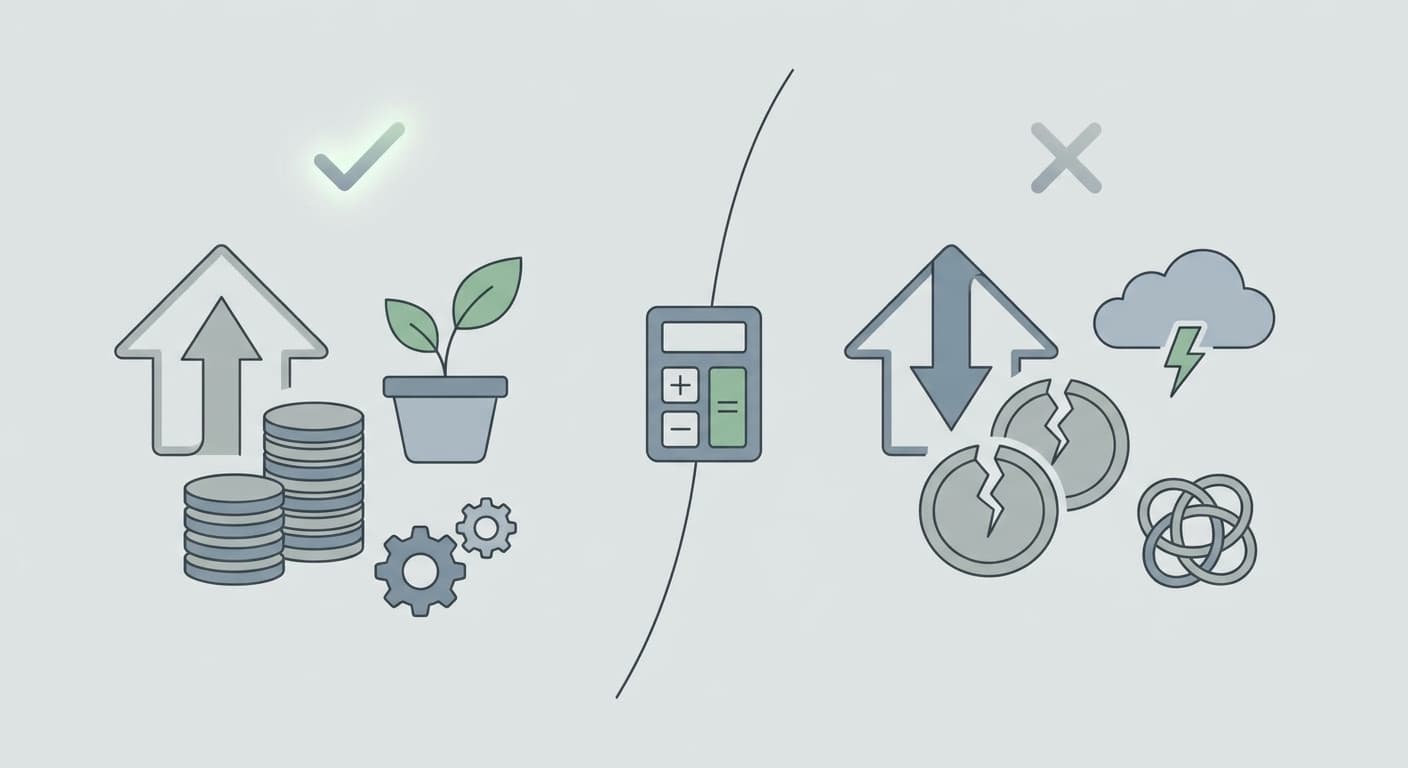
A real estate appreciation calculator is useful because it turns a vague "homes go up over time" into a hard number: $350,000 growing at the long-run national rate of about 3.8% per year reaches roughly $510,000 in 10 years. Its biggest weakness is that it projects a single smooth rate and ignores taxes, insurance, maintenance, and selling costs that can erase most of that paper gain. That trade-off, accuracy of the core formula versus blind spots around it, is the whole pros-and-cons story. You can run the projection yourself with our free Real Estate Appreciation Calculator before reading another word.
Here is the trap most owners fall into. An appreciation projection might tell you to expect roughly $90,000 in gains over six years, and the nominal number often lands close, say $94,000. What the projection never shows is the tens of thousands spent along the way on a new roof, property taxes, and a 6% agent commission at sale. After those, "real" profit can be less than half what the calculator implied. That gap is the single most important thing to understand before you trust any appreciation number.
This article is the honest scorecard: where these tools help, where they mislead, and how to use one without fooling yourself.
What a Real Estate Appreciation Calculator Actually Does
A real estate appreciation calculator applies compound growth to a property's current value. The formula is simple and not in dispute:
Future Value = Present Value × (1 + annual rate)^years
Type in a $350,000 home, a 3.5% annual rate, and 10 years, and it returns $493,710. Each year's gain compounds on the prior year's larger base, so the curve bends upward over time. A good calculator, like ours, also subtracts inflation to show the "real" value in today's dollars, because a bigger nominal number is not the same as more buying power.
The math is exact. The judgment call is the rate you feed it, and that is where most of the pros and cons live.
Tip
Before projecting, anchor your rate to data, not optimism. The Federal Housing Finance Agency House Price Index is the cleanest free source for U.S. home-price trends back to 1991.
The Pros: Where Appreciation Calculators Earn Their Keep
Pro 1: It makes compounding visible
People wildly underestimate compounding. The difference between a 3% and a 5% rate looks tiny until you stretch it across 20 years. A calculator makes that gap concrete, and concrete numbers change decisions.
| Scenario | Rate | $350K After 10 Years | $350K After 20 Years |
|---|---|---|---|
| Slow market | 2% | $426,648 | $520,082 |
| National baseline (round number) | 3.5% | $493,710 | $696,426 |
| Strong metro | 5% | $570,113 | $928,654 |
| Hot market peak | 7% | $688,503 | $1,354,390 |
Every cell above was computed as $350,000 × (1 + rate)^years. The headline: at 7% versus 2%, the same starting home is worth over $834,000 more after 20 years. That spread is why your local market matters far more than the national figure, and why a calculator that lets you test rates beats any single "average."
Pro 2: It separates nominal gains from real gains
This is the feature most casual tools skip, and the one that prevents the most expensive misjudgments. A $500,000 home growing at 5% for 20 years reaches $1,326,649 nominally. Adjusted for 3% inflation, its real value is about $734,533. You doubled your nominal number but your true buying power grew far less.
| $500K Home, 20 Years | Nominal Value | Real Value (3% inflation) | Real Gain |
|---|---|---|---|
| At 3% appreciation | $903,056 | $500,000 | $0 |
| At 5% appreciation | $1,326,649 | $734,533 | $234,533 |
| At 7% appreciation | $1,934,842 | $1,071,275 | $571,275 |
Notice the top row: a home appreciating at exactly the inflation rate gains nothing in real terms. The calculator makes that brutal truth obvious. To dig deeper into how inflation eats returns, pair it with our Inflation Calculator.
Pro 3: It models scenarios in seconds
The strongest use case is comparison, not prediction. Run conservative, expected, and optimistic rates side by side and you get a range, which is far more honest than a single forecast. Investors use this to stress-test a purchase: if appreciation comes in at 2% instead of 5%, does the deal still work? When you combine the projection with a Mortgage Calculator and a Home Equity Calculator, you can see your equity build year by year.
Pro 4: It quantifies leverage, the real estate superpower
Stocks rarely let ordinary people borrow 80% of the purchase price. Real estate does. If you put 20% down on a $350,000 home, your equity is $70,000. A 3.5% appreciation gain in year one is $12,250, which is a 17.5% return on your $70,000 of equity, before costs. A calculator that shows the property value lets you do this equity-return math, which is the honest argument for buying over renting or indexing.
Important
Leverage cuts both ways. The same 5x leverage that turns a 3.5% gain into 17.5% turns a 3.5% price drop into a 17.5% equity loss. The calculator shows the upside; you have to remember the downside.
The Cons: Where Appreciation Calculators Mislead
Con 1: It ignores every carrying cost
This is the deal-breaker, and it is exactly the trap described in the opening. The calculator says your $350,000 home will be worth $493,710 in 10 years, a $143,710 gain. It says nothing about what you paid to own it. Here is what a realistic decade of ownership actually nets:
| Cost Over 10 Years | Estimate (on a $350K home) | Notes |
|---|---|---|
| Property taxes (~1.1%/yr) | $38,500 | National effective average; varies widely by state |
| Insurance (~$1,800/yr) | $18,000 | Rising fast in disaster-prone states |
| Maintenance (~1%/yr) | $35,000 | The "1% rule" of thumb |
| Selling costs (~6%) | $29,623 | Agent commission on $493,710 sale |
| Total drag | $121,123 | Subtracted from the $143,710 gain |
After those costs, the $143,710 paper gain shrinks to roughly $22,587 of net appreciation profit, before counting your mortgage interest. The raw calculator output overstated the real benefit by more than 6x. Property-tax rates vary enormously, so confirm yours with the Tax Foundation's property tax data rather than assuming the national average.
Warning
Treating the appreciation number as your profit is the most common and most expensive mistake. It is a gross figure, not a net one. Always subtract carrying and transaction costs before you celebrate.
Con 2: It assumes a smooth rate that never exists
Real housing markets do not rise 3.5% every single year. They lurch. The 2008 crash erased years of gains in months; the 2020-2022 boom delivered double-digit jumps. A calculator's smooth curve hides this volatility. If you need to sell during a downturn, the long-run average is cold comfort. The number is a long-horizon planning tool, not a year-by-year forecast.
Con 3: It is only as good as the rate you guess
Garbage in, garbage out. Punch in 8% because your neighborhood felt hot last year, and you will build a fantasy. Sustained 8% appreciation is rare; the U.S. long-run figure sits near 3.8% per year. The calculator cannot tell you that your rate is unrealistic. That judgment is on you, and it is the most common way these tools go wrong.
Con 4: It ignores the opportunity cost of your money
A home growing at 3.5% looks fine in isolation. But the same dollars in an S&P 500 index fund have historically returned about 10% nominally, or roughly 6.5-7% after inflation, according to long-run S&P 500 historical data. An appreciation calculator never shows you that alternative. You have to bring it yourself.
| $100,000 Invested, 10 Years | Asset | Nominal Result |
|---|---|---|
| Stock market | S&P 500 at ~10% | $259,374 |
| Home (unleveraged) | Housing at ~3.8% | $145,202 |
| Home (20% down, equity) | Leverage amplifies | Higher % on equity, higher risk |
Unleveraged, a home badly trails the index over a decade. Leverage closes the gap, which is why the comparison is not as lopsided as the first two rows suggest, but the calculator alone will never start this conversation. Run the alternative with our ROI Calculator and Compound Interest Calculator.
Pros vs Cons at a Glance
| Strength | Matching Weakness |
|---|---|
| Exact compound-growth math | Assumes one smooth rate that never happens |
| Shows real (inflation-adjusted) value | Ignores taxes, insurance, maintenance, selling costs |
| Fast scenario comparison | Output quality depends entirely on your rate guess |
| Quantifies leverage upside | Hides leverage downside and opportunity cost |
The verdict: a real estate appreciation calculator is excellent for the narrow job it does and dangerous if you mistake its output for your net profit.
How to Use One Without Fooling Yourself
- Use a defensible rate. Anchor to the FHFA long-run figure (~3.8%) or your metro's actual 10-year trend, not last year's spike.
- Run three scenarios. Conservative, expected, optimistic. Treat the output as a range.
- Always check the real value. Nominal gains flatter you; inflation-adjusted gains tell the truth.
- Subtract carrying costs separately. The calculator will not. Budget taxes, insurance, and ~1%/year maintenance.
- Subtract selling costs. Roughly 6% in agent commissions plus closing fees come off the top at sale.
- Compare to alternatives. Model the same money in stocks before concluding real estate "wins."
Follow those six steps and the calculator becomes a genuinely useful decision tool instead of a confidence machine.
Frequently Asked Questions
Real estate appreciation calculator pros and cons: what is the bottom line?
The main pro is exact, transparent compound-growth math that makes a $350,000 home's projected $493,710 value in 10 years concrete and comparable across rates; the main con is that it ignores property taxes, insurance, maintenance, and ~6% selling costs that can shrink a $143,710 gross gain to roughly $22,000 net.
Is a real estate appreciation calculator accurate?
The formula is mathematically exact, but accuracy depends entirely on the rate you enter; using the U.S. long-run average of about 3.8% per year gives a defensible projection, while guessing 8% based on a recent local spike produces a fantasy number that real markets rarely sustain.
What appreciation rate should I use in 2026?
Use about 3.5-4% for a national baseline, since the FHFA House Price Index has averaged roughly 3.8% annually since 1991; adjust up only if your specific metro has a documented multi-year trend above that, and always run a 2% conservative scenario alongside it.
Does the calculator account for inflation?
Better calculators, including ours, do; a $500,000 home at 5% over 20 years reaches $1,326,649 nominally but only about $734,533 in real, inflation-adjusted dollars at 3% inflation, so always read the real value before assuming you have doubled your wealth.
Should I trust appreciation gains as my actual profit?
No; appreciation is a gross figure, not net profit, because it excludes the property taxes (~1.1%/yr), insurance, maintenance (~1%/yr), and selling commissions (~6%) that on a typical $350,000 home can total over $120,000 across a decade and leave far less true profit than the headline gain suggests.
How does projected appreciation compare to the stock market?
Unleveraged, housing trails badly: $100,000 at the ~3.8% housing rate grows to about $145,202 in 10 years versus roughly $259,374 for the S&P 500 at ~10%, but a 20% down payment provides 5x leverage that can push real estate's return on equity above the index, at higher risk.
Can it predict when my home will double in value?
Roughly, using the Rule of 72: divide 72 by your appreciation rate, so a home at 3.5% doubles in about 21 years and one at 6% in about 12 years, though this is a smooth-rate estimate that ignores the booms and crashes real markets actually experience.
Related Articles
- Mortgage Calculator: The Complete 2026 Guide — How payments, equity, and amortization interact with the home value you are projecting.
- Wedding Planning by the Numbers — How we read real calculator-usage data to separate signal from noise, the same skill you need for appreciation rates.
Related Calculators
- Real Estate Appreciation Calculator — Project future property value with compound growth and inflation adjustment.
- Mortgage Calculator — See monthly payments and how equity builds as you pay down principal.
- Home Equity Calculator — Track your current equity position against your home's value.
- ROI Calculator — Compare real estate returns against any other investment.
- Compound Interest Calculator — Model the same money growing in a stock-market index fund.
- Inflation Calculator — Convert future nominal values into today's purchasing power.
This article provides general information for educational purposes. Consult a qualified financial advisor or real estate professional for personalized recommendations.
This article is provided for informational and educational purposes only. Content should not be considered professional financial, medical, legal, or other advice. Always consult a qualified professional before making important decisions. UseCalcPro is not responsible for any actions taken based on the information in this article.
Try These Calculators
Enter your home value and state to estimate annual and monthly property taxes. Compares effective rates across all 50 states with assessment adjustments.
Estimate 2026 local HVAC replacement cost near you by home size, system type, ductwork, and ZIP. Typical $7,000-$20,000; Bay Area/NYC $12,000-$28,000.