How to Choose the Right Size Ferret Cage: 2026 Dimensions & Setup Guide
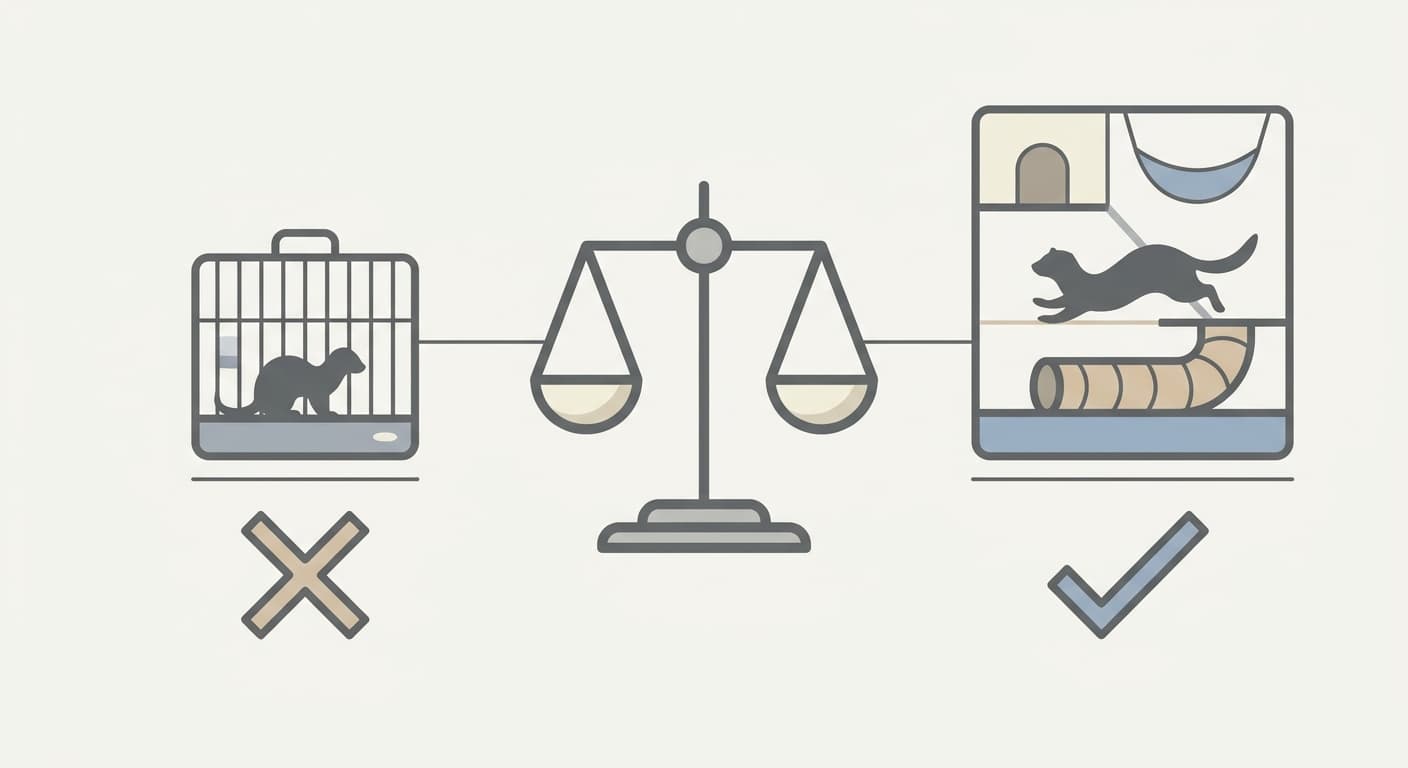
The right size ferret cage starts at 24" x 24" x 18" for one ferret as an absolute minimum, but veterinary sources recommend at least 36" x 24" x 24" with two or more levels. Each additional ferret widens and deepens the footprint, so the floor area scales with the number of animals. Run your own numbers with our free Ferret Cage Calculator before you buy.
A common and costly mistake is buying a "small animal cage" rated for a rabbit or a guinea pig, then discovering the bar spacing is 1.5 inches and the ferret is loose in the wall within an hour. Ferrets treat any gap of 1 inch or wider as a door. Sizing a ferret cage is two problems at once: enough floor space for an animal that plays hard, and bar spacing tight enough to contain an escape artist.
This guide covers exact dimensions by ferret count, bar spacing, level requirements, accessory budgets, and how to pick between a commercial cage and a custom build. Every number is re-derivable, and the FAQ at the end answers the most common sizing questions verbatim.
How big should a ferret cage be? The baseline numbers
According to VCA Animal Hospitals, the suggested minimum cage size for a ferret is 24" x 24" x 18" high (60 x 60 x 45 cm), and multi-tiered cages are preferred. It is a floor, not a target. VCA is explicit that the cage "should be as large as you can afford," and that ferrets must spend at least two to three hours a day outside the cage regardless of its size.
The Ferret Cage Calculator sizes the cage by floor area rather than volume. It starts a single ferret at a 36" x 24" footprint and 36" of height, then widens it by 6 inches, deepens it by 4 inches, and raises it by 12 inches for each additional ferret. The minimum floor area is width x depth divided by 144 (square inches per square foot), and the calculator also reports an "ideal" floor area that is 1.5x the minimum to leave room for ramps and furnishings.
Important
Floor area is the containment floor, not a substitute for exercise. Even the 32.6-cubic-foot Ferret Nation double unit is a holding pen if the ferret never gets free-roam time. Budget two to three hours of supervised out-of-cage play daily, as VCA recommends.
Minimum cage size formula
The calculator's dimension rules are:
Width (in)  = 36 + (N - 1) x 6
Depth (in)  = 24 + (N - 1) x 4
Height (in) = 36 + (N - 1) x 12   (multi-level style)
Min floor area (sq ft) = (Width x Depth) / 144
Ideal floor area       = Min floor area x 1.5
Where N is the number of ferrets. Worked out for the first four ferrets:
| Ferrets (N) | Min Dimensions (W x D x H) | Min Floor Area | Ideal Floor Area |
|---|---|---|---|
| 1 | 36" x 24" x 36" | 6.00 sq ft | 9.00 sq ft |
| 2 | 42" x 28" x 48" | 8.17 sq ft | 12.25 sq ft |
| 3 | 48" x 32" x 60" | 10.67 sq ft | 16.00 sq ft |
| 4 | 54" x 36" x 72" | 13.50 sq ft | 20.25 sq ft |
Re-deriving the floor-area column: divide width x depth by 144. For one ferret, 36 x 24 = 864, and 864 / 144 = 6.00 sq ft; the ideal is 6.00 x 1.5 = 9.00 sq ft. For two ferrets, 42 x 28 = 1,176, and 1,176 / 144 = 8.17 sq ft (ideal 12.25). For three, 48 x 32 = 1,536, 1,536 / 144 = 10.67 sq ft (ideal 16.00). For four, 54 x 36 = 1,944, 1,944 / 144 = 13.50 sq ft (ideal 20.25). Height climbs in 12-inch steps because each added ferret earns another level to climb.
Notice the footprint grows steadily rather than doubling. Ferrets pile together to sleep and share play space, so two animals do not need twice the floor of one. The 50 percent jump from minimum to ideal floor area is not waste; it is the space ramps, hammocks, and litter pans eat up before a ferret ever uses the room.
Multi-ferret cage sizing: 2, 3, and 4 ferrets
Ferrets are social and do best in pairs or small groups, which means most owners are sizing for more than one animal. The jump from one ferret to two does not double the cage, because ferrets pile together to sleep and share play space. The footprint widens by 6 inches and deepens by 4 inches per animal rather than restarting from scratch.
Two ferrets
Two ferrets need a 42" x 28" footprint at minimum, which is 8.17 sq ft of floor, with an ideal of 12.25 sq ft and at least two levels. The practical answer most owners land on is a tall multi-level cage like the 36" x 24" x 36" Ferret Nation single unit, whose larger footprint and stacked levels leave room for two hammocks, a litter pan, food and water, and a tunnel without crowding.
Three ferrets
Three ferrets push the minimum footprint to 48" x 32", or 10.67 sq ft (ideal 16.00 sq ft). Deepening the cage adds floor area on every level, which matters more than height once you have three animals competing for hammock spots.
Four ferrets
Four ferrets need a 54" x 36" footprint at minimum, 13.50 sq ft of floor (ideal 20.25 sq ft). This is where most owners step up to a commercial double-unit cage. The MidWest Homes Ferret Nation 182 double unit measures 36" x 25" x 62.5", giving a 6.25 sq ft footprint per level (36 x 25 = 900, 900 / 144 = 6.25) across two stacked levels plus shelves. Its stacked levels and full-height climbing room comfortably house four ferrets and leave headroom for a fifth.
Tip
When in doubt, buy the double unit. The price gap between a single and double Ferret Nation is small relative to the cage's lifespan, and ferrets almost always end up as a multi-ferret household once the first one charms you.
Bar spacing: the number that actually keeps ferrets in
Floor space keeps a ferret comfortable; bar spacing keeps it home. Multiple ferret husbandry sources, summarized by exotic-pet guidance like the Veterinary Center for Birds and Exotics, set the standard at 1 inch or less between bars. A ferret's skeleton is built to follow its head through gaps, so any opening wider than 1 inch is a potential exit.
This rule disqualifies most cages marketed for rabbits and guinea pigs, which commonly use 1-inch to 1.5-inch spacing. A cage that is perfectly safe for a 4-pound guinea pig can be wide open to a 2-pound ferret.
| Animal | Typical Bar Spacing | Safe for Ferrets? |
|---|---|---|
| Ferret (required) | 1.0 in or less | Yes |
| Rabbit cage (common) | 1.0 - 1.5 in | Often no |
| Guinea pig cage (common) | 1.0 - 1.5 in | Often no |
| Chinchilla cage | 0.5 - 1.0 in | Usually yes |
| Bird flight cage | varies, often 0.5 - 0.75 in | Usually yes (check shelves) |
The chinchilla and bird-cage rows are why some owners cross-shop those categories. If you already own a chinchilla cage with half-inch spacing, it may be ferret-safe on bar spacing alone, though you still need to confirm the floor and shelf gaps. Check the spacing on any cage with a ruler before assuming the marketing label is accurate.
Warning
Bar spacing is measured between bars, not center to center. Sellers sometimes list the wider center-to-center figure, which hides a 1.25-inch true gap behind a "1-inch" claim. Always measure the open space a ferret could push through.
How many levels does a ferret cage need?
Ferrets are climbers and burrowers, so vertical space counts as usable space only if you connect it with ramps. The calculator recommends levels with this rule, which enforces a two-level floor so no multi-level cage ever drops below two stories:
Levels = max(2, ceil(N / 2) + 1)
Worked out: for one ferret, ceil(1/2) + 1 = ceil(0.5) + 1 = 1 + 1 = 2, and max(2, 2) = 2 levels (the floor and the formula agree here). For two ferrets, ceil(2/2) + 1 = 1 + 1 = 2, so max(2, 2) = 2 levels. For three ferrets, ceil(3/2) + 1 = ceil(1.5) + 1 = 2 + 1 = 3, so max(2, 3) = 3 levels. For four ferrets, ceil(4/2) + 1 = 2 + 1 = 3, so max(2, 3) = 3 levels. The max(2, ...) floor only changes the result for very small inputs; for one and two ferrets the formula already returns 2, so the floor simply guarantees it can never fall lower.
| Ferrets | Recommended Levels | Reasoning |
|---|---|---|
| 1 | 2 | Sleeping level plus a play/litter level |
| 2 | 2 | Two animals still share two levels comfortably |
| 3 | 3 | Adds a dedicated litter or food level |
| 4 | 3 | Three full levels spread out a group of four |
Space levels 8 to 12 inches apart. Closer than 8 inches wastes climbing room; farther than 12 inches risks fall injuries, especially in older ferrets. Cover any wire shelf with fleece or linoleum, because bare wire causes painful pressure sores on ferret feet over time. Ramps should be at least 5 inches wide with low side rails so a ferret cannot roll off.
Accessory budget: what goes inside the cage
A cage is the frame; the inside is where comfort lives. Plan a setup budget of roughly $50 to $150 beyond the cage itself, scaling with the number of ferrets. Here is a realistic per-item breakdown for a two-ferret setup.
| Accessory | Quantity (2 ferrets) | Unit Cost | Line Total |
|---|---|---|---|
| Hammocks | 3 | $12 | $36 |
| Water bottle (16 oz) | 1 | $10 | $10 |
| Ceramic food dish | 2 | $7 | $14 |
| Corner litter pan + litter | 1 | $13 | $13 |
| Tunnel / tube | 1 | $18 | $18 |
| Sleep sack / hide box | 1 | $15 | $15 |
| Total | $106 |
Re-deriving the total: 36 + 10 + 14 + 13 + 18 + 15 = $106, which sits squarely in the $50 to $150 setup range. The hammock count follows a simple rule of one per ferret plus one extra, so two ferrets get three hammocks. Ferrets are picky sleepers and will fight over a favorite spot, so the spare hammock prevents squabbles.
If you are pricing out a ferret from scratch, the cage and accessories are only the start. Use our Pet First Year Cost Calculator to fold in food, litter, and vet visits across the whole first year.
Commercial cage vs. custom build
Most owners buy a commercial cage, and for good reason: a purpose-built ferret cage already solves bar spacing, secure latches, and shelf coverings. The Ferret Nation 182 double unit runs about $250 to $300 at major online retailers in 2026, based on current listings at MidWest Homes for Pets and Amazon.
A custom build can be cheaper per square foot but requires you to solve the escape problem yourself. The two failure points in DIY ferret cages are bar or mesh spacing wider than 1 inch and gaps around doors. If you build, use hardware cloth with openings no larger than 0.5 inch and double-latch every door.
| Option | Typical Cost | Pros | Cons |
|---|---|---|---|
| Commercial (Ferret Nation 182) | $250 - $300 | Escape-proof, multi-level, resale value | Higher upfront cost |
| DIY wood + hardware cloth | $80 - $180 | Custom footprint, cheaper materials | You must guarantee 1-in containment |
| Repurposed cage (chinchilla/bird) | $0 - $150 | Uses what you own | Must verify bar spacing and floor gaps |
For comparison shopping across small-pet cage sizing, the same floor-area-and-spacing logic applies to other species. Our Hamster Cage Calculator, Guinea Pig Cage Calculator, and Bird Cage Size Calculator each apply the right minimums for their animal, and a rabbit hutch follows yet another floor-space standard.
Frequently Asked Questions
How do I choose the right size ferret cage?
For one ferret, choose at least 24" x 24" x 18" as a bare minimum and 36" x 24" x 36" with two or more levels as the recommended size. Each additional ferret widens the footprint by 6 inches, deepens it by 4 inches, and adds a level of height, so the floor area grows from 6 sq ft for one ferret to 13.5 sq ft for four. Bar spacing must be 1 inch or less to contain an escape artist.
How tall should a ferret cage be?
The calculator starts a single multi-level ferret cage at 36 inches tall and adds 12 inches for each additional ferret, reaching 48 inches for two, 60 inches for three, and 72 inches for four. Height only counts as usable space if you connect the levels with ramps and space the levels 8 to 12 inches apart.
How many levels does a ferret cage need?
The calculator recommends two levels for one or two ferrets and three levels for three or four, following max(2, ceil(N/2)+1). The minimum is always two levels for a multi-level cage so even a single ferret gets a sleeping level plus a play and litter level.
What goes inside a ferret cage, and what does it cost?
Plan roughly $50 to $150 of furnishings beyond the cage: hammocks (one per ferret plus a spare), a water bottle, ceramic food dishes, a corner litter pan, a tunnel, and a sleep sack. A two-ferret setup totals about $106. Cover any wire shelf with fleece to prevent pressure sores.
How big should a cage be for 2 ferrets?
Two ferrets need a 42" x 28" footprint at minimum, which is 8.17 sq ft of floor (ideal 12.25 sq ft), with at least two levels. Most owners meet this with a tall multi-level cage like the 36" x 24" x 36" Ferret Nation single unit, leaving room for three hammocks, a litter pan, and a tunnel without crowding.
What bar spacing is safe for ferrets?
Bar spacing must be 1 inch or less, measured as the open gap between bars, because ferrets can follow their heads through any wider opening. This rule disqualifies most rabbit and guinea pig cages, which commonly use 1 to 1.5 inch spacing.
Related Articles
- Reptile Heating and Pet Care Calculator Data — How enclosure material and size drive real annual costs for small exotics.
- Cat Age Guide — Translating animal years to human years, with the same plain-math approach used here.
- Dog Age Guide — Size-adjusted aging for dogs, another sizing-by-the-numbers pet reference.
Related Calculators
- Ferret Cage Calculator — Minimum dimensions, levels, and accessories by ferret count.
- Hamster Cage Calculator — Minimum floor space by hamster breed.
- Guinea Pig Cage Calculator — C&C and standard cage size requirements.
- Bird Cage Size Calculator — Species-specific cage dimensions and bar spacing.
- Chinchilla Cage Calculator — Multi-level cage sizing for chinchillas.
- Pet First Year Cost Calculator — Total first-year cost including cage, food, and vet care.
This article provides general information for educational purposes. Cage standards reflect published veterinary and rescue guidance; consult your veterinarian or a ferret-specialty organization for care decisions specific to your animals.
This article is provided for informational and educational purposes only. Content should not be considered professional financial, medical, legal, or other advice. Always consult a qualified professional before making important decisions. UseCalcPro is not responsible for any actions taken based on the information in this article.
Try These Calculators
Ferret cage size calculator finds minimum dimensions by number of ferrets. Get recommended levels, bar spacing, accessories, and multi-ferret cage setups.
Calculate the right dance floor size for your event. Enter guest count, dance style, and participation rate to get dimensions, panels, and square footage.