When Did I Conceive? Understanding Conception Dates and Calculations
"When exactly did I get pregnant?"
Whether you're curious about that romantic getaway, need to know for medical reasons, or are simply piecing together your pregnancy timeline, determining your conception date is a common question. The answer involves a bit of biology and math.
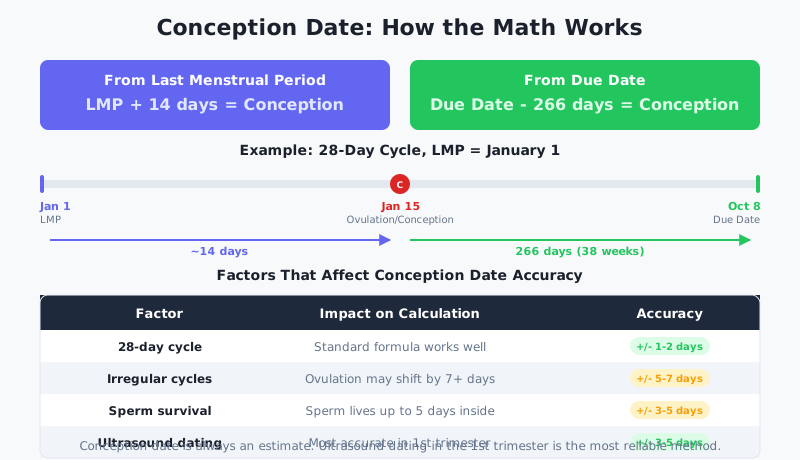
Quick answer: Conception typically occurs about 14 days before your next expected period, or roughly 2 weeks after the first day of your last menstrual period (LMP) for those with 28-day cycles. From your due date, you can calculate backwards: conception occurred approximately 266 days (38 weeks) before your due date.
A worked example shows how close these calculations can get with good cycle data. Take an LMP of January 3rd with cycles averaging 30 days, tracked with OPKs that showed a positive surge on cycle day 17. Working backwards from an 8-week ultrasound dating, the estimated conception date lands on January 20th — just one day off from the OPK prediction. That is how close these calculations can get with good cycle data, and also why they're always an estimate rather than a certainty.
Use our Conception Calculator to estimate your conception date based on your due date, LMP, or current pregnancy week.
How Conception Works: The Biology
Understanding conception starts with understanding the biology of how pregnancy begins.
The Conception Timeline
Conception isn't an instant event—it's a process that unfolds over several days:
| Day | Event | Details |
|---|---|---|
| Day 0 | Ovulation | Egg released from ovary |
| Day 0-1 | Fertilization | Sperm meets egg in fallopian tube |
| Day 1-5 | Cell division | Fertilized egg (zygote) divides as it travels |
| Day 5-6 | Blastocyst formation | Ball of cells with inner mass forms |
| Day 6-12 | Implantation | Embryo attaches to uterine wall |
According to the American College of Obstetricians and Gynecologists (ACOG), fertilization typically occurs within 12-24 hours of ovulation—the egg has a short lifespan once released.
Info
Conception vs. Fertilization vs. Implantation: These terms are sometimes used interchangeably, but they're different stages. Fertilization is when sperm meets egg. Implantation is when the embryo attaches to the uterus (6-12 days later). "Conception" most commonly refers to fertilization.
The Fertile Window
You can only conceive during a specific window each cycle:
- Egg viability: 12-24 hours after ovulation
- Sperm viability: Up to 5 days in the reproductive tract
- Fertile window: Approximately 6 days (5 days before ovulation + ovulation day)
This means that sex up to 5 days before ovulation can result in pregnancy, as sperm can survive in the fallopian tubes waiting for the egg.
The Mayo Clinic notes that the highest pregnancy rates occur when intercourse happens 1-2 days before ovulation.
Calculating Your Conception Date
There are several methods to estimate when conception occurred, each with different levels of accuracy.
Method 1: From Your Due Date
This is the most common method if you already have an established due date.
Formula: Conception Date = Due Date - 266 days (38 weeks)
Example:
- Due date: October 15, 2026
- Conception: October 15 - 266 days = January 22, 2026
Our Conception Calculator does this calculation instantly.
Tip
Remember the window: Conception likely occurred within a range of about 5 days around this calculated date, depending on when you ovulated and when sperm was present.
Method 2: From Your Last Menstrual Period (LMP)
If you know your LMP, you can estimate conception:
Formula (for 28-day cycles): Conception Date = LMP + 14 days
For different cycle lengths: Conception Date = LMP + (Cycle Length - 14)
Examples:
| Cycle Length | LMP | Ovulation/Conception Estimate |
|---|---|---|
| 28 days | Jan 1 | Jan 15 (Day 14) |
| 30 days | Jan 1 | Jan 17 (Day 16) |
| 35 days | Jan 1 | Jan 22 (Day 21) |
| 25 days | Jan 1 | Jan 12 (Day 11) |
This method assumes you ovulated at the expected time for your cycle length—the luteal phase (time from ovulation to period) is typically 12-16 days, averaging 14 days.
Method 3: From an Ultrasound
First-trimester ultrasounds provide the most accurate dating. If you have ultrasound measurements:
Using gestational age from ultrasound: Conception Date = Ultrasound Date - (Gestational Age in days - 14)
Example:
- Ultrasound date: March 1, 2026
- Gestational age at ultrasound: 8 weeks 3 days (59 days)
- Days since conception: 59 - 14 = 45 days
- Conception: March 1 - 45 days = January 15, 2026
According to ACOG, crown-rump length (CRL) measurements in the first trimester can estimate gestational age within 5-7 days.
Method 4: If You Know Exactly When You Had Sex
If you only had intercourse once during your fertile window, conception likely occurred:
- On that day (if it was ovulation day)
- 1-2 days after intercourse (if it was before ovulation)
Important: Sperm can survive up to 5 days, so if you had sex on multiple days, any of those could be the "conception day."
The Conception Window: Why It's a Range
Conception is best understood as a window, not a single date. Here's why:
Factor 1: Ovulation Timing Varies
Even with regular cycles, ovulation can vary by 1-3 days each month. Stress, illness, travel, and other factors can shift ovulation.
Factor 2: Sperm Survival
Since sperm can live up to 5 days in the reproductive tract, intercourse on Monday could result in fertilization on Friday.
Factor 3: Fertilization Takes Time
After ovulation, the egg travels through the fallopian tube. Sperm must reach and penetrate the egg, which takes time.
Important
For legal or paternity purposes: If conception date is being determined for legal reasons, understand that the "conception date" is an estimate within a window. Medical evidence can typically narrow this to a range of about 1-2 weeks, but rarely pinpoints an exact date.
Conception Date vs. Gestational Age
These two dating systems often cause confusion:
| Dating Method | Counts From | Total Pregnancy Length |
|---|---|---|
| Fetal Age | Conception | 38 weeks (266 days) |
| Gestational Age | LMP | 40 weeks (280 days) |
The difference: Gestational age includes the approximately 2 weeks before conception (from your period to ovulation). When your doctor says you're "8 weeks pregnant," they mean gestational age—your baby has actually been developing for about 6 weeks since conception.
| Gestational Age | Fetal Age | Stage |
|---|---|---|
| Week 4 | Week 2 | Implantation occurring |
| Week 8 | Week 6 | All major organs forming |
| Week 12 | Week 10 | End of first trimester |
| Week 20 | Week 18 | Anatomy scan; often learn sex |
| Week 40 | Week 38 | Due date |
Our Pregnancy Calculator shows both gestational age and weeks since conception.
Why Knowing Your Conception Date Matters
1. Understanding Your Timeline
Knowing when conception occurred helps you understand:
- How your symptoms align with development
- When implantation likely occurred
- Why your due date is calculated the way it is
2. Paternity Questions
While conception date is an estimate, it can help narrow down the likely window if there are questions about paternity. Medical professionals can provide conception windows based on dating ultrasounds.
3. IVF and Assisted Reproduction
For IVF pregnancies, the conception date is known precisely:
- Fresh embryo transfer: Conception = retrieval date
- Frozen embryo transfer: Conception = original retrieval date
This makes dating extremely accurate in assisted reproduction cases.
4. Medical Decisions
Some medical decisions reference weeks from conception (fetal age) rather than gestational age. Understanding both systems helps you communicate with healthcare providers.
Conception Date by Situation
For a Surprise Pregnancy
If you discovered you're pregnant and want to know when conception occurred:
- Get a dating ultrasound (most accurate method)
- Work backwards from gestational age to estimate conception date
- Consider your cycle and when you might have ovulated
Use our Conception Calculator by entering your due date or gestational age.
For Those Actively Tracking
If you were tracking ovulation:
- Your conception date is your ovulation date (±1 day)
- OPK positive means conception likely occurred within 12-36 hours after
- BBT rise confirms ovulation occurred the day before
See our Ovulation Tracking Guide for tracking methods.
After IVF or IUI
IVF:
- Day 3 embryo transfer: Conception = transfer date - 3 days
- Day 5 blastocyst transfer: Conception = transfer date - 5 days
IUI:
- Conception likely occurred within 12-24 hours of the procedure
These cases have much more precise conception dates than natural conception.
Real Examples: Calculating Conception
Example 1: From Due Date
Situation: Sarah's due date is November 20, 2026. When did she conceive?
Calculation:
- Due date: November 20, 2026
- Subtract 266 days: November 20 - 266 = February 27, 2026
Conception window: Approximately February 22-27, 2026
Example 2: From LMP with Regular Cycle
Situation: Maria's LMP was March 5, 2026. She has 28-day cycles.
Calculation:
- LMP: March 5, 2026
- Add 14 days for ovulation: March 19, 2026
- Conception date: ~March 19, 2026
Conception window: March 14-19, 2026 (accounting for sperm survival)
Example 3: From LMP with Longer Cycle
Situation: Jessica's LMP was April 1, 2026. She has 35-day cycles.
Calculation:
- Typical luteal phase: 14 days
- Ovulation: Cycle day 21 (35 - 14)
- LMP + 21 days = April 22, 2026
Conception window: April 17-22, 2026
Example 4: From First Trimester Ultrasound
Situation: Lisa had an ultrasound on May 15 measuring 10 weeks 2 days.
Calculation:
- Gestational age: 72 days (10 weeks 2 days)
- Subtract 14 days for conception: 72 - 14 = 58 days pregnant (from conception)
- Conception: May 15 - 58 days = March 18, 2026
Special Circumstances
Irregular Periods
If your periods are irregular, LMP-based calculations are less accurate. Options:
- Dating ultrasound in the first trimester is most reliable
- Use conception range rather than a single date
- Consider multiple possible conception windows
Breastfeeding
Ovulation can return while breastfeeding, sometimes before your period returns. If you conceived while nursing:
- Dating ultrasound is essential
- LMP may not be available or accurate
Birth Control Failure
If you conceived while on birth control:
- Ovulation may have occurred unexpectedly
- Dating ultrasound provides the most accurate timeline
- Consider the full fertile window when estimating
Unknown LMP
If you don't remember your LMP:
- Ultrasound dating is necessary
- Once you have gestational age, you can calculate backwards to conception
What Happens After Conception
Understanding the days following conception helps contextualize the early pregnancy timeline.
Days 1-5: Travel and Division
After fertilization, the zygote:
- Begins dividing (2 cells, 4 cells, 8 cells...)
- Travels down the fallopian tube
- Develops into a morula (ball of 16+ cells)
Days 5-6: Blastocyst Formation
The cell mass becomes a blastocyst with:
- Outer layer (becomes placenta)
- Inner cell mass (becomes baby)
- Fluid-filled cavity
Days 6-12: Implantation
The blastocyst:
- Reaches the uterus
- Attaches to the uterine lining
- Burrows in over 1-2 days
Learn more in our Implantation Guide.
Days 12-14: hCG Production Begins
After implantation:
- The embryo begins producing hCG
- Levels double every 48-72 hours
- Home pregnancy tests become positive
Use our Implantation Calculator to estimate when implantation occurred based on your conception date.
Conception and Pregnancy Tests
When Can You Test?
| Days Post-Conception | hCG Status | Test Sensitivity |
|---|---|---|
| Day 6-12 | Implantation occurring | Too early |
| Day 10-12 | hCG starting to rise | Early detection tests may detect |
| Day 12-14 | hCG doubling | Most sensitive tests positive |
| Day 14+ | Higher hCG levels | Most tests positive |
Most home pregnancy tests are accurate by the first day of your missed period, which is approximately 14 days after conception.
Tip
Testing too early increases false negatives. If you get a negative but still suspect pregnancy, wait 2-3 days and test again.
Frequently Asked Questions
Can I determine the exact day I conceived?
Not exactly. Conception occurs within a window of about 12-24 hours after ovulation, but since ovulation timing varies and sperm can survive for days, the "conception window" is typically 5-7 days wide. Medical dating can narrow this but cannot pinpoint a single day.
How do doctors calculate conception date?
Doctors typically use your due date (established via ultrasound or LMP) and subtract 266 days (38 weeks). This gives the estimated conception date. However, doctors more commonly work with gestational age, which starts from LMP, rather than fetal age from conception.
Is conception the same as implantation?
No. Conception (fertilization) occurs when sperm meets egg in the fallopian tube. Implantation occurs 6-12 days later when the embryo attaches to the uterine wall. Pregnancy technically begins at implantation, as that's when the embryo connects to the mother's blood supply and begins producing hCG.
Can conception date help determine paternity?
Yes, but with limitations. A conception window can help narrow down possibilities when there are multiple potential fathers. However, because the window is typically 5-7 days (accounting for sperm survival and ovulation variation), DNA testing is the only definitive method for establishing paternity.
Why is my due date different from what I calculated from conception?
Doctors use gestational age (starting from LMP), which adds about 2 weeks before conception occurred. If you calculate from conception and add 38 weeks, then add 2 more weeks, you'll get the standard 40-week due date. Alternatively, early ultrasound dating may have adjusted your due date based on measurements.
What if I had sex multiple times during my fertile window?
If you had intercourse on multiple days during your fertile window, conception could have resulted from any of those encounters. The egg is fertilized by a single sperm, but there's no way to know which day's sperm "won the race." Your conception date is still approximately the day of ovulation.
How accurate is a conception date from a due date?
Fairly accurate—usually within 5-7 days. The calculation assumes standard ovulation timing. If your actual ovulation was earlier or later than typical, the conception date would shift accordingly. First-trimester ultrasound dating provides the most accurate foundation for this calculation.
Related Articles
- Complete Pregnancy Journey: From Conception to Due Date — Overview of the entire pregnancy timeline
- How to Track Ovulation: Complete Guide for TTC — Methods for identifying when you ovulate
- Implantation: Timeline, Symptoms, and What to Expect — What happens after conception
- Due Date Calculator: How Accurate Is Your Due Date? — Understanding due date predictions
- Pregnancy Week by Week Guide — Weekly development from conception to birth
Related Calculators
- Conception Calculator — Estimate your conception date
- Ovulation Calculator — Find your fertile window
- Pregnancy Calculator — Track your pregnancy week by week
- Implantation Calculator — Calculate when implantation occurred
- Due Date Calculator — Multiple methods to estimate delivery date
This article provides general information for educational purposes. Conception date calculations are estimates. For questions about paternity or other legal matters, consult with appropriate professionals. For medical concerns, speak with your healthcare provider.
This article is provided for informational and educational purposes only. Content should not be considered professional financial, medical, legal, or other advice. Always consult a qualified professional before making important decisions. UseCalcPro is not responsible for any actions taken based on the information in this article.
Try These Calculators
Work backward from a due date or forward from your last period to find when conception likely happened. See the fertile window and estimated due date.
When is your baby due? Enter your last period or conception date to get an estimated due date, trimester timeline, and key pregnancy milestones week by week.
Estimate when implantation may occur based on your last menstrual period and average cycle length. See the 6-12 DPO window and earliest pregnancy test date.
Calculate your ovulation date and fertile window based on your menstrual cycle. Track your most fertile days for conception planning or natural family planning.
Enter your last period date to estimate your due date, trimester timeline, and key milestones. Track your pregnancy week by week from LMP or conception.