Complete Pregnancy Journey: From Conception to Due Date Calculator Guide
Two pink lines. A digital "Pregnant." That moment when your whole world shifts.
Whether you've been trying for months or this came as a surprise, you probably have one burning question: when is my baby due? The short answer: pregnancy typically lasts 40 weeks (280 days) from the first day of your last menstrual period, or about 38 weeks from conception. For most women, that means a due date roughly 9 months and 1 week from when your last period started.
Consider a representative case: 14 months of tracking cycles with OPKs and BBT charts before finally seeing two pink lines on cycle day 29. Cycles ranging from 26 to 33 days make the standard "day 14 ovulation" assumption effectively useless for many women. Across a 39-week pregnancy, cross-referencing every milestone against three different apps and an OB's ultrasound dating -- which can land 4 or more days off from LMP-based calculations -- is a common experience. That hands-on uncertainty at every stage is exactly why this guide exists.
Use our Pregnancy Calculator to instantly determine your due date, current week, and key milestones.
But there's so much more to understand about the incredible journey from conception to birth. In this comprehensive guide, we'll walk through every stage—from ovulation and conception to implantation, development, and finally, delivery day.
How Pregnancy Dating Works
Before diving into the timeline, it's important to understand how doctors calculate pregnancy dates. This often confuses new parents because the counting system seems counterintuitive.
The Two Dating Methods
| Method | Starts From | Total Duration | Used By |
|---|---|---|---|
| Gestational Age | First day of last menstrual period (LMP) | 40 weeks | Most doctors, ultrasounds |
| Fetal Age | Actual conception date | 38 weeks | Some medical contexts |
According to the American College of Obstetricians and Gynecologists (ACOG), gestational age dating is the standard because:
- Most women know when their last period started
- Conception dates are harder to pinpoint exactly
- It provides a consistent framework for prenatal care
Info
Why does pregnancy "start" before conception? When using gestational age, you're technically "pregnant" for about 2 weeks before you actually conceive. This is because ovulation and conception typically occur around day 14 of a 28-day cycle, but dating begins from day 1 of your period.
Calculating Your Due Date
The standard formula doctors use is Naegele's Rule:
Due Date = LMP + 280 days (40 weeks)
Or more simply:
- Take the first day of your last period
- Add 7 days
- Subtract 3 months
- Add 1 year (if applicable)
Example: If your LMP was January 15, 2026:
- Add 7 days: January 22
- Subtract 3 months: October 22
- Your due date: October 22, 2026
Our Due Date Calculator does this math instantly and accounts for cycle length variations.
The Conception Timeline: Week by Week
Let's break down exactly what happens from ovulation through early pregnancy.
Week 1-2: Menstruation and Preparation
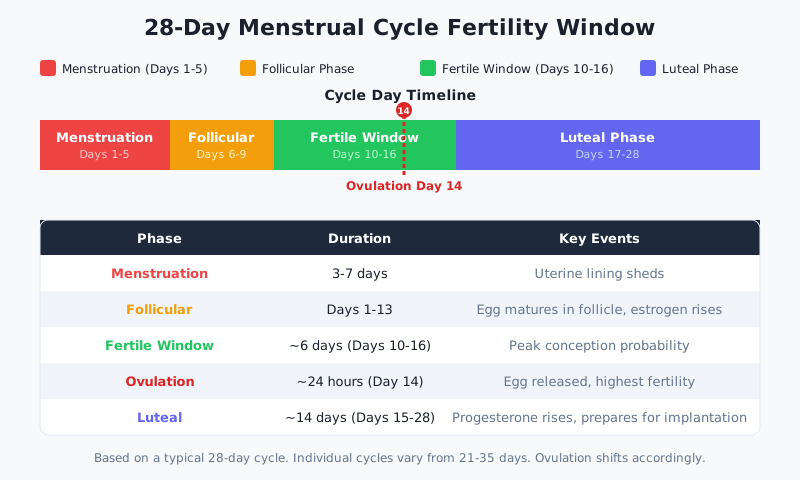
During what's counted as "weeks 1-2" of pregnancy, you're actually having your period and your body is preparing for ovulation. Your uterine lining sheds, then begins building again to potentially support a fertilized egg.
Key events:
- Menstrual bleeding (days 1-5 typically)
- Follicles in your ovaries begin maturing
- Estrogen levels rise, thickening the uterine lining
- Your body prepares for ovulation
Tip
Want to maximize your chances of conception? Start tracking your cycle now. See our complete Ovulation Tracking Guide for methods that work.
Week 2-3: Ovulation and Conception
This is when the magic happens. Around day 14 of a typical 28-day cycle (though this varies widely), a mature egg is released from your ovary.
The conception process:
- Ovulation — An egg is released from the ovary
- Fertilization window — The egg survives 12-24 hours; sperm can survive up to 5 days
- Sperm meets egg — Of the millions of sperm, only one fertilizes the egg
- Zygote forms — The fertilized egg begins dividing
According to the Mayo Clinic, your fertile window is approximately 6 days: the 5 days before ovulation plus ovulation day itself.
Use our Ovulation Calculator to identify your most fertile days.
Week 3-4: The Journey to Implantation
After fertilization, the tiny embryo (now called a blastocyst) travels down the fallopian tube toward the uterus. This journey takes about 6-12 days.
Day-by-day breakdown:
| Days Post-Ovulation | Stage | What's Happening |
|---|---|---|
| Day 0 | Ovulation | Egg released from ovary |
| Day 0-1 | Fertilization | Sperm penetrates egg |
| Day 1-3 | Cell division | Zygote divides into 2, 4, 8 cells |
| Day 4-5 | Morula | Solid ball of 16+ cells |
| Day 5-6 | Blastocyst | Hollow ball with inner cell mass |
| Day 6-12 | Implantation | Blastocyst attaches to uterine wall |
Important
Implantation bleeding — Some women notice light spotting 6-12 days after ovulation. This is caused by the embryo burrowing into the uterine lining and is completely normal. It's typically lighter than a period and lasts 1-2 days.
Learn more about this crucial stage in our Implantation Guide.
Week 4-5: Early Pregnancy Begins
Around week 4, the blastocyst has fully implanted and begins producing human chorionic gonadotropin (hCG)—the hormone detected by pregnancy tests. This is typically when you'd miss your period.
What's developing:
- The embryo is about the size of a poppy seed
- The placenta begins forming
- The amniotic sac develops
- Neural tube (future brain and spinal cord) starts forming
Use our Conception Calculator to estimate when conception occurred based on your current pregnancy stage or due date.
Understanding the Three Trimesters
Pregnancy is divided into three trimesters, each lasting approximately 13-14 weeks.
First Trimester (Weeks 1-13)
The first trimester is the most critical for development. By the end of week 13, all major organs and body systems have formed.
Key milestones:
| Week | Baby's Size | Major Developments |
|---|---|---|
| Week 5 | Sesame seed | Heart begins beating |
| Week 6 | Lentil | Brain hemispheres forming |
| Week 8 | Kidney bean | All major organs present |
| Week 10 | Kumquat | Fingers and toes separating |
| Week 12 | Lime | Reflexes developing, can move |
Common symptoms:
- Morning sickness (nausea/vomiting)
- Fatigue
- Breast tenderness
- Frequent urination
- Food aversions or cravings
Warning
When to call your doctor: Contact your healthcare provider immediately if you experience severe abdominal pain, heavy bleeding, high fever, or severe vomiting that prevents keeping fluids down.
According to the March of Dimes, about 80% of miscarriages occur in the first trimester, which is why many women wait until after week 12 to announce their pregnancy.
Second Trimester (Weeks 14-27)
Often called the "honeymoon phase" of pregnancy, many women feel their best during the second trimester. Morning sickness typically subsides, energy returns, and your bump becomes visible.
Key milestones:
| Week | Baby's Size | Major Developments |
|---|---|---|
| Week 14 | Lemon | Can make facial expressions |
| Week 16 | Avocado | Can hear sounds |
| Week 18 | Bell pepper | You may feel first movements (quickening) |
| Week 20 | Banana | Anatomy ultrasound; can often learn sex |
| Week 24 | Corn on the cob | Viability milestone if born early |
Common symptoms:
- Growing belly
- Feeling baby move (typically weeks 16-25 for first pregnancies)
- Round ligament pain
- Skin changes (linea nigra, stretch marks)
- Nasal congestion
The Cleveland Clinic notes that the anatomy ultrasound around week 18-22 is one of the most detailed scans of your pregnancy, checking baby's organs, growth, and placenta position.
Third Trimester (Weeks 28-40+)
The home stretch! Your baby is gaining weight rapidly, and your body is preparing for labor.
Key milestones:
| Week | Baby's Size | Major Developments |
|---|---|---|
| Week 28 | Eggplant | Eyes can open and close |
| Week 32 | Squash | Practicing breathing movements |
| Week 36 | Papaya | Considered "early term" if born |
| Week 37 | Winter melon | Full term begins |
| Week 40 | Watermelon | Due date! |
Common symptoms:
- Braxton Hicks contractions (practice contractions)
- Shortness of breath
- Frequent urination (baby pressing on bladder)
- Back pain
- Difficulty sleeping
- Swelling in feet and ankles
Tip
Kick counts — Starting around week 28, you should feel your baby move at least 10 times within 2 hours. Tracking movements helps you learn your baby's patterns and notice any changes.
For a detailed breakdown of what happens each week, see our Pregnancy Week-by-Week Guide.
How Accurate Is Your Due Date?
Here's something most pregnancy books don't emphasize enough: only about 5% of babies are born on their actual due date.
According to ACOG, a due date is really an estimate within a range:
| Term | Week Range | Percentage of Births |
|---|---|---|
| Early term | 37-38 weeks | ~26% |
| Full term | 39-40 weeks | ~57% |
| Late term | 41 weeks | ~12% |
| Post-term | 42+ weeks | ~5% |
Factors affecting due date accuracy:
- Cycle regularity — Irregular cycles make LMP dating less accurate
- Conception date certainty — IVF pregnancies have exact conception dates
- First trimester ultrasound — Most accurate dating method (±5-7 days)
- Baby's growth pattern — Some babies grow faster or slower
Info
When dating is adjusted: If an early ultrasound differs from LMP dating by more than 7 days in the first trimester, your due date may be changed to match the ultrasound measurements.
Learn more about what affects predictions in our Due Date Accuracy Guide.
Prenatal Care Timeline
Regular prenatal care is essential for a healthy pregnancy. Here's what to expect at each stage.
First Trimester Appointments
Initial visit (weeks 6-10):
- Confirm pregnancy
- Complete health history
- Physical exam
- Blood tests (blood type, Rh factor, infections, genetic carrier screening)
- Urine test
- Calculate due date
Follow-up visits: Every 4 weeks typically
Second Trimester Appointments
Visits every 4 weeks with key tests:
| Test | When | Purpose |
|---|---|---|
| NIPT or First Trimester Screen | Weeks 10-14 | Genetic screening |
| Quad Screen | Weeks 15-22 | Genetic markers |
| Anatomy Ultrasound | Weeks 18-22 | Check baby's development |
| Glucose Screening | Weeks 24-28 | Test for gestational diabetes |
Third Trimester Appointments
Visits become more frequent:
- Weeks 28-36: Every 2 weeks
- Weeks 36-40: Weekly
Key third trimester tests:
- Group B Strep test (weeks 35-37)
- Cervical checks (starting around week 36-37)
- Non-stress tests if needed
The National Institutes of Health recommends all pregnant women receive regular prenatal care, as it significantly reduces pregnancy complications.
Signs of Labor: When It's Time
As you approach your due date, knowing the signs of labor becomes crucial.
Early Labor Signs
These may occur days to weeks before active labor:
- Lightening — Baby drops lower into pelvis
- Increased Braxton Hicks — More frequent practice contractions
- Cervical changes — Effacement (thinning) and dilation begin
- Nesting urge — Sudden energy to organize and prepare
- Bloody show — Mucus plug released
Active Labor Signs
Call your provider or go to the hospital when:
- Contractions are regular — Coming every 5 minutes, lasting 1 minute, for at least 1 hour (5-1-1 rule)
- Water breaks — Clear or slightly yellow fluid leaking
- Can't talk through contractions — Intensity requires focus
Warning
Go to the hospital immediately if you experience:
- Heavy bleeding (more than a period)
- Sudden, severe headache or vision changes
- Baby's movements significantly decrease
- Water breaks and fluid is green or brown
- Fever over 100.4°F
Special Considerations
Calculating Due Date with Irregular Cycles
If your cycles are longer or shorter than 28 days, standard calculations need adjustment:
Adjusted calculation: Due Date = LMP + 280 days + (actual cycle length - 28)
Example: 35-day cycle
- LMP: January 1
- Standard due date: October 8
- Adjusted: October 8 + 7 days = October 15
Our Pregnancy Calculator automatically adjusts for cycle length variations.
IVF and Assisted Reproduction
For IVF pregnancies, dating is extremely accurate because you know the exact:
- Egg retrieval date
- Fertilization date
- Transfer date and embryo age (day 3 or day 5)
IVF due date calculation:
- For day 5 blastocyst transfer: Transfer date + 261 days
- For day 3 embryo transfer: Transfer date + 263 days
Multiple Pregnancies
Twins and multiples have different timelines:
- Average twin delivery: 36-37 weeks
- Average triplet delivery: 32-33 weeks
- More frequent monitoring required
- Earlier viability planning discussions
Using Pregnancy Calculators Effectively
Our suite of calculators helps you track every stage:
Pregnancy Calculator
Enter your LMP or due date to see:
- Current gestational week
- Estimated due date
- Trimester milestones
- Key appointment windows
Ovulation Calculator
For those trying to conceive:
- Fertile window prediction
- Ovulation day estimate
- Best days for intercourse
Conception Calculator
Figure out when conception occurred:
- Based on due date
- Based on current pregnancy week
- Helpful for understanding early timeline
Implantation Calculator
Understand the crucial implantation window:
- Likely implantation date range
- When to expect implantation bleeding
- When hCG begins rising
Due Date Calculator
Multiple calculation methods:
- From LMP
- From conception date
- From ultrasound measurements
Frequently Asked Questions
How do I calculate my due date if I don't know my LMP?
If you don't remember your last period, an early ultrasound (ideally between weeks 7-13) is the most accurate way to date your pregnancy. Crown-rump length measurements in the first trimester can estimate gestational age within 5-7 days. From there, your due date can be calculated.
Can my due date change during pregnancy?
Yes, due dates can be adjusted, typically based on first-trimester ultrasound measurements. According to ACOG, if the ultrasound-based due date differs by more than 7 days from LMP-based dating in the first trimester, the ultrasound date is generally used.
When should I take a pregnancy test?
Most home pregnancy tests can detect pregnancy on the first day of your missed period, which is about 14 days after ovulation. Some sensitive tests can detect hCG a few days earlier, but testing too early increases the chance of false negatives. For the most accurate result, test with first morning urine when hCG is most concentrated.
Is it normal for my symptoms to come and go?
Yes, pregnancy symptoms often fluctuate, especially in the first trimester. Many women experience days with intense nausea followed by days of feeling completely normal. Unless symptoms disappear entirely and suddenly along with other concerning signs (bleeding, cramping), variation is normal.
How accurate are online pregnancy calculators?
Online calculators are quite accurate for estimating due dates using standard formulas. They're based on the same Naegele's Rule that doctors use. However, they can't account for individual variations in ovulation timing or baby's growth. Early ultrasound dating combined with calculator estimates gives the most complete picture.
What's the difference between gestational age and fetal age?
Gestational age counts from the first day of your last period and is the standard dating method (40 weeks total). Fetal age counts from actual conception and is about 2 weeks less (38 weeks total). When your doctor says you're "8 weeks pregnant," they mean gestational age—your baby has actually been developing for about 6 weeks.
When is a baby considered full term?
According to ACOG definitions:
- Early term: 37 weeks 0 days through 38 weeks 6 days
- Full term: 39 weeks 0 days through 40 weeks 6 days
- Late term: 41 weeks 0 days through 41 weeks 6 days
- Post-term: 42 weeks 0 days and beyond
Babies born at 39-40 weeks generally have the best outcomes.
Related Articles
- How to Track Ovulation: Complete Guide for TTC — Methods for identifying your fertile window, from apps to OPKs to BBT charting
- When Did I Conceive? Understanding Conception Dates — How to calculate your conception date and why it matters
- Implantation: Timeline, Symptoms, and What to Expect — Everything about this crucial early pregnancy stage
- Due Date Calculator: How Accurate Is Your Due Date? — Understanding what affects due date predictions
- Pregnancy Week by Week: What to Expect Each Trimester — Detailed breakdown of baby's development and your changing body
Related Calculators
- Pregnancy Calculator — Track your pregnancy week, due date, and milestones
- Ovulation Calculator — Find your fertile window and best days to conceive
- Conception Calculator — Estimate when conception occurred
- Implantation Calculator — Calculate your implantation window
- Due Date Calculator — Multiple methods to estimate delivery date
- BMI Calculator — Check pre-pregnancy BMI for healthy weight gain guidance
This article provides general information for educational purposes. Every pregnancy is unique. Consult with your healthcare provider for personalized medical advice, prenatal care recommendations, and any concerns about your pregnancy.
This article is provided for informational and educational purposes only. Content should not be considered professional financial, medical, legal, or other advice. Always consult a qualified professional before making important decisions. UseCalcPro is not responsible for any actions taken based on the information in this article.
Try These Calculators
Enter your last period date to estimate your due date, trimester timeline, and key milestones. Track your pregnancy week by week from LMP or conception.
When is your baby due? Enter your last period or conception date to get an estimated due date, trimester timeline, and key pregnancy milestones week by week.
Work backward from a due date or forward from your last period to find when conception likely happened. See the fertile window and estimated due date.
Estimate when implantation may occur based on your last menstrual period and average cycle length. See the 6-12 DPO window and earliest pregnancy test date.
Calculate your ovulation date and fertile window based on your menstrual cycle. Track your most fertile days for conception planning or natural family planning.