Due Date Calculator: How Accurate Is Your Due Date Really?
Your due date feels like everything. It's the day you circle on the calendar, count down to, plan around. But here's the reality check most pregnancy books gloss over:
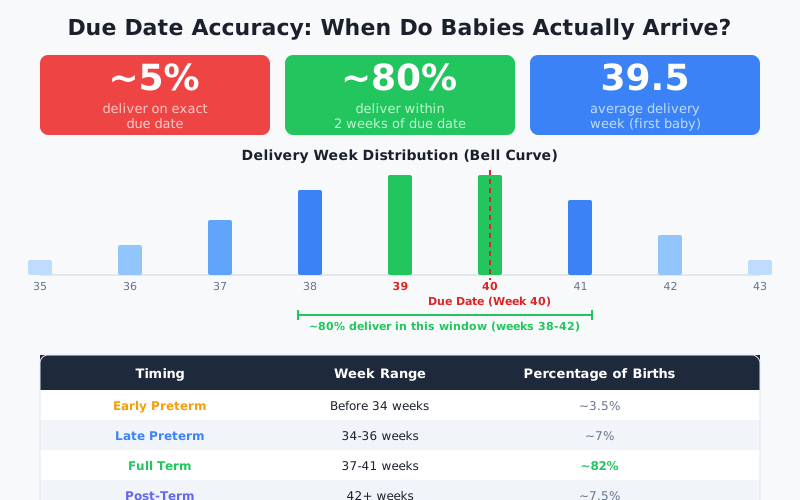
Only about 5% of babies are born on their exact due date. Your due date is better understood as a due "window"—most babies arrive sometime between 37 and 42 weeks of pregnancy. The standard 40-week calculation gives you a target, but your baby will arrive when they're ready.
This plays out differently for every pregnancy. Consider two examples: a due date set for October 12th based on LMP, then moved to October 8th after an 8-week ultrasound -- with the baby arriving on October 17th, a full 9 days past the adjusted date. In a second pregnancy, the due date was March 22nd, and the baby came at 38 weeks and 5 days, on March 15th. Two pregnancies, two completely different patterns, and neither followed the date circled on the calendar. That real-world unpredictability is exactly what this guide addresses.
Use our Due Date Calculator to estimate your delivery date using multiple methods.
Let's explore how due dates are calculated, what affects their accuracy, and what the statistics actually show about when babies arrive.
How Due Dates Are Calculated
There are several methods for calculating an estimated due date (EDD), each with different levels of accuracy.
Method 1: Last Menstrual Period (LMP)
The most traditional method uses Naegele's Rule, developed in the early 1800s:
Formula: Due Date = First day of LMP + 280 days (40 weeks)
Simplified method:
- Take the first day of your last period
- Add 7 days
- Subtract 3 months
- Add 1 year (if applicable)
Example:
- LMP: March 10, 2026
- Add 7 days: March 17
- Subtract 3 months: December 17
- Due date: December 17, 2026
Our Due Date Calculator performs this calculation instantly.
Info
Assumption of 28-day cycles: Naegele's Rule assumes a 28-day cycle with ovulation on day 14. If your cycles are longer or shorter, the calculation needs adjustment.
Adjusted formula for different cycle lengths: Due Date = LMP + 280 + (Actual Cycle Length - 28)
| Cycle Length | Adjustment | Example (LMP March 10) |
|---|---|---|
| 25 days | -3 days | Dec 14, 2026 |
| 28 days | 0 days | Dec 17, 2026 |
| 32 days | +4 days | Dec 21, 2026 |
| 35 days | +7 days | Dec 24, 2026 |
Method 2: Ultrasound Dating
First-trimester ultrasounds provide the most accurate dating, measuring the embryo's crown-rump length (CRL).
According to the American College of Obstetricians and Gynecologists (ACOG), dating accuracy by gestational age:
| Gestational Age at Ultrasound | Accuracy |
|---|---|
| Before 9 weeks | ±5 days |
| 9-13 weeks | ±7 days |
| 14-20 weeks | ±10-14 days |
| 21-28 weeks | ±14-21 days |
| After 28 weeks | ±21+ days |
Why early is more accurate: In the first trimester, all embryos grow at nearly identical rates. Later in pregnancy, individual variation in baby size makes dating less precise.
Important
When dates are changed: ACOG recommends changing the due date only if ultrasound differs from LMP by more than 5 days (before 9 weeks), 7 days (9-13 weeks), or 10-14 days (14-20 weeks).
Method 3: Conception Date
If you know exactly when you conceived (common with IVF or precise ovulation tracking):
Formula: Due Date = Conception Date + 266 days (38 weeks)
This method is highly accurate for IVF pregnancies where fertilization date is known precisely.
Method 4: IVF Transfer Date
For IVF patients, due dates are calculated from transfer date:
| Transfer Type | Calculation |
|---|---|
| Day 5 blastocyst | Transfer date + 261 days |
| Day 3 embryo | Transfer date + 263 days |
| FET (from original retrieval) | Same as above, using equivalent |
IVF due dates are among the most accurate because conception timing is precisely known.
How Accurate Are Due Dates?
Here's what the statistics actually show about when babies arrive:
Distribution of Delivery Times
| Timing | Week Range | Percentage |
|---|---|---|
| Preterm | Before 37 weeks | ~10% |
| Early term | 37-38 weeks | ~26% |
| Full term | 39-40 weeks | ~57% |
| Late term | 41 weeks | ~12% |
| Post-term | 42+ weeks | ~5% |
Key insight: About 70% of babies arrive within 10 days of their due date. But that still leaves 30% who arrive earlier or later.
The "Due Date" Myth
The 40-week due date is based on averages, but human pregnancy length naturally varies:
- Average first pregnancy: 41 weeks 1 day
- Average subsequent pregnancies: 40 weeks 3 days
- Individual variation: 37-42 weeks is considered normal range
A study published in Human Reproduction found that pregnancy length varies naturally by up to 5 weeks between women, even when conception date is precisely known.
Tip
Think in ranges, not dates. Instead of saying "I'm due December 17," consider saying "I'm due mid-December" or "between December 10-24." This sets more realistic expectations.
Factors That Affect Due Date Accuracy
1. Cycle Regularity
Irregular cycles make LMP dating less accurate:
| Cycle Pattern | LMP Accuracy | Recommendation |
|---|---|---|
| Very regular (26-30 days) | Good | LMP dating reliable |
| Somewhat irregular (±3-4 days) | Moderate | Ultrasound confirmation helpful |
| Very irregular (skipped periods, PCOS) | Poor | Rely on ultrasound dating |
Women with PCOS, recent hormonal contraceptive use, or breastfeeding often have unpredictable ovulation, affecting LMP-based calculations.
2. First Pregnancy vs. Subsequent
| Factor | First Pregnancy | Subsequent Pregnancies |
|---|---|---|
| Average delivery | 41w 1d | 40w 3d |
| Past 40 weeks | More common | Less common |
| Accurate prediction | Harder | Pattern may repeat |
If your first baby came at 41 weeks, subsequent pregnancies often follow similar patterns—but not always.
3. Mother's Age
Research shows maternal age affects pregnancy length:
| Age Group | Tendency |
|---|---|
| Under 25 | More likely to deliver past due date |
| 25-35 | Average distribution |
| Over 35 | Slightly more medical interventions/inductions |
4. Baby's Sex
Some studies suggest:
- Boys: Slightly more likely to go post-term
- Girls: Slightly more likely to arrive early
The difference is small (a few days on average) but statistically present.
5. Ethnicity
According to research from NIH, average pregnancy length varies somewhat by ethnicity:
- Average variation of about 1 week between different ethnic groups
- Due date calculations may be slightly less accurate for some populations
6. BMI
| BMI Category | Tendency |
|---|---|
| Underweight | Slightly higher preterm risk |
| Normal weight | Average delivery timing |
| Overweight | Slightly longer pregnancies |
| Obese | Higher rates of induction/earlier intervention |
When Due Dates Change
Your due date may be adjusted during pregnancy. Here's when and why:
Reasons for Date Changes
-
Early ultrasound disagrees with LMP
- If difference is significant, ultrasound date is usually adopted
- This happens often with irregular cycles
-
Multiple ultrasounds suggest different timing
- First trimester measurements take precedence
- Later measurements assess growth, not dating
-
IVF with known conception date
- May override LMP-based calculation
- Most accurate dating method available
What Doesn't Change the Due Date
- Baby measuring "big" or "small" in third trimester
- Maternal weight gain
- Symptoms or feelings about timing
- Family history of early/late babies
Warning
Late ultrasounds are not for dating. If a 32-week ultrasound shows your baby measuring larger or smaller than expected, this reflects the baby's individual growth pattern, not an error in due date. Due dates should not be changed based on third-trimester ultrasounds.
Understanding "Term" Definitions
ACOG has specific definitions for pregnancy timing:
| Classification | Week Range | Meaning |
|---|---|---|
| Preterm | Before 37w 0d | Baby needs extra support |
| Early term | 37w 0d - 38w 6d | Developed but still maturing |
| Full term | 39w 0d - 40w 6d | Optimal timing |
| Late term | 41w 0d - 41w 6d | Close monitoring needed |
| Post-term | 42w 0d+ | Intervention usually recommended |
Why 39 Weeks Matters
Research shows babies born at 39+ weeks have better outcomes:
- Lower respiratory issues
- Better temperature regulation
- Improved feeding
- Reduced NICU admissions
This is why elective deliveries before 39 weeks are discouraged without medical indication.
What Happens When You Go Past Your Due Date
Going past your due date is common—especially for first pregnancies. Here's what to expect:
40-41 Weeks
- Additional monitoring may begin
- Non-stress tests (NST) to check baby's heart rate
- Amniotic fluid checks
- Discussion of induction timing
41+ Weeks
At this point, most providers recommend:
- Frequent monitoring (1-2 times per week)
- Discussion of induction benefits
- Consideration of cervical ripeness
42+ Weeks
According to ACOG, most providers recommend delivery by 42 weeks due to:
- Increased risk of stillbirth
- Placental aging
- Larger baby size
- Meconium in amniotic fluid
Info
Your choice matters. While evidence supports delivery by 42 weeks, the timing between 41-42 weeks involves discussion with your provider about risks, benefits, and your preferences.
Induction and Due Dates
Reasons for Induction
Medical indications:
- Post-term pregnancy (42+ weeks)
- Preeclampsia
- Gestational diabetes
- Low amniotic fluid
- Placental issues
- Baby growth concerns
Elective induction (after 39 weeks):
- Maternal preference
- Logistics (distance, childcare)
- History of rapid labor
- Mental health considerations
The ARRIVE Study
A major study (ARRIVE trial) found that elective induction at 39 weeks for low-risk first-time mothers:
- Did NOT increase cesarean rates
- May have slightly reduced cesarean risk
- Had no adverse neonatal outcomes
This has shifted practice for some providers to offer elective induction at 39 weeks.
Making Peace with Due Date Uncertainty
Practical Tips
For planning:
- Don't schedule important events in the 2 weeks before or after your due date
- Have baby essentials ready by 37 weeks
- Prepare work transitions for a range of dates
For mental health:
- Focus on a "due range" rather than a single day
- Avoid telling everyone your exact due date
- Have plans for the waiting period
For physical preparation:
- Be ready for labor from 37 weeks
- Know your hospital route and backup routes
- Have bags packed by 36-37 weeks
Tip
The "due month" approach: Consider telling casual acquirers you're due "mid-December" or "in December" rather than a specific date. This reduces the constant "is the baby here yet?" messages.
Signs Labor Is Approaching
While the due date provides a general timeframe, your body gives signals that labor is near:
Days to Weeks Before
- Lightening: Baby drops lower into pelvis
- Increased Braxton Hicks: More frequent practice contractions
- Cervical changes: Effacement and early dilation
- Nesting instinct: Sudden urge to prepare
Hours to Days Before
- Bloody show: Mucus plug release
- Loose stools: Body clearing out
- Low back pain: Persistent and increasing
- Water breaking: Only happens first in about 15% of labors
True Labor Signs
- Regular contractions: Getting stronger, longer, closer
- 5-1-1 rule: 5 minutes apart, 1 minute long, for 1 hour
- Can't talk through contractions: Intensity requires focus
- Progress: Contractions don't stop with rest or position change
See our Complete Pregnancy Journey Guide for more on labor signs.
Alternative Due Date Theories
Nichols Rule
An alternative to Naegele's Rule that adds 15 days instead of 7, acknowledging that many pregnancies go past 40 weeks. This gives a due date 8 days later than standard.
Mittendorf-Williams Rule
Adjusts for:
- First pregnancy vs. subsequent
- Maternal race Gives different calculations for different populations.
The 10-Month Calendar
Some cultures and practitioners count pregnancy as 10 lunar months (40 weeks), which can feel more accurate than saying "9 months."
None of these alternatives have replaced Naegele's Rule in standard practice, but they highlight the inherent imprecision of due date calculations.
Frequently Asked Questions
How accurate is my due date?
Your due date is an estimate, not a precise prediction. About 5% of babies arrive on their exact due date, but about 70% arrive within 10 days of it. First-trimester ultrasound dating is most accurate (±5-7 days), while LMP dating is less precise, especially with irregular cycles.
Can my due date be wrong?
Yes. LMP-based due dates can be off if you have irregular cycles, ovulated later than expected, or aren't sure of your period dates. Ultrasound dating can also have a margin of error (especially later in pregnancy). The combination of LMP and first-trimester ultrasound gives the most reliable estimate.
Why did my doctor change my due date?
Due dates are typically changed when a first-trimester ultrasound differs significantly from the LMP-based calculation. ACOG guidelines recommend changing the due date if ultrasound differs by more than 5-7 days in the first trimester. This usually means you ovulated earlier or later than assumed.
What if I go past my due date?
Going past your due date is common, especially for first pregnancies. Most providers increase monitoring after 40 weeks and discuss induction options. By 41-42 weeks, induction is usually recommended due to increased risks with post-term pregnancy.
Can I make my baby come on my due date?
You cannot reliably make labor start on a specific date. While some activities (walking, sex, nipple stimulation) may potentially encourage labor when your body is already ready, there's no proven way to trigger labor at a desired time. Your baby will come when they're ready.
Should I trust LMP or ultrasound dating?
First-trimester ultrasound is generally more accurate than LMP dating. However, if your LMP and early ultrasound agree closely, that's a strong confirmation. If they differ significantly, the ultrasound date is usually adopted. For IVF pregnancies, the transfer date calculation is most accurate.
Why do some women always deliver early or late?
Individual physiology plays a role. Some women's bodies tend toward shorter pregnancies, while others consistently go longer. Genetics, cervical length, and hormonal patterns may contribute. If you consistently deliver early or late, future pregnancies may follow the pattern—but not always.
Does my due date affect when I can be induced?
Yes. Elective induction (without medical indication) is generally not offered before 39 weeks due to baby's development needs. Medical inductions can happen earlier when necessary. After 39 weeks, many providers offer elective induction; after 41-42 weeks, induction is typically recommended.
Related Articles
- Complete Pregnancy Journey: From Conception to Due Date — Full timeline from conception to birth
- How to Track Ovulation — Accurate ovulation dating improves due date accuracy
- When Did I Conceive? — Calculate conception from your due date
- Implantation Guide — Understanding early pregnancy timing
- Pregnancy Week by Week — What to expect as you approach your due date
Related Calculators
- Due Date Calculator — Calculate your due date multiple ways
- Pregnancy Calculator — Track your pregnancy week by week
- Conception Calculator — Work backwards from your due date
- Ovulation Calculator — Understand your cycle timing
- Implantation Calculator — Estimate implantation timing
This article provides general information for educational purposes. Due dates are estimates, and every pregnancy is unique. Discuss any concerns about your due date or delivery timing with your healthcare provider.
This article is provided for informational and educational purposes only. Content should not be considered professional financial, medical, legal, or other advice. Always consult a qualified professional before making important decisions. UseCalcPro is not responsible for any actions taken based on the information in this article.
Try These Calculators
When is your baby due? Enter your last period or conception date to get an estimated due date, trimester timeline, and key pregnancy milestones week by week.
Work backward from a due date or forward from your last period to find when conception likely happened. See the fertile window and estimated due date.
Estimate when implantation may occur based on your last menstrual period and average cycle length. See the 6-12 DPO window and earliest pregnancy test date.
Enter your last period date to estimate your due date, trimester timeline, and key milestones. Track your pregnancy week by week from LMP or conception.
Calculate your ovulation date and fertile window based on your menstrual cycle. Track your most fertile days for conception planning or natural family planning.