Bird Cage Size Recommendations by Species: 2026 Dimensions Chart
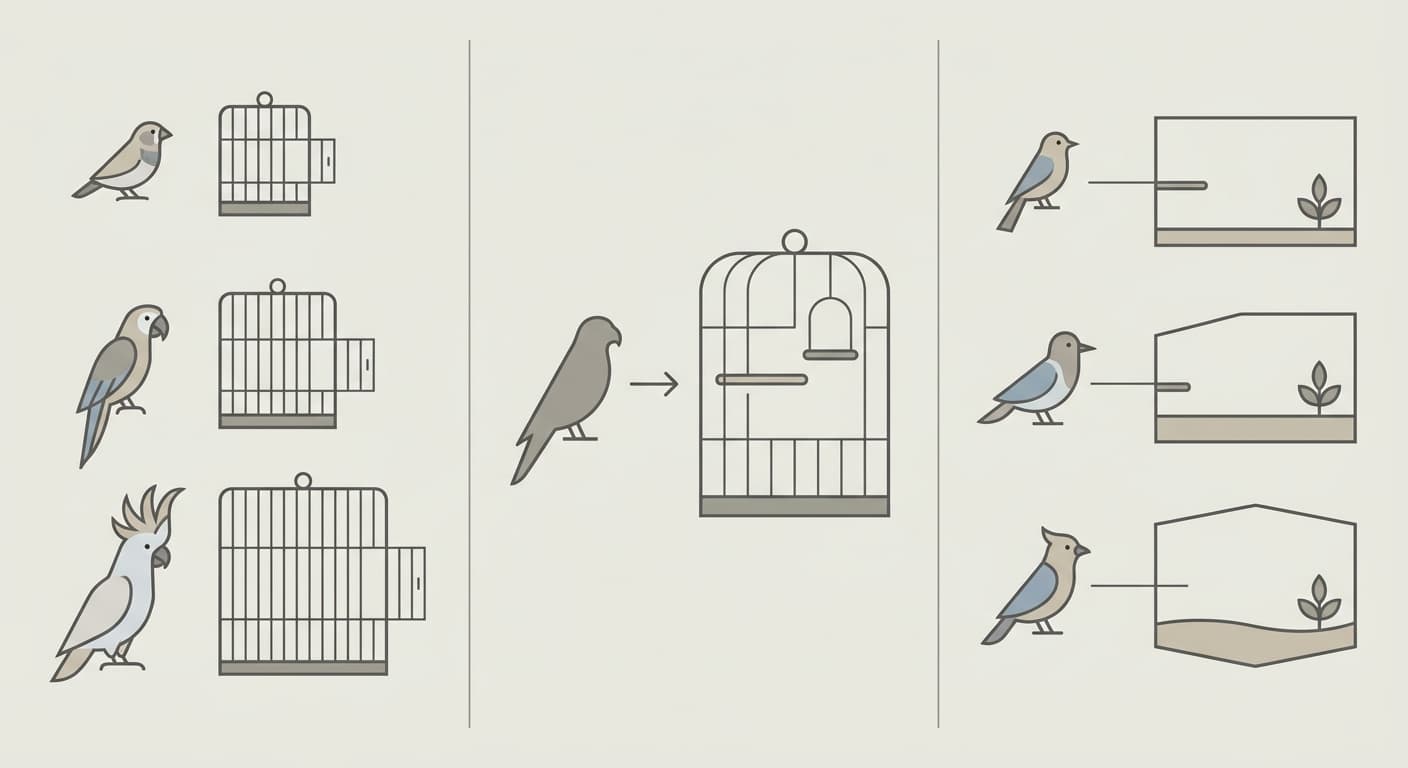
Bird cage size recommendations scale with wingspan: a finch needs a minimum of 18" x 18" x 18" (about 3.4 cubic feet), while a large macaw needs at least 48" x 36" x 60" (60 cubic feet) — nearly 18 times the volume. Avian-care guides set the floor at 1.5 to 2 times a bird's full wingspan in width. Run your own species and flock size through our free Bird Cage Size Calculator before you buy a cage.
The most common cage mistake is buying for the bird's body, not its wings. A cockatiel housed in a 16-inch-wide "starter" cage may never once fully extend both wings — its 13-inch wingspan needs roughly 20 inches of clearance to flap. The other frequent danger is bar spacing: a small bird's head can slip through 5/8-inch bars meant for a larger species and become trapped. Sizing a bird cage is two separate problems: enough horizontal room to fly, and bar spacing tight enough that the head can never pass through.
This guide gives exact minimum and recommended dimensions for 13 species groups, safe bar spacing by bird size, the math for housing multiple birds, and how perches and toys scale. Every number is re-derivable, and the FAQ at the end answers the most common sizing questions verbatim.
Bird Cage Size Recommendations by Species (2026 Chart)
The width of a cage matters more than its height, because almost every pet bird flies horizontally rather than vertically. The Pearl Parrots cage-wingspan guide phrases it as a wingspan rule: a cage's width and depth should be at least 1.5 times the bird's full adult wingspan for birds that spend most of the day out, and 2 times the wingspan for birds that stay caged. A cockatiel with a 13-inch wingspan therefore needs roughly 20 inches of width at the 1.5x floor and 26 inches at the 2x target.
The table below gives single-bird minimums and recommended sizes for the main species groups. The recommended column adds a 50% buffer to each dimension (the rule our calculator uses), so a 24" x 20" x 24" cockatiel minimum becomes 36" x 30" x 36" recommended.
| Species Group | Min Cage (L x W x H) | Recommended (L x W x H) | Bar Spacing | Wingspan |
|---|---|---|---|---|
| Finches / Canaries | 18" x 18" x 18" | 27" x 27" x 27" | 0.25-0.5" | 6-8" |
| Budgies | 18" x 18" x 24" | 27" x 27" x 36" | 0.5" | 8-10" |
| Lovebirds | 24" x 24" x 24" | 36" x 36" x 36" | 0.5" | 8-10" |
| Cockatiels | 24" x 20" x 24" | 36" x 30" x 36" | 0.5-0.625" | 12-14" |
| Conures (small) | 24" x 24" x 30" | 36" x 36" x 45" | 0.625-0.75" | 14-18" |
| African Grey | 36" x 24" x 48" | 54" x 36" x 72" | 0.75-1.0" | 18-20" |
| Amazons | 36" x 24" x 48" | 54" x 36" x 72" | 0.75-1.0" | 18-22" |
| Large Macaw | 48" x 36" x 60" | 72" x 54" x 90" | 1.0-1.5" | 36-40" |
Important
These are floors, not goals. Even a 60-cubic-foot macaw cage is a holding pen if the bird never gets supervised out-of-cage time. Parrots need several hours of free-flight or play-stand time daily regardless of cage size.
Re-deriving the volume gap between species
Cubic feet equals (length x width x height in inches) divided by 1,728, the number of cubic inches in a cubic foot. For a finch minimum of 18 x 18 x 18, that is 5,832 cubic inches, or 5,832 / 1,728 = 3.375 cubic feet (about 3.4). For a large macaw minimum of 48 x 36 x 60, that is 103,680 cubic inches, or 103,680 / 1,728 = 60.0 cubic feet. Dividing 103,680 by 5,832 gives 17.8 — a macaw's minimum cage holds nearly eighteen finch cages by volume. This is why a single cage cannot suit "any bird"; the requirement scales sharply with size.
| Species | Min Volume (cu in) | Min Volume (cu ft) | vs. Finch |
|---|---|---|---|
| Finch | 5,832 | 3.4 | 1.0x |
| Cockatiel | 11,520 | 6.7 | 2.0x |
| African Grey | 41,472 | 24.0 | 7.1x |
| Large Macaw | 103,680 | 60.0 | 17.8x |
Re-checking each row: cockatiel 24 x 20 x 24 = 11,520, and 11,520 / 1,728 = 6.67, rounded to 6.7. African Grey 36 x 24 x 48 = 41,472, and 41,472 / 1,728 = 24.0. The "vs. Finch" column divides each volume by the finch's 5,832: 11,520 / 5,832 = 1.98 (2.0x), 41,472 / 5,832 = 7.11 (7.1x), 103,680 / 5,832 = 17.78 (17.8x). Every figure reconciles.
Bar Spacing by Species: The Safety Number That Kills Birds
Bar spacing is the single most dangerous specification to get wrong, and it has nothing to do with cage size. A finch in a cage with 5/8-inch bars can push its head through and strangle; a macaw in a flimsy small-bird cage will bend the bars apart. According to STAR St. Louis Avian Rescue, budgies and cockatiels need 1/2-inch bar spacing, conures need 5/8 to 3/4 inch, African greys and amazons need 3/4 to 1 inch, and macaws need 1 to 1.5 inches. The rule of thumb: when in doubt, go narrower, because tight bars never endanger a larger bird.
| Bird Group | Example Species | Safe Bar Spacing | Risk if Too Wide |
|---|---|---|---|
| Tiny | Finches, canaries | 0.25-0.5" | Head entrapment, strangulation |
| Small | Budgies, lovebirds | 0.5" (no wider) | Escape, head stuck |
| Medium | Cockatiels | 0.5-0.625" | Beak or toe injury |
| Medium-Large | Small conures | 0.625-0.75" | Beak or toe injury |
| Large | African Grey, Amazon | 0.75-1.0" | Head trapped between bars |
| Extra Large | Macaws, cockatoos | 1.0-1.5" | Toe entrapment if too narrow |
Warning
Never reuse a larger bird's cage for a smaller bird without checking bar spacing. A cockatiel cage with 5/8-inch bars is lethal for a budgie or finch, whose smaller head can slip through and become trapped.
A second safety factor for big parrots is bar gauge — the thickness of the metal, not the gap between bars. An African Grey bites with a force of well over 100 PSI and a large macaw far more, so their cages use heavy welded steel, not the thin wire acceptable for finches. A cage that passes the spacing test but uses thin bars will still fail with a determined large parrot. If you keep multiple species, the Hamster Cage Calculator and our other small-animal tools follow the same "narrower is safer" logic for bar spacing.
How to Scale Cage Size for Multiple Birds: The Square-Root Rule
Housing two birds does not mean doubling the cage. Our calculator scales each dimension by the square root of the bird count, which is the mathematically correct way to keep floor space proportional. For 2 birds, every dimension is multiplied by the square root of 2 (about 1.41); for 4 birds, by the square root of 4 (exactly 2.0). The reason: doubling each linear dimension quadruples the floor area, so multiplying by 1.41 (whose square is 2.0) exactly doubles the floor area for a second bird.
| Bird Count | Scale Factor | Budgie Min Size | Cockatiel Min Size | Floor Area Multiple |
|---|---|---|---|---|
| 1 bird | 1.00x | 18" x 18" x 24" | 24" x 20" x 24" | 1.0x |
| 2 birds | 1.41x | 25" x 25" x 34" | 34" x 28" x 34" | 2.0x |
| 3 birds | 1.73x | 31" x 31" x 42" | 42" x 35" x 42" | 3.0x |
| 4 birds | 2.00x | 36" x 36" x 48" | 48" x 40" x 48" | 4.0x |
Re-deriving the cockatiel row for 2 birds: the base length of 24 inches times 1.41 equals 33.8, rounded to 34. Width 20 x 1.41 = 28.2, rounded to 28. Height 24 x 1.41 = 33.8, rounded to 34 — giving 34" x 28" x 34". For 4 birds, every base dimension simply doubles: 24 x 2 = 48, 20 x 2 = 40, 24 x 2 = 48, giving 48" x 40" x 48". The floor-area multiple is the scale factor squared: 1.41 squared is 1.99 (about 2.0), and 2.0 squared is exactly 4.0. Each bird ends up with the same floor space it would have had alone.
Tip
Quick mental shortcut: for 2 birds, multiply every cage dimension by 1.41. For 4 birds, double every dimension. You never need to remember the species-specific numbers — just the scale factor.
Most flock keepers also keep other pets. If you are sizing housing across species, the same per-animal-space logic appears in our Guinea Pig Cage Calculator, which uses square footage and C&C grids instead of cubic inches.
Perches, Toys, and Cage Shape
Enrichment scales with both species size and bird count. Tiny birds like finches need at least 3 perches and 3 toys; medium birds like cockatiels need 4 of each; extra-large birds like macaws need 6 of each. Our calculator adds 0.5 perches and 0.5 toys per additional bird, rounded down — so 2 cockatiels still get the base 4 perches, but a third bird bumps it to 5.
| Bird Size | Perches | Toys | Food Bowls | Water Dishes |
|---|---|---|---|---|
| Tiny (Finch) | 3 | 3 | 2 | 1 |
| Small (Budgie) | 4 | 4 | 2 | 1 |
| Medium (Cockatiel) | 4 | 4 | 2 | 1 |
| Large (African Grey) | 5 | 5 | 2 | 1 |
| Extra Large (Macaw) | 6 | 6 | 2 | 1 |
Cage shape matters as much as raw dimensions. Rectangular cages beat round cages for every species: round cages have no corners where a bird can feel secure, which can trigger anxiety and repetitive pacing, and they waste perch space. A wide, shallow flight cage suits finches and canaries that fly side to side, while taller cages help climbing species like cockatoos and conures. Use varied perch diameters — about 3/8 inch for finches, 5/8 to 1 inch for cockatiels, and 1 to 2 inches for macaws — to exercise foot muscles and prevent pressure sores. To estimate how much seed those perched birds will eat, pair this guide with our Bird Feeder Calculator.
How to Use the Bird Cage Size Calculator
The calculator turns these rules into an instant spec sheet for your exact setup. Choose your species from 13 groups, enter the number of birds, and it returns the minimum dimensions, recommended dimensions, safe bar-spacing range, and a count of perches, toys, food bowls, and water dishes.
- Open the Bird Cage Size Calculator.
- Select your species group (finch through large macaw).
- Enter how many birds will share the cage (1 to 10).
- Read the minimum and recommended dimensions plus the accessory list.
- Cross-check the bar spacing against the cage you are considering before buying.
For a 2-budgie example, the tool applies the 1.41x scale factor to the 18" x 18" x 24" base and returns a 25" x 25" x 34" minimum with 0.5-inch bar spacing, 4 perches, and 4 toys — exactly the numbers in the multi-bird table above.
Frequently Asked Questions
What size cage does a cockatiel need?
A single cockatiel needs a minimum cage of 24" x 20" x 24" (about 6.7 cubic feet), with a recommended size of 36" x 30" x 36" and bar spacing of 1/2 to 5/8 inch; use the Bird Cage Size Calculator to confirm for your bird.
What are the bird cage size recommendations by species?
A finch needs at least 18" x 18" x 18", a budgie 18" x 18" x 24", a cockatiel 24" x 20" x 24", an African Grey 36" x 24" x 48", and a large macaw 48" x 36" x 60", with each species adding a 50% buffer for the recommended size.
How do I choose the right size cage for a ferret?
A ferret is not a bird, so the wingspan rule does not apply: a single ferret needs about 6 cubic feet (24" x 24" x 18") minimum with bar spacing of 1 inch or less, as covered in our ferret cage sizing guide and Ferret Cage Calculator.
What size cage do guinea pigs need?
Guinea pigs are sized by floor area, not volume: a single pig needs 7.5 square feet (a 2x3 C&C cage) and a pair prefers 10.5 square feet, which you can plan with the Guinea Pig Cage Calculator.
How does cage size scale for multiple birds?
Cage dimensions scale by the square root of the bird count, so 2 birds multiply each dimension by 1.41 (doubling floor area) and 4 birds multiply each dimension by 2.0 (quadrupling floor area).
What bar spacing is safe for small birds like finches and budgies?
Finches and canaries need 0.25 to 0.5 inch bar spacing and budgies need exactly 0.5 inch; spacing any wider lets a small bird push its head through and become fatally trapped.
Should I get a round or rectangular bird cage?
Rectangular cages are strongly preferred because round cages lack the corners where a bird feels secure, reduce usable perch space, and can trigger anxiety and pacing.
Related Articles
- How to Choose the Right Size Ferret Cage: 2026 Dimensions & Setup Guide — Volume-based sizing and bar-spacing rules for an escape-artist mammal.
- Reptile Pet Care Calculator Data: 2026 — Enclosure sizing and care math for reptiles, sized by body length rather than wingspan.
- Dog Age Calculator Guide — Another data-driven pet planning tool from our pet calculator suite.
Related Calculators
- Bird Cage Size Calculator — Minimum and recommended dimensions, bar spacing, and accessories for 13 bird species.
- Bird Feeder Calculator — Estimate weekly birdseed use and feeder refill frequency.
- Ferret Cage Calculator — Cage volume, levels, and accessories by number of ferrets.
- Guinea Pig Cage Calculator — C&C grid counts and coroplast dimensions by pig count.
- Rabbit Hutch Calculator — Hutch size by rabbit weight and count.
This article provides general information for educational purposes. Consult an avian veterinarian for guidance specific to your bird's species, age, and health.
This article is provided for informational and educational purposes only. Content should not be considered professional financial, medical, legal, or other advice. Always consult a qualified professional before making important decisions. UseCalcPro is not responsible for any actions taken based on the information in this article.
Try These Calculators
Ferret cage size calculator finds minimum dimensions by number of ferrets. Get recommended levels, bar spacing, accessories, and multi-ferret cage setups.
Calculate minimum hamster cage size by species using US, German TVT, and DieBrain standards. Check bedding depth, wheel size, and bar spacing requirements.