How Many Calories in a Smoothie? (2026 Data by Type & Chain)
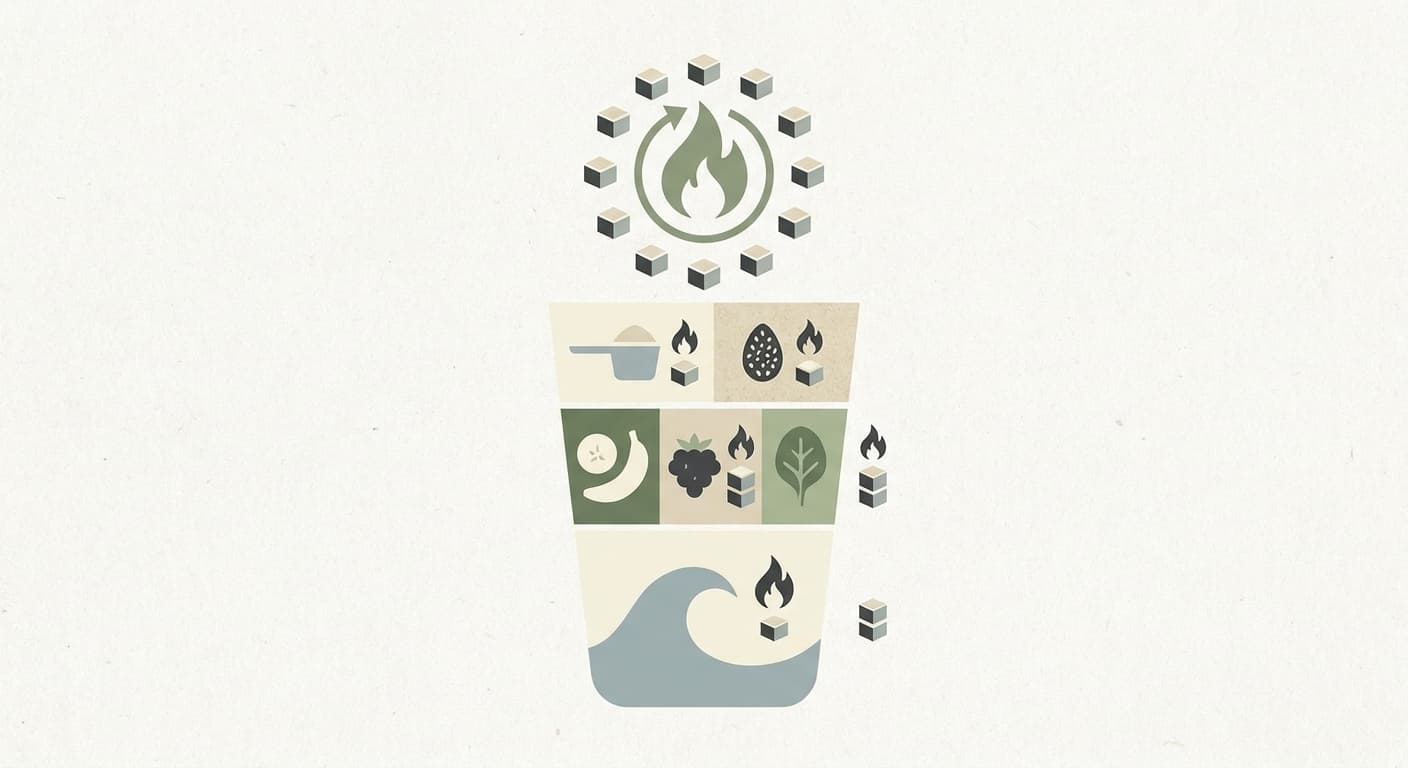
A homemade fruit smoothie has about 150 to 250 calories per serving, but a large chain smoothie can hit 340 to 1,270 calories — the base liquid and add-ins matter far more than the fruit. A 20 oz Smoothie King The Hulk Strawberry packs 890 calories, while a water-based green smoothie can stay under 150. To build your own and see the exact number before you blend, use our free Smoothie Calculator.
A useful comparison is a homemade 195-calorie breakfast smoothie against a 32 oz "healthy" mango smoothie from a counter the same week. The store version came in at over 600 calories — three times the homemade one — for the same fruit-forward flavor. The difference was not the fruit. It was the sherbet, frozen yogurt, and fruit-juice base that the shop blended in. That is the trap this guide is built to help you avoid.
Below is a breakdown of smoothie calories by type, by individual ingredient, and by chain, with the ingredient math worked out so every total reconciles, along with exactly how to build a low-calorie smoothie that still tastes like dessert.
How Many Calories in a Smoothie by Type
The honest answer to "how many calories in a smoothie" is: it depends entirely on what goes in. A smoothie is just a sum of its parts — base liquid, fruit, protein, and any sweetener. The same cup of fruit can live inside a 150-calorie drink or a 600-calorie one depending on the base and add-ins.
Here is the per-serving range by smoothie type, built from the ingredient values in the next section. Each total is the sum of a typical recipe for that style, so you can trace where the calories come from.
| Smoothie Type | Typical Recipe (1 serving) | Calories | Protein |
|---|---|---|---|
| Green (water + greens + fruit) | Water + 1 cup spinach + 1/2 banana + 1/2 cup mango | ~109 kcal | ~2g |
| Basic fruit (almond milk) | Almond milk + banana + 1/2 cup strawberries | ~170 kcal | ~2g |
| Berry yogurt | 1/2 cup Greek yogurt + 1/2 banana + 1/2 cup blueberries + water | ~160 kcal | ~8.5g |
| Protein (milk + whey) | Whole milk + banana + 1/2 cup blueberries + whey scoop | ~418 kcal | ~35g |
| Peanut butter power | Almond milk + banana + 2 tbsp peanut butter | ~335 kcal | ~10g |
The pattern is clear: fruit is the cheapest calorie source in the glass. The big swings come from the base (0 to 150 calories) and the protein or nut-butter add-in (0 to 190 calories). Plug your own combination into the Smoothie Calculator to see the per-serving number update as you swap ingredients.
Tip
If you want a smoothie under 200 calories, the single highest-leverage swap is the base. Switching from whole milk (150 kcal) to unsweetened almond milk (40 kcal) or water (0 kcal) cuts 110-150 calories before you touch the fruit.
Fruit Smoothie Calories
A standard fruit smoothie — fruit plus a light base, no protein powder or nut butter — runs 150 to 250 calories per serving. A classic banana-strawberry blend on almond milk lands at 170 calories: 40 (almond milk) + 105 (banana) + 25 (half cup strawberries) = 170. Swap the almond milk for orange juice and the same drink jumps to 240 calories, because juice adds 110 calories and a lot of sugar versus 40 for the milk.
Fruit-only smoothies are naturally low in protein (1-3g), so they digest fast and may leave you hungry within an hour or two. They work best as a snack or a side, not a meal replacement.
Green Smoothie Calories
Green smoothies are the lowest-calorie style because leafy greens add volume with almost no calories. A water-based green smoothie with 1 cup spinach (7 kcal), half a banana (52 kcal), and half a cup of mango (50 kcal) totals just 109 calories. That is the math behind the "fill your blender and stay under 150" promise.
The catch: many green smoothies sold as "detox" or "wellness" drinks load up on apple juice, agave, or coconut milk to mask the bitterness of kale and spinach. Those add-ins can push a green smoothie past 350 calories. If it tastes sweet without any fruit doing the heavy lifting, check the base.
Protein Smoothie Calories
Protein smoothies are the highest-calorie homemade style because you are deliberately adding dense ingredients. A post-workout blend of whole milk (150), banana (105), half a cup of blueberries (43), and one whey scoop (120) totals 418 calories with 35g of protein. That is a legitimate meal-replacement number — and the protein keeps you full for hours, which a fruit smoothie won't.
A peanut-butter smoothie sits in similar territory: almond milk (40) + banana (105) + 2 tbsp peanut butter (190) = 335 calories. Peanut butter is calorie-dense (about 95 calories per tablespoon), so measure it — a heavy-handed "scoop" can be 3-4 tablespoons and 285-380 calories on its own.
Important
A protein smoothie can absolutely be a meal. A fruit smoothie usually can't. If you are drinking a smoothie instead of eating breakfast, aim for at least 15-20g of protein from Greek yogurt, whey, or plant protein, or you will likely be hungry again before lunch.
Calories by Smoothie Ingredient
To answer "how many calories in a smoothie" for your recipe, add up the parts. This table is the building block for every total above. Values are rounded from USDA FoodData Central entries for the common smoothie portion of each ingredient.
| Ingredient | Portion | Calories | Protein |
|---|---|---|---|
| Water | 8 oz | 0 kcal | 0g |
| Unsweetened almond milk | 8 oz | 40 kcal | 1g |
| Oat milk | 8 oz | 120 kcal | 3g |
| Orange juice | 8 oz | 110 kcal | 2g |
| Whole milk | 8 oz | 150 kcal | 8g |
| Greek yogurt (nonfat) | 1 cup | 130 kcal | 15g |
| Banana | 1 medium | 105 kcal | 1g |
| Strawberries | 1 cup whole | 50 kcal | 1g |
| Blueberries | 1 cup | 85 kcal | 1g |
| Mango | 1 cup | 100 kcal | 1g |
| Spinach | 1 cup raw | 7 kcal | 1g |
| Kale | 1 cup raw | 33 kcal | 2g |
| Whey protein | 1 scoop | 120 kcal | 25g |
| Plant protein | 1 scoop | 110 kcal | 20g |
| Peanut butter | 2 tbsp | 190 kcal | 8g |
| Honey | 1 tbsp | 64 kcal | 0g |
The formula is simple: base + fruit + protein + sweetener = total calories. Here is a worked example, step by step, for a popular "PB banana" smoothie on almond milk:
- Base: unsweetened almond milk, 8 oz = 40 kcal.
- Fruit: 1 banana = 105 kcal.
- Add-in: 2 tbsp peanut butter = 190 kcal.
- Sweetener: none = 0 kcal.
- Total: 40 + 105 + 190 = 335 kcal.
Want to skip the arithmetic? The Smoothie Calculator sums base, fruit, protein, and sweetener instantly and also returns protein, carbs, fat, and total volume per serving. For tracking the dollar cost per smoothie alongside calories, the Recipe Cost Calculator breaks down price per serving.
Warning
Frozen yogurt, sherbet, and "smoothie boost" syrups are the hidden calorie bombs that turn a healthy drink into a milkshake. A half-cup of frozen yogurt adds about 110 calories and 18g of sugar — more than the fruit. These ingredients are why store smoothies dwarf homemade ones, even at the same size.
Homemade vs. Store: The Calorie Gap
Here is where the numbers get dramatic. A homemade fruit smoothie is 150-250 calories. The same flavor at a chain, in a larger cup with added frozen yogurt or fruit-juice bases, is routinely 2-5x higher. The gap is driven by three things: portion size, added sugar bases, and indulgent add-ins like ice cream and sherbet.
This table compares popular 2026 chain smoothies against a homemade equivalent. Chain figures are from each brand's published nutrition data; homemade figures use the ingredient table above.
| Smoothie | Size | Calories | Sugar |
|---|---|---|---|
| Homemade fruit (almond milk) | ~16 oz | ~170 kcal | ~18g |
| Smoothie King Angel Food Slim | 20 oz | 220 kcal | ~37g |
| Jamba Strawberries Wild | 22 oz (medium) | 340 kcal | ~75g |
| Jamba Fruity Rocks | 22 oz (medium) | 400 kcal | ~80g |
| Smoothie King The Hulk Strawberry | 20 oz | 890 kcal | ~140g |
| Smoothie King The Hulk Strawberry | 32 oz | 1,270 kcal | ~200g |
Sources: Smoothie King Angel Food Slim nutrition, Smoothie King The Hulk Strawberry 20 oz (CalorieKing), The Hulk Strawberry 32 oz (FastFoodNutrition), and Jamba medium smoothie figures (FatSecret).
Two takeaways. First, even the "slim" chain options carry more sugar than a homemade smoothie because they lean on fruit-juice bases. Second, mass-gainer blends like The Hulk are not snacks — at 890 to 1,270 calories, a single 32 oz cup can be two-thirds of an entire day's calories for someone on a 2,000-calorie target.
Tip
Ordering out and want to keep it reasonable? Ask for the smallest size, request water or skim milk as the base instead of juice or sherbet, and skip the "boosts." That alone can cut a 600-calorie chain smoothie to under 350.
Why Chain Smoothies Run So High
Three structural reasons explain the gap, and none of them is the fruit:
- Portion size. A homemade smoothie is typically 12-16 oz. Chains start at 20 oz and go to 32-44 oz. Doubling the volume roughly doubles the calories.
- Sugar-heavy bases. Many chain smoothies use sherbet, frozen yogurt, fruit-juice concentrate, or "turbinado" (raw sugar) blends. These add 100-300 calories of mostly sugar per drink.
- Indulgence add-ins. Mass-gainer and "treat" blends include ice cream, peanut butter, and proprietary calorie powders designed to push calories up on purpose.
When you make a smoothie at home, you control all three. That is the entire reason a homemade version can deliver the same flavor at a quarter of the calories. To compare your homemade recipe head-to-head against any chain order, build it in the Smoothie Calculator and read the per-serving total.
How to Make a Low-Calorie Smoothie (Under 200)
You can build a genuinely satisfying smoothie under 200 calories — even under 150 — by being deliberate about four choices. The recipe is: zero/low-calorie base + volume from greens + one cup of fruit + no liquid sweetener.
Here is a worked low-calorie recipe that lands at 159 calories with real staying power:
- Base: water (0 kcal) or unsweetened almond milk (40 kcal). This example uses water.
- Volume: 1 cup spinach (7 kcal) — you won't taste it behind the fruit.
- Fruit: 1 banana (105 kcal) for creaminess and natural sweetness.
- Flavor: 1/2 cup strawberries (25 kcal).
- Protein (optional but smart): if you add half a scoop of plant protein (~55 kcal), you reach 192 kcal with ~12g protein.
- Total without protein: 0 + 7 + 105 + 25 = 137 kcal. With half a scoop of protein: 192 kcal.
The strategy is simple: spend your calories on fruit and protein, not on the base or sweeteners. Frozen fruit makes the texture thick and creamy without ice or extra calories, so it tastes more indulgent than the number suggests.
Tip
Freeze ripe bananas before they brown. Frozen banana blends into a texture close to soft-serve and adds natural sweetness, so you can skip honey (64 kcal/tbsp) or agave entirely. This one habit removes the most common source of "sneaky" smoothie calories.
Low-Calorie Swaps That Actually Work
These swaps each cut calories without wrecking flavor or texture:
| Instead of... | Swap to... | Calories Saved |
|---|---|---|
| Orange juice base (110) | Unsweetened almond milk (40) | ~70 kcal |
| Whole milk base (150) | Water (0) | ~150 kcal |
| Honey, 1 tbsp (64) | Frozen banana (already in recipe) | ~64 kcal |
| Frozen yogurt, 1/2 cup (~110) | Nonfat Greek yogurt, 1/2 cup (~65) | ~45 kcal |
| 2 tbsp peanut butter (190) | 1 tbsp PB powder (~30) | ~160 kcal |
Stacking even two of these swaps on a typical recipe removes 150-300 calories. If your goal is hitting a daily calorie target rather than just one smoothie, our Calorie Calculator estimates your maintenance and weight-loss calorie needs so you know how a smoothie fits your day.
Important
"Low-calorie" and "filling" are not the same thing. A 137-calorie green smoothie is light but won't keep you full long. Add protein (Greek yogurt, whey, or a half scoop of plant protein) to turn a snack into a meal without blowing past 250 calories.
Where the Calculator Fits
The Smoothie Calculator does the arithmetic in this guide instantly: pick a base, choose up to five fruits, add optional protein and sweetener, and it returns per-serving calories, protein, carbs, fat, and total volume. It is the fastest way to test a recipe against a calorie target before you blend.
What it can't do is account for what you can't see in a store smoothie — the sherbet, the fruit-juice concentrate, the proprietary "boost" powders. For those, trust the chain's published nutrition label, not the menu's "made with real fruit" copy. And if you are scaling a smoothie recipe up for a group, the Recipe Converter Calculator handles the portion math.
Frequently Asked Questions
How many calories in a smoothie?
A homemade fruit smoothie has about 150 to 250 calories per serving, depending on the base and fruit. A green smoothie can drop under 150, a protein smoothie climbs to 400+, and a large chain smoothie ranges from 340 to over 1,270 calories. The base liquid and add-ins drive the total far more than the fruit does. Build yours in the Smoothie Calculator for the exact number.
How many calories in a smoothie from a chain?
Chain smoothies run 220 to 1,270 calories depending on brand, size, and blend. A 20 oz Smoothie King Angel Food Slim is 220 calories, a medium (22 oz) Jamba Strawberries Wild is 340, and a 32 oz Smoothie King The Hulk Strawberry hits 1,270 calories — over half a day's calories in one cup. Chains run high because of larger portions and sugar-heavy bases like sherbet and fruit juice.
How many calories in a fruit smoothie?
A standard fruit smoothie is 150 to 250 calories. A banana-strawberry smoothie on almond milk is about 170 calories (40 base + 105 banana + 25 strawberries). Swapping the base to orange juice raises it to about 240. Fruit smoothies are low in protein, so they work better as a snack than a meal.
How many calories in a green smoothie?
A water-based green smoothie is one of the lowest-calorie options, around 100 to 150 calories. One cup of spinach adds just 7 calories, so the fruit you pair it with determines the total. Watch out for "wellness" green smoothies that add apple juice or agave — those can exceed 350 calories despite the green color.
How many calories in a protein smoothie?
A protein smoothie typically runs 350 to 450 calories with 25 to 35g of protein. A whole-milk, banana, blueberry, and whey blend is about 418 calories with 35g protein — a real meal replacement. Use unsweetened almond milk instead of whole milk to cut roughly 110 calories while keeping the protein high.
Are homemade smoothies lower in calories than store-bought?
Yes, usually by a wide margin. A homemade fruit smoothie is 150-250 calories, while a comparable chain smoothie is 340-600+ for the same flavor. The gap comes from larger portions, sugar-heavy bases (sherbet, fruit juice), and add-ins like frozen yogurt — all of which you control when blending at home.
How do I make a low-calorie smoothie?
Use a zero- or low-calorie base (water or unsweetened almond milk), add volume with leafy greens, keep fruit to about one cup, and skip liquid sweeteners. A water + spinach + banana + strawberry smoothie is just 137 calories. Add a half scoop of protein for staying power without exceeding 200 calories.
Which is healthier, almond milk or whole milk in a smoothie?
For calories, unsweetened almond milk wins at 40 calories per 8 oz versus 150 for whole milk — a 110-calorie saving. Whole milk adds 8g of protein and a richer texture, so it suits a meal-replacement smoothie. For a light snack smoothie, almond milk keeps the calories down without sacrificing creaminess.
Related Articles
- Cooking Measurement Guide — Convert cups, ounces, and tablespoons accurately when measuring smoothie ingredients.
- Recipe Scaling Guide — Multiply a single-serving smoothie up to a batch without throwing off the ratios.
Related Calculators
- Smoothie Calculator — Build a smoothie and get per-serving calories, protein, carbs, and fat instantly.
- Calorie Calculator — Estimate your daily calorie needs so you know how a smoothie fits your goals.
- Recipe Cost Calculator — Track the dollar cost per serving of any smoothie recipe.
- Recipe Converter Calculator — Scale a smoothie recipe up or down and convert measurement units.
This article provides general information for educational purposes. Nutrition values are rounded estimates from USDA FoodData Central and brand-published data; actual calories vary by exact ingredients, portions, and preparation. Consult a registered dietitian for personalized nutrition guidance.
This article is provided for informational and educational purposes only. Content should not be considered professional financial, medical, legal, or other advice. Always consult a qualified professional before making important decisions. UseCalcPro is not responsible for any actions taken based on the information in this article.
Try These Calculators
Build your perfect smoothie and calculate calories, protein, carbs, and fat per serving. Choose from 7 fruits, 6 bases, protein add-ins, and sweeteners.
Calculate your cat's daily calorie needs based on weight, age, body condition, and activity level. Get dry food cups, wet food cans, and protein targets.
Calculate how many treats your dog can have per day using the 10% calorie rule. Get daily treat limits by weight, homemade treat calories, and safe portions.
Find out how many calories you need each day for weight loss, maintenance, or muscle gain. Personalized TDEE results using the Mifflin-St Jeor equation.